Bittensor and Subnets: How the Emission Engine Works

Most crypto networks pay miners to secure a ledger. Bittensor pays them to produce useful AI. That difference rewires everything about how the token economy works.
Key Takeaways
- TAO has a 21 million hard cap. No pre-mine, no VC bags.
- First halving already happened in December 2025. Daily issuance dropped from 7,200 to 3,600 TAO. Next one is around 2029.
- Since February 2025, every subnet has its own alpha token.
- There's no committee deciding who gets rewarded. Whichever subnet has more TAO staked into it, gets a bigger share of emissions
- Subnet Zero exists for people who don't want to pick sides. Stake TAO there, you get a cut from all subnets automatically.
TAO: The Base Layer
TAO is Bittensor's native token hard capped at 21m, no pre-mine, no VC allocation. Every TAO ever issued was earned through on-chain work.
The first halving hit on December 14, 2025, cutting daily issuance in half: 7,200 TAO/day down to 3,600. Next halving is around 2029.
About 9.6 million TAO are circulating today. Roughly 71% is staked, keeping the freely tradeable supply thin.
TAO runs three jobs inside the network:
- Reserve currency — every subnet's alpha token is priced against TAO
- Emission weight signal — more TAO flowing into a subnet = more emissions it earns
- Subnet Zero — stake TAO here for proportional emissions across all active subnets at once, without picking individual ones
Subnets: The Application Layer
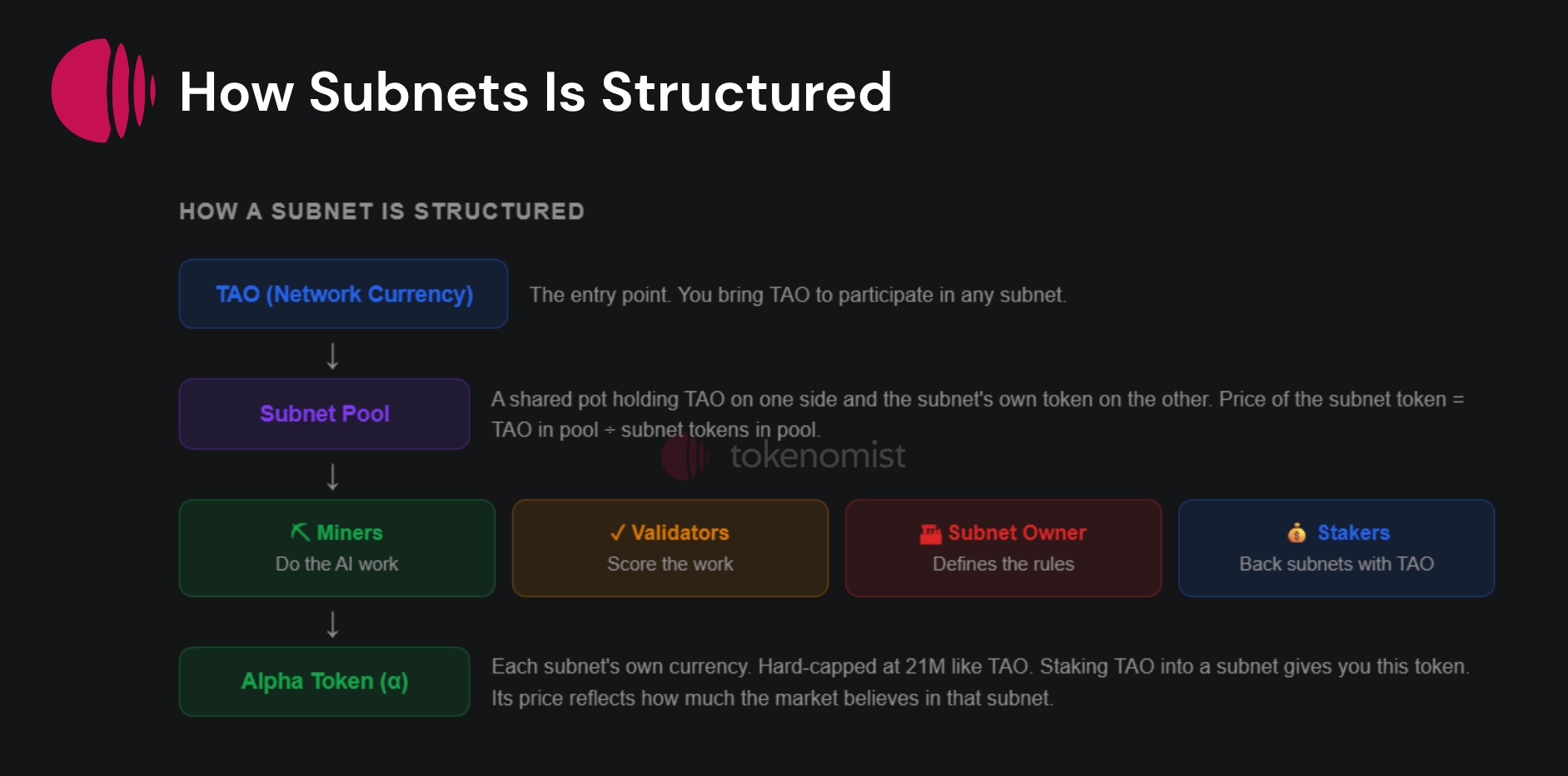
Each subnet is a standalone AI market. One runs GPU inference. Another trains models. Another detects deepfakes. Since February 14, 2025, every subnet has its own alpha token, a subnet-specific currency built on top of TAO.
The pool mechanics are simple. Stake TAO in, alpha comes out. More TAO flowing in drives the alpha price up. Pull TAO out, price drops. Every staker is casting a live, capital-weighted vote on which subnets deserve resources.
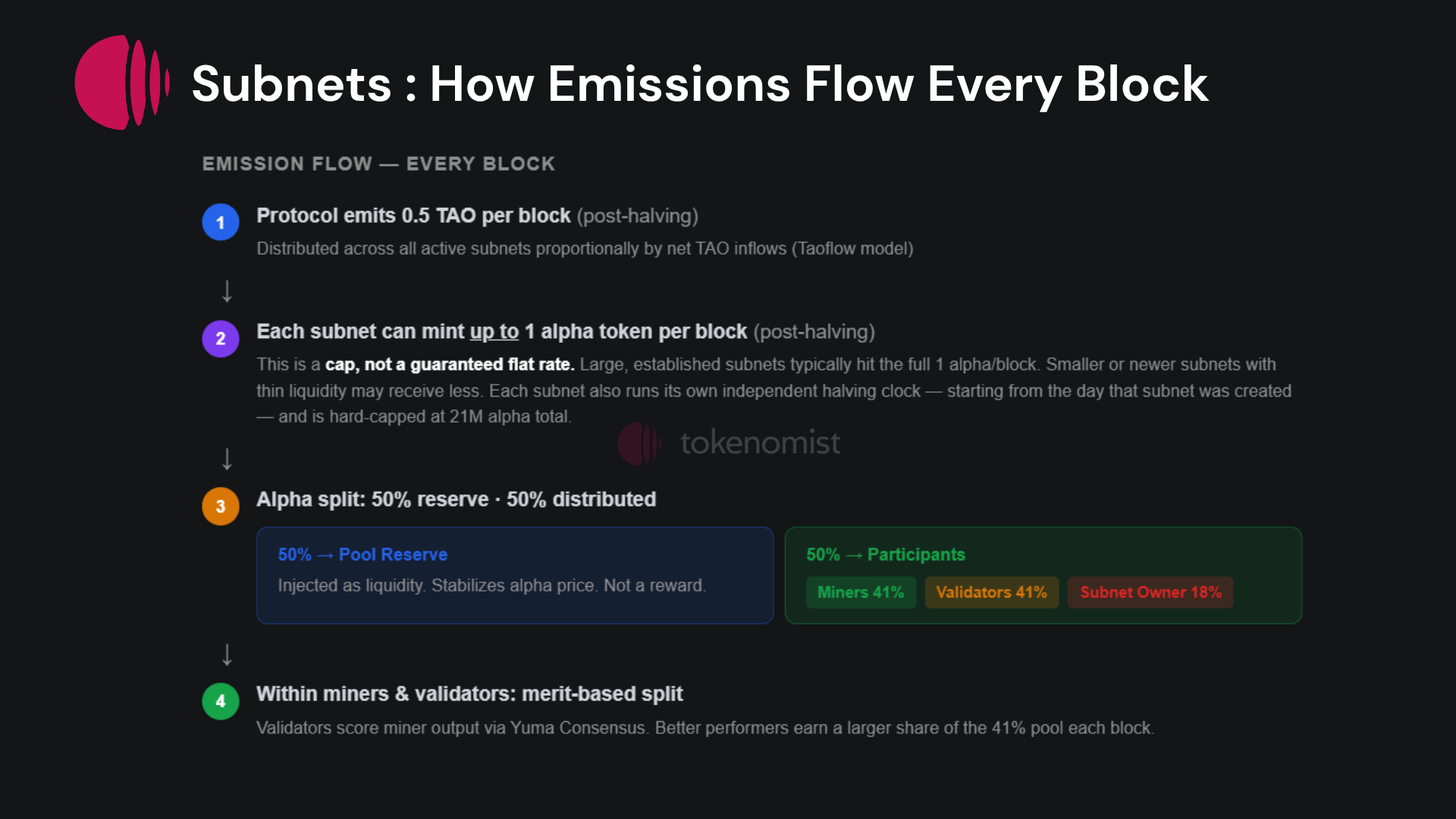
How Emissions Flow Every Block
Emissions" is just the word for new tokens being released as rewards. Every ~12 seconds (one block), the Bittensor protocol releases new TAO and new alpha tokens and distributes them to participants. Here's exactly what happens:
What Happens When You Stake TAO?
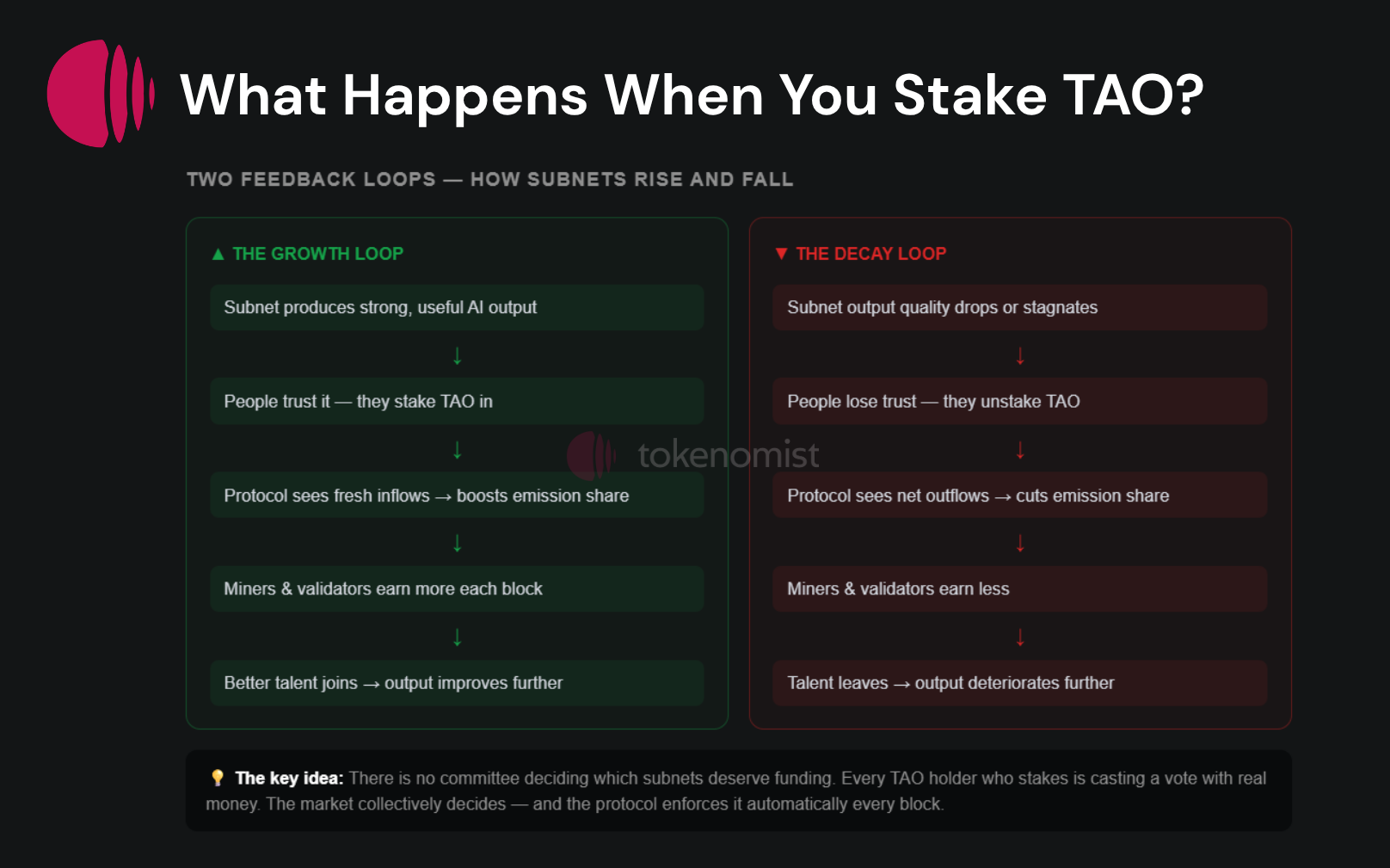
Every TAO staked or unstaked reshapes the emission landscape. It is not a passive deposit, it is a continuous vote.
When you stake TAO into a subnet, that TAO enters the subnet's pool. The protocol reads it as a signal, It immediately starts receiving a larger share of block emissions. Miners and validators inside it earn more.
When you pull TAO out, the opposite happens. The subnet loses emission weight. Rewards shrink. Workers earn less.
No committee decides which subnets get funded. Your stake does.
Where the System Still Has Gaps
Early versions of Bittensor showed that emissions can be influenced by capital and validator behavior, not just real usage.
The SN28 case is a good example. The subnet was able to attract more emissions by concentrating stake and aligning validators, which increased its share of rewards. This wasn’t because of strong AI output, but because of how capital was positioned inside the network.
Upgrades like Taoflow improved this by focusing more on actual TAO flows into subnets, making simple loops harder to sustain.
However, one gap still remains.
The system tracks capital flows effectively, but it cannot fully distinguish whether that flow is driven by real demand or coordinated activity.
Conclusion
Bittensor’s supply structure is one of the cleaner designs in crypto. It has a hard cap, no insider allocations, and a large share of supply staked in the network.
The open question is whether emission share actually reflects real AI output quality. Most subnets today are still pre-revenue, and capital is largely driven by incentives rather than external demand.
This creates a gap between a well-designed emission system and proven utility.
Over the next 12 months, the key question is whether subnets can convert emissions into real usage.
Recommend Article