Weekly Token Unlocks Digest: Mar 23-29, 2026 | $PARTI Unlock and $HYPE Momentum

This week’s digest covers a high-impact $PARTI unlock, continued outperformance from $HYPE driven by new on-chain trading products, and a fresh DeFi Layer-2 launch from Katana Network ($KAT) introducing a vote-escrow incentive model designed to recycle real protocol revenue back to users.
🔑 Key Takeaways
- $PARTI unlocks $7M (19.86% of circulating supply) on Mar 25, one of the largest relative supply events in March.
- $HYPE rallied ~30%, fueled by the launch of S&P 500 perpetual futures on Hyperliquid, bringing massive trading volume to the chain.
- $KAT from Katana Network launched on Mar 18, introducing a vote-escrow (vKAT) incentive model to direct emissions toward high-revenue DeFi pools.
Weekly Recap
Last week delivered a mix of macro pressure and crypto-specific positives, with Bitcoin consolidating around the $70,000–$72,000 zone after early gains while Ethereum continued to outperform. The total crypto market cap held relatively steady amid modest altcoin rotation, and ETF inflows remained supportive even as traditional risk assets felt the heat.
On the macro side, the FOMC meeting on March 18 kept rates unchanged at 3.5%–3.75%, as expected. Chair Powell noted that inflation remains “somewhat elevated” and progress toward the Fed’s 2% target is “not as much as we had hoped,” partly due to near-term energy price spikes. This contributed to some post-meeting volatility, though crypto showed partial decoupling from equities. That uncertainty was driven by escalating tensions in the Middle East, where Iranian attacks on vessels in the Strait of Hormuz sharply reduced traffic through the critical chokepoint (which handles ~20% of global oil and LNG flows).
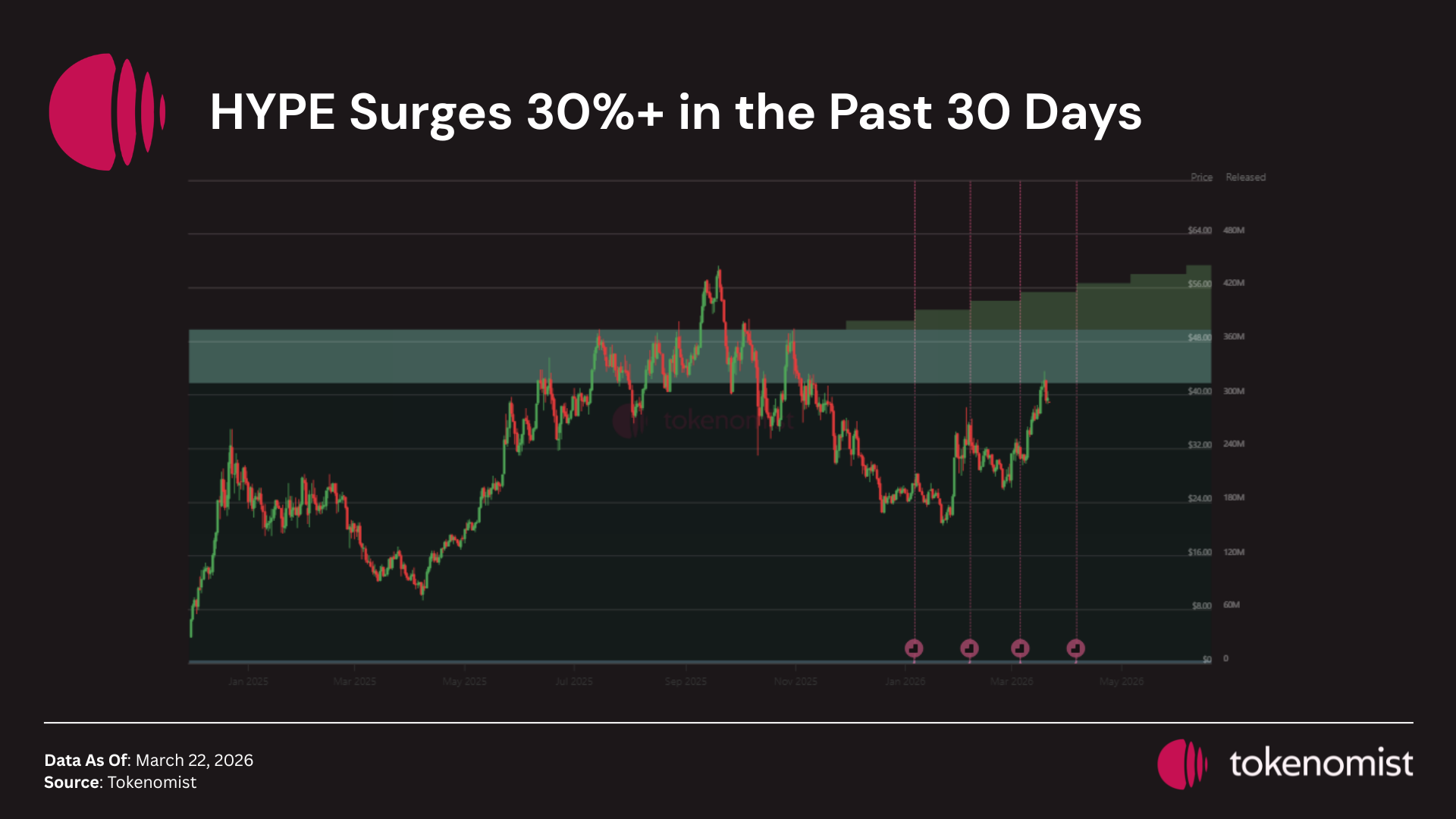
Crypto markets absorbed the shock better than many expected, with Bitcoin occasionally behaving like a hedge alongside gold. $HYPE delivered standout outperformance. Trade[XYZ] partnered with S&P Dow Jones Indices to launch the first officially licensed S&P 500 perpetual futures contract on the Hyperliquid blockchain, offering 24/7 on-chain access. With 50% of trading fees flowing to the Hyperliquid ecosystem, the launch ignited massive volume and sent $HYPE surging roughly 30% to multi-month highs near $42.
Upcoming Events
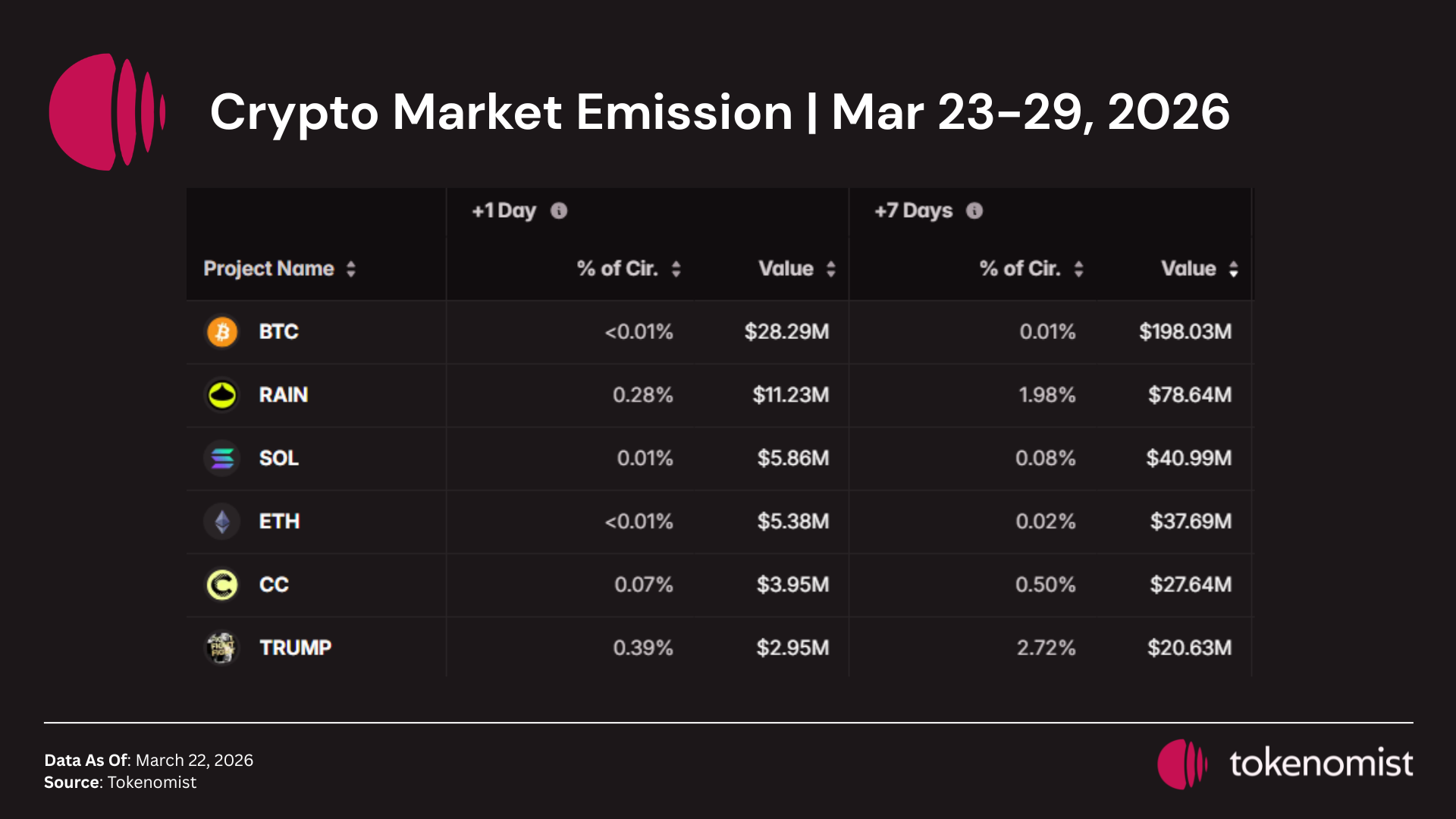
Next week’s scheduled token releases are set to exceed $590 Million in total value. Notable tokens facing sizable releases include $BTC, $RAIN, $SOL, $ETH, and $RIVER.
Unlocks Spotlight: $PARTI
- Unlock Date: March 25, 2026
- Amount: $7M
- Unlock as % of Circulating Supply: 19.86%
- Vested Allocations: Community Growth, Private Sales, and Team & Advisors
Several insider rounds (e.g., KOL Round, Private Sales) use cliff + nonlinear/linear vesting, while Community Growth relies heavily on periodic cliffs like this one. This blend means the unlock could drive both adoption incentives and potential selling pressure.
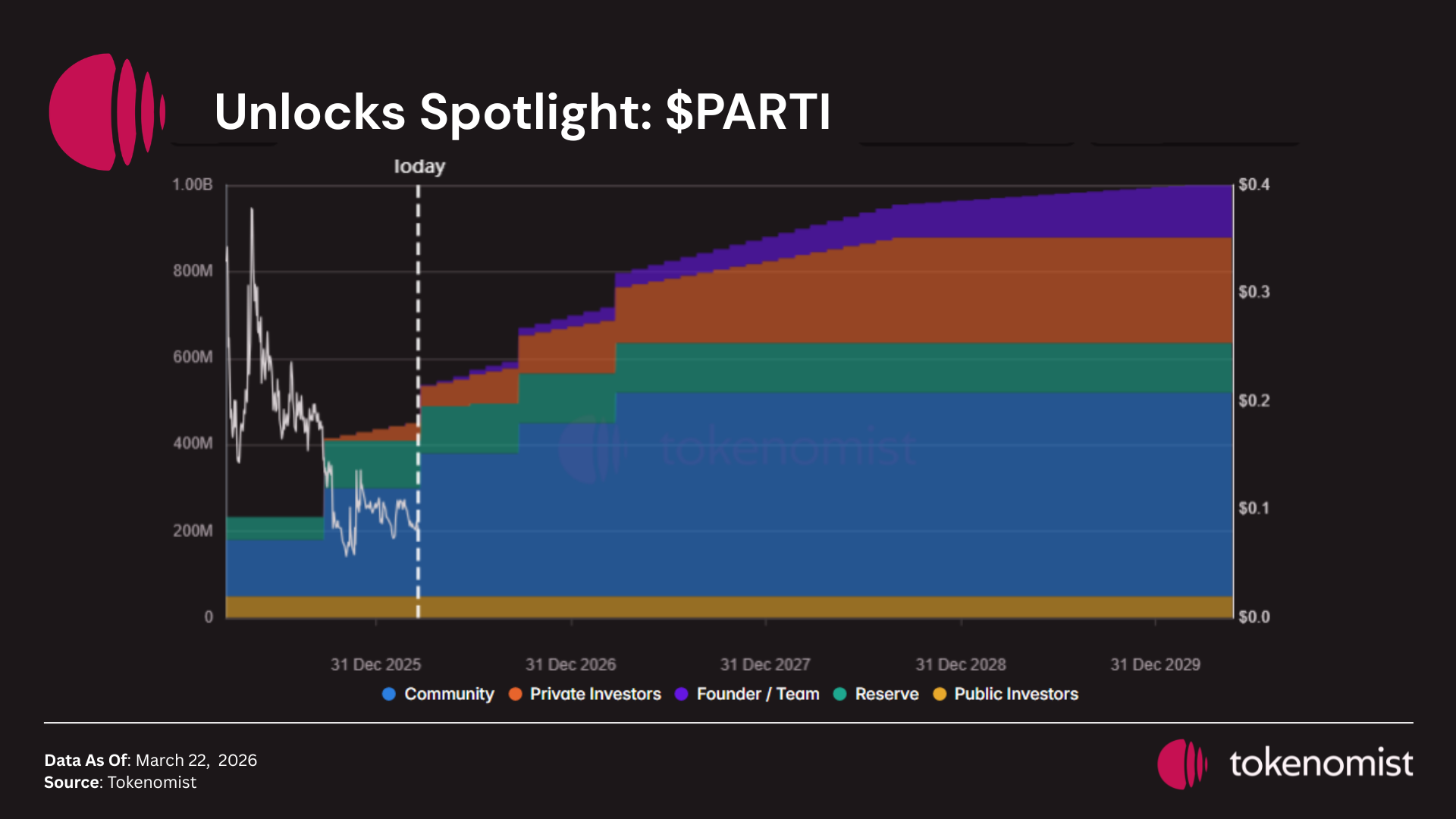
At a ~$80M FDV, this is one of the highest %-of-circulating-supply unlocks in the March calendar (highlighted alongside names like NIL at 36.4%). $PARTI has been consolidating near $0.08 levels recently with modest volume; this event could act as a clear catalyst.
New TGEs on the Radar
This week, the freshest launch drawing attention is $KAT from Katana Network — a DeFi-native Layer-2 blockchain built on Polygon using the CDK stack. Incubated by Polygon Labs and GSR, Katana stands out for its no-VC, community-first approach. The Token Generation Event hit on March 18, 2026, making $KAT fully transferable and live on-chain.
KAT is live. The Armory is open⚔️
— Katana ⚔️ (@katana) March 18, 2026
Katana introduces something new:
A chain that routes revenue back into the ecosystem to reward active users.
At the center is KAT.
Stake, vote, earn here: https://t.co/hmG4UdbQZd pic.twitter.com/kxIUdbCvA6
$KAT Tokenomics Snapshot
- 15% Community Airdrop to POL stakers on Ethereum
- 20% User Liquidity Mining & Ecosystem Incentives
- 48.35% Ecosystem & Community Treasury
- 15.65% Core Contributors
- 1% Public Sale
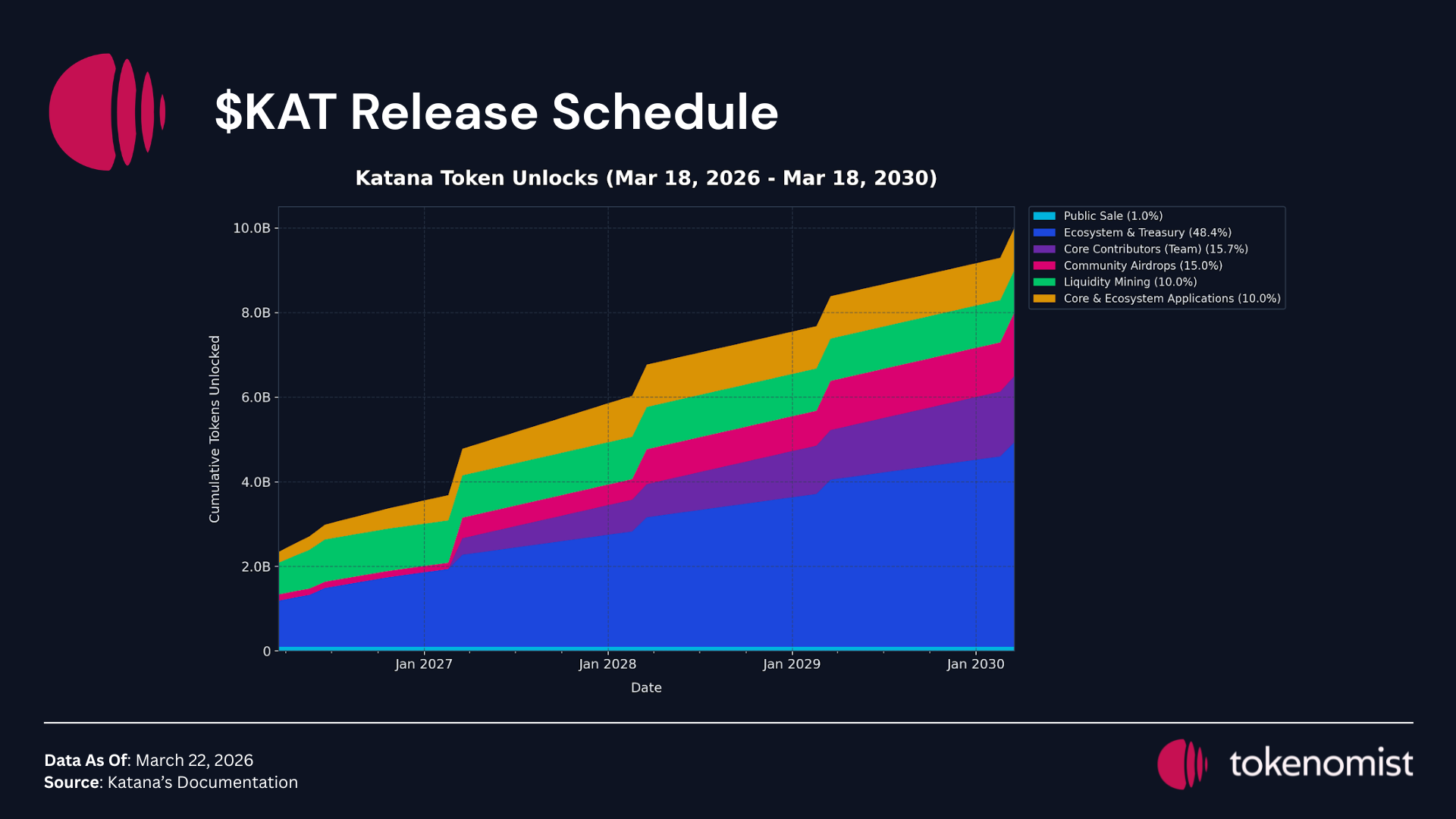
$KAT is the coordination token for Katana Network — it helps users guide rewards to build deeper liquidity and earn sustainable "real yield" from actual chain activity. Importantly, $KAT is not used for gas (ETH covers transaction fees) and it's not a full governance token for core chain decisions like upgrades.
Instead, holders can lock $KAT 1:1 to get vKAT (a vote-escrowed version), then vote weekly on which core DeFi pools or apps (like Sushi for trading or Morpho for lending) should receive the next batch of $KAT incentives — directing emissions where they can generate the most fees and revenue, which then flows back as rewards to vKAT holders. This creates a flywheel that recycles real network revenue into better liquidity and yields, rather than relying on endless new token minting.
Recommend Article