Weekly Unlock Digest: May 18-24, 2026 | PYTH's $95M Cliff

🔑 Key Takeaways
- Bitcoin's recovery above the 21-week EMA reflects institutional positioning, not broad altcoin rotation.
- PYTH's May 19 unlock spans four allocation categories, with Private Sales representing the most direct source of potential sell pressure.
- Cronos's governance-approved shift to revenue-backed staking yields represents a notable design pivot, directly tying staking rewards to protocol activity rather than token minting.
Weekly Recap
Crypto markets staged a structurally meaningful recovery through the first half of the week before surrendering gains on Friday. Bitcoin opened the week at approximately $82,164 — its strongest opening price since late January. Total crypto market capitalization recovered to approximately $2.7 trillion, while the Fear & Greed Index climbed to 47 — a sharp reversal from the extreme-fear reading of 16 recorded just a month prior.
The week's defining macro catalyst was legislative. The Senate Banking Committee officially approved the CLARITY Act — the long-anticipated U.S. crypto market structure bill — with bipartisan support, clearing the path for a potential full Senate floor vote within weeks. The initial market reaction was positive, with XRP briefly rallying 5% on the news. However, the gains were short-lived: Bitcoin gave back its CLARITY Act gains by Friday as stocks, gold, and crypto slid simultaneously, with crude oil topping $100 and traders repricing Federal Reserve expectations toward rate hikes.
The week's standout performer outside the majors was Toncoin, which surged over 100% following Pavel Durov's announcement that Telegram had become TON's largest validator, alongside the unveiling of Phase 2 of the MTONGA roadmap. The move demonstrated how ecosystem-specific catalysts can sharply diverge from broader market direction.
Upcoming Events
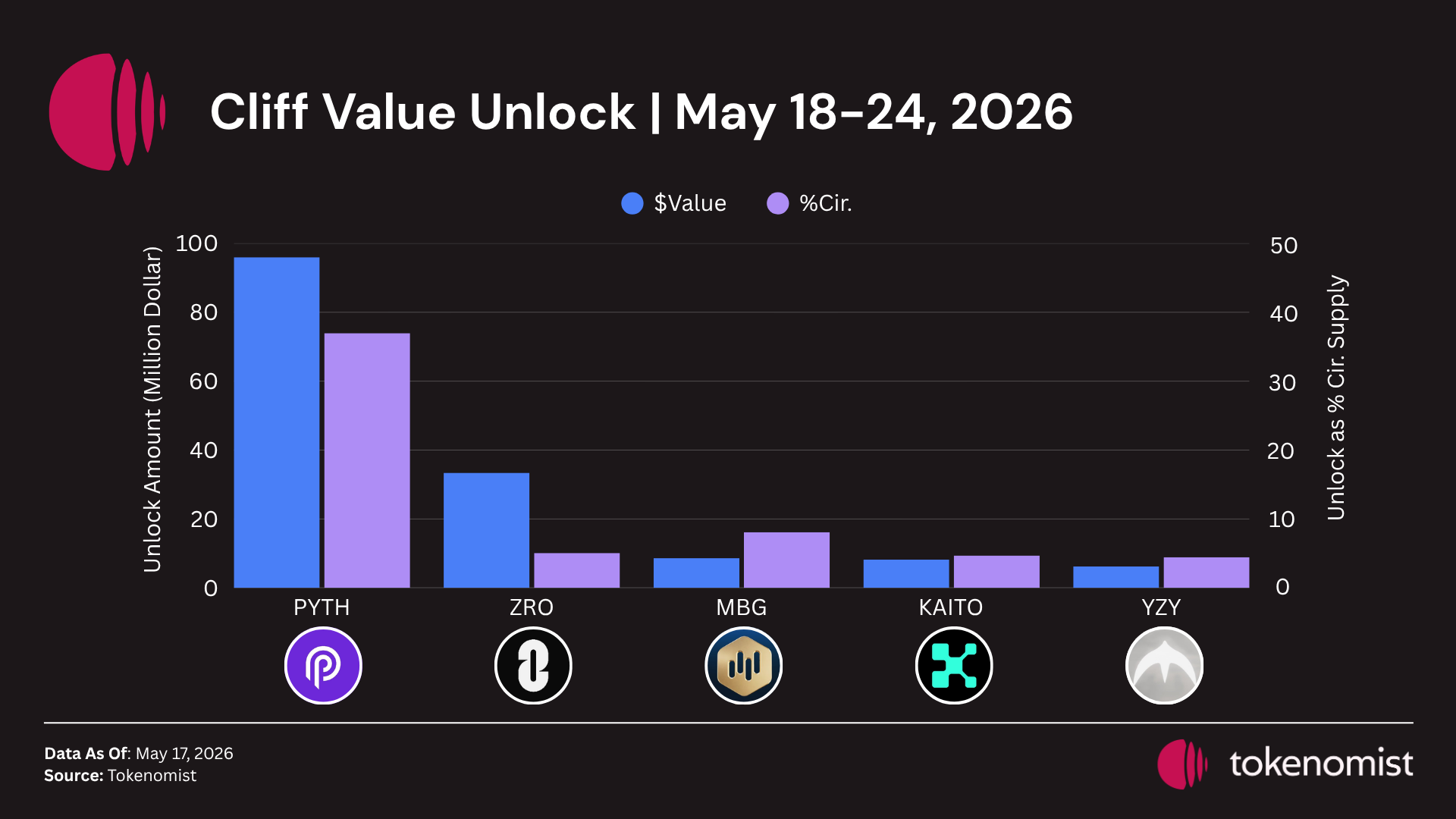
Next week’s scheduled token releases are set to exceed $990 Million in total value. Top tokens facing the largest cliff unlocks next week include $PYTH, $ZRO, $MBG, $KAITO, and $YZY.
Unlocks Spotlight: $PYTH
- Unlock Date: May 19, 2026
- Amount: $95.24M
- Unlock as % of Circulating Supply: 36.96%
- Vested Allocations: Ecosystem Growth, Publisher Reward, Private Sales, and Protocol Management
PYTH's May 19 event is the largest single unlock on the calendar this week. At 36.96% of circulating supply, this is a significant dilution event on paper. To contextualize the scale: approximately 57.50% of PYTH's total 10 billion token supply had already been unlocked heading into this event, meaning the May 19 release will push the unlocked share meaningfully higher in a single day. The cliff vesting structure concentrates the supply impact into a narrow window, leaving little room for the market to absorb the change incrementally.
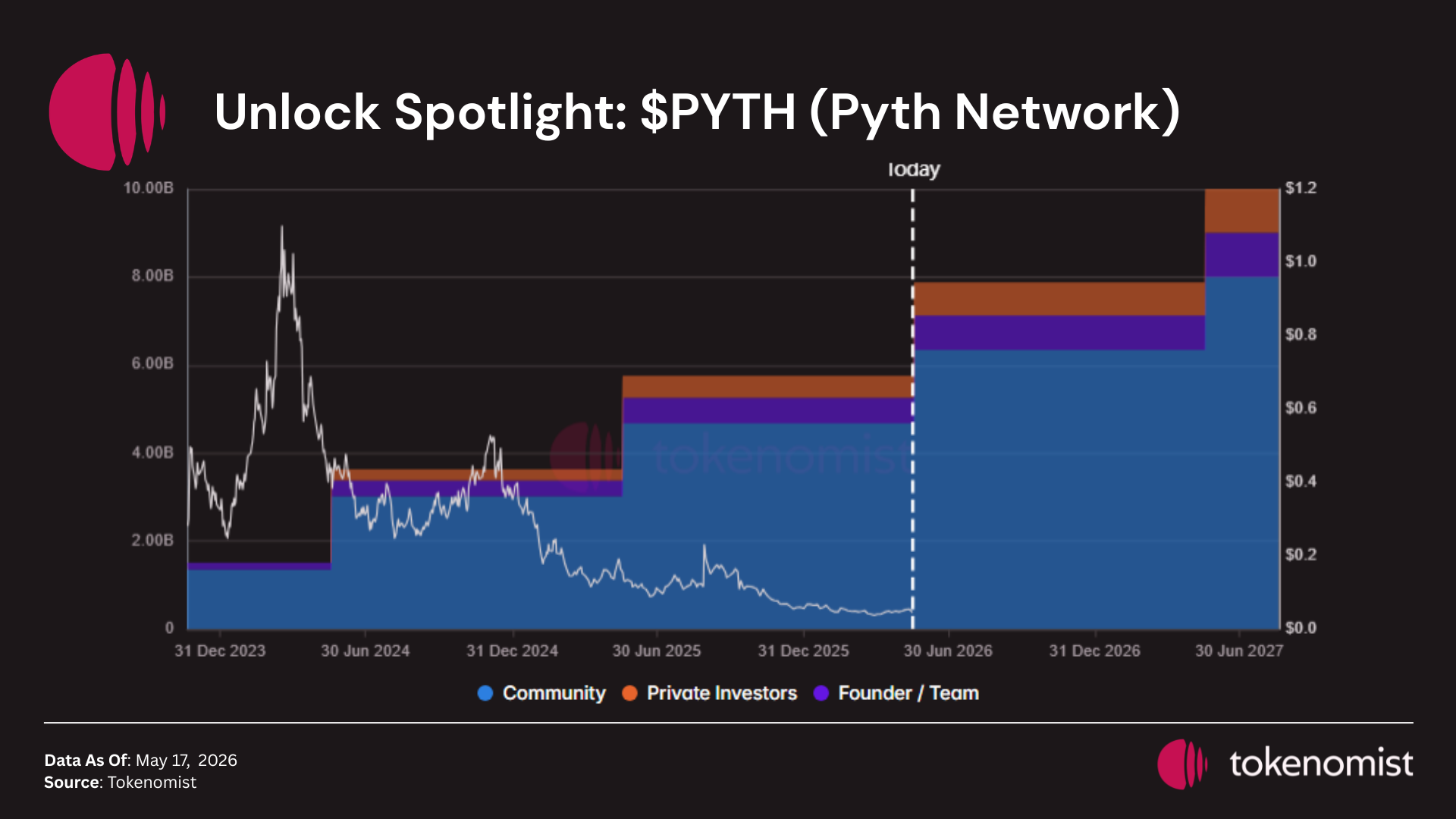
The four vested allocations tell different stories about potential sell pressure. Private Sales recipients — early backers who purchased at below-market prices — represent the most liquid and potentially motivated sellers in this cohort. Ecosystem Growth and Publisher Reward allocations, by contrast, are typically distributed toward protocol participants and data publishers with operational roles in the network; their incentive to liquidate immediately is less clear-cut, particularly if staking or governance participation offers yield alternatives. Protocol Management tokens are generally held longer-term to fund treasury operations.
Notable Tokenomics Updates
Cronos ($CRO) — Governance Proposal #33: From Inflation to Revenue
Cronos passed one of the more structurally significant tokenomics overhauls in the Layer 1 space this month. Governance proposal #33, introduced by the Cronos team on May 5, formally ends inflation-funded staking and replaces it with a model where yields are fully funded by actual protocol revenue, primarily from the Cronos App.
This is the beginning of a new economic era for Cronos.
— Cronos (@CronosApp) May 5, 2026
A governance proposal is live today. It transitions CRO from inflation-funded rewards to a revenue-backed model - powered by the Cronos App and the broader ecosystem.
Here is what's changing. pic.twitter.com/D908UozFIC
The mechanics are notable. The new tiered structure offers APY rates of up to 10% for stakers who lock CRO for up to four years, with a 6.8% monthly emissions decay rate as circulating supply approaches the 100-billion-token cap. Rather than minting new tokens to fund rewards — which introduces continuous sell pressure from yield recipients — the model draws from Cronos App trading fees and prediction market revenues. The practical effect is that staking yields become a function of protocol activity rather than a fixed inflation schedule.
Cronos POS Mainnet V7, scheduled for May 20, 2026, implements these tokenomics changes at the protocol level — making it the largest upgrade the proof-of-stake chain has shipped since launch. V7 also rebalances the validator-reward structure to favor longer-term stakers over short-duration delegators.
Recommend Article