Weekly Unlock Digest: July 13-19, 2026 | $LAB begins unlocking into a 90% drawdown

🔑 Key Takeaways
- Bitcoin rose ~3% on the week despite Strategy selling 3,588 BTC ($216M) — a sharp contrast to a month earlier, when a 32-BTC sale coincided with a market-wide sell-off.
- $DBR faces a $10M cliff unlock on July 17, adding 11.43% to circulating supply.
- GRVT confirmed a July 21 TGE, with its Season 2 allocation rising to 18% of a fixed 1B-token supply.
- BitTorrent introduced a revenue-funded BTT buyback-and-burn program, with its first burn set out for mid-October.
Weekly Recap
The week's defining event came from the largest corporate bitcoin holder. In a July 6 filing, Strategy disclosed the sale of 3,588 BTC for roughly $216M between June 29 and July 5 — the largest bitcoin disposal in the company's history. The proceeds were earmarked to fund dividends on its preferred "Digital Credit" securities (STRF, STRE, STRK, STRD, and STRC) and to replenish its USD reserve, which stood at $2.55B as of July 5. The sale marks a clear departure from the "never sell" posture that has defined Michael Saylor's thesis for years.
What stands out is the market's response to it. Rather than triggering a cascade, bitcoin rose roughly 3% over the week, reclaiming the low-$60,000s and trading near $64,000 by Friday. That absorption is notable against recent memory: just a month earlier, a far smaller 32-BTC sale coincided with a sharp drop across crypto. Strategy still holds 843,775 BTC, making the sale roughly 0.4% of its stack. MSTR shares actually gained 21% on the week following its Digital Credit Capital Framework announcement, with STRC recovering back toward its $100 par.
Upcoming Events
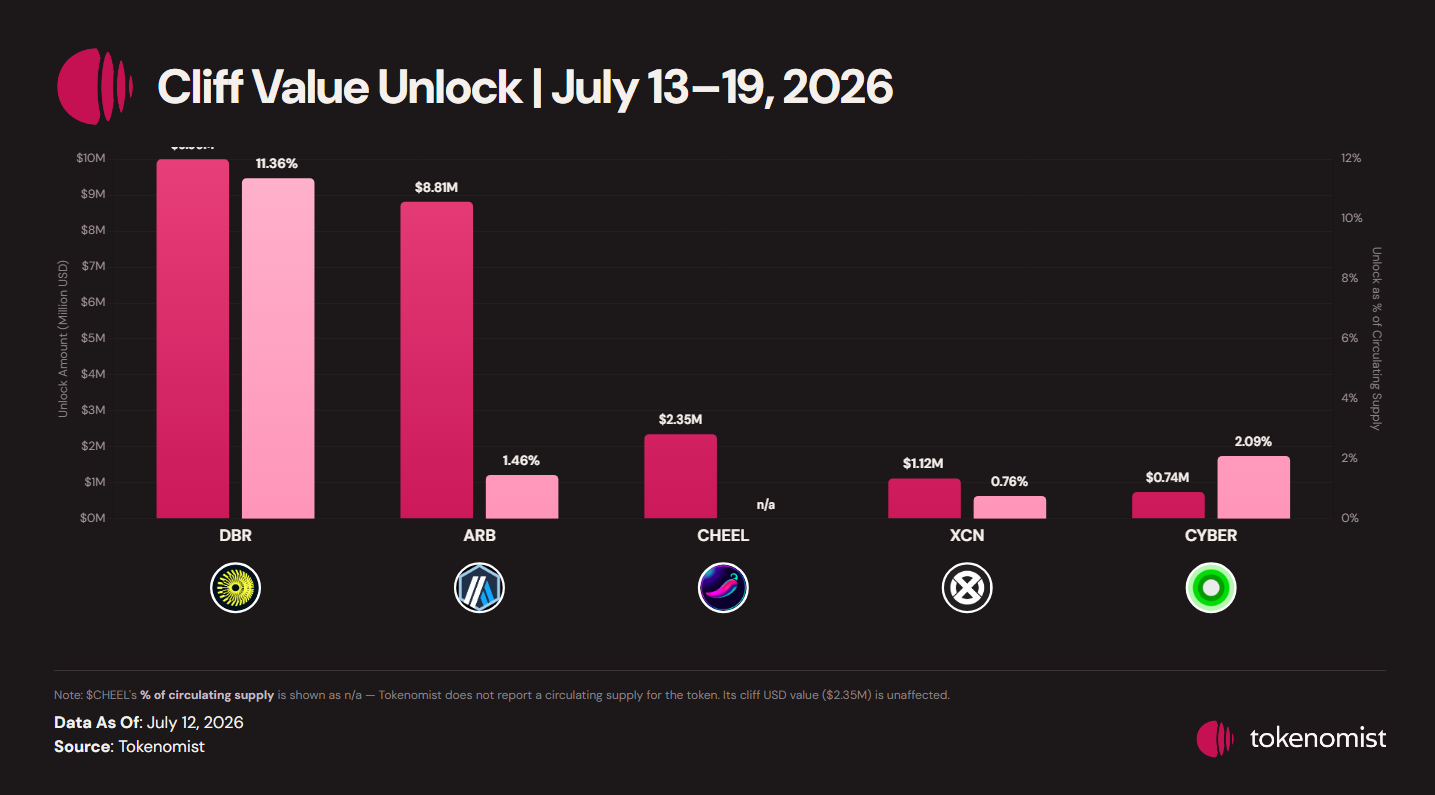
Next week’s scheduled token releases are set to exceed $660 Million in total value. Top tokens facing the largest cliff unlocks next week include $DBR, $ARB, $CHEEL, $XCN, and $CYBER.
Unlock Spotlight: $DBR
- Unlock date: July 17, 2026
- Unlock amount: $10M
- Unlock as % cir. supply: 11.43%
- Vested allocation: Ecosystem, Core Contributors, Strategic Partners, deBridge Foundation, Community, and Validators
The July 17 release is the protocol's second double-digit quarterly cliff of the year, following a comparable 12.9% unlock in April, and it spans nearly the full set of vesting buckets — meaning newly liquid supply reaches insider, ecosystem, and community allocations at the same time. At 11.43% of circulating supply, the event introduces a meaningful one-time increase in float that could add near-term selling pressure if recipients seek liquidity into a market still in Extreme Fear.
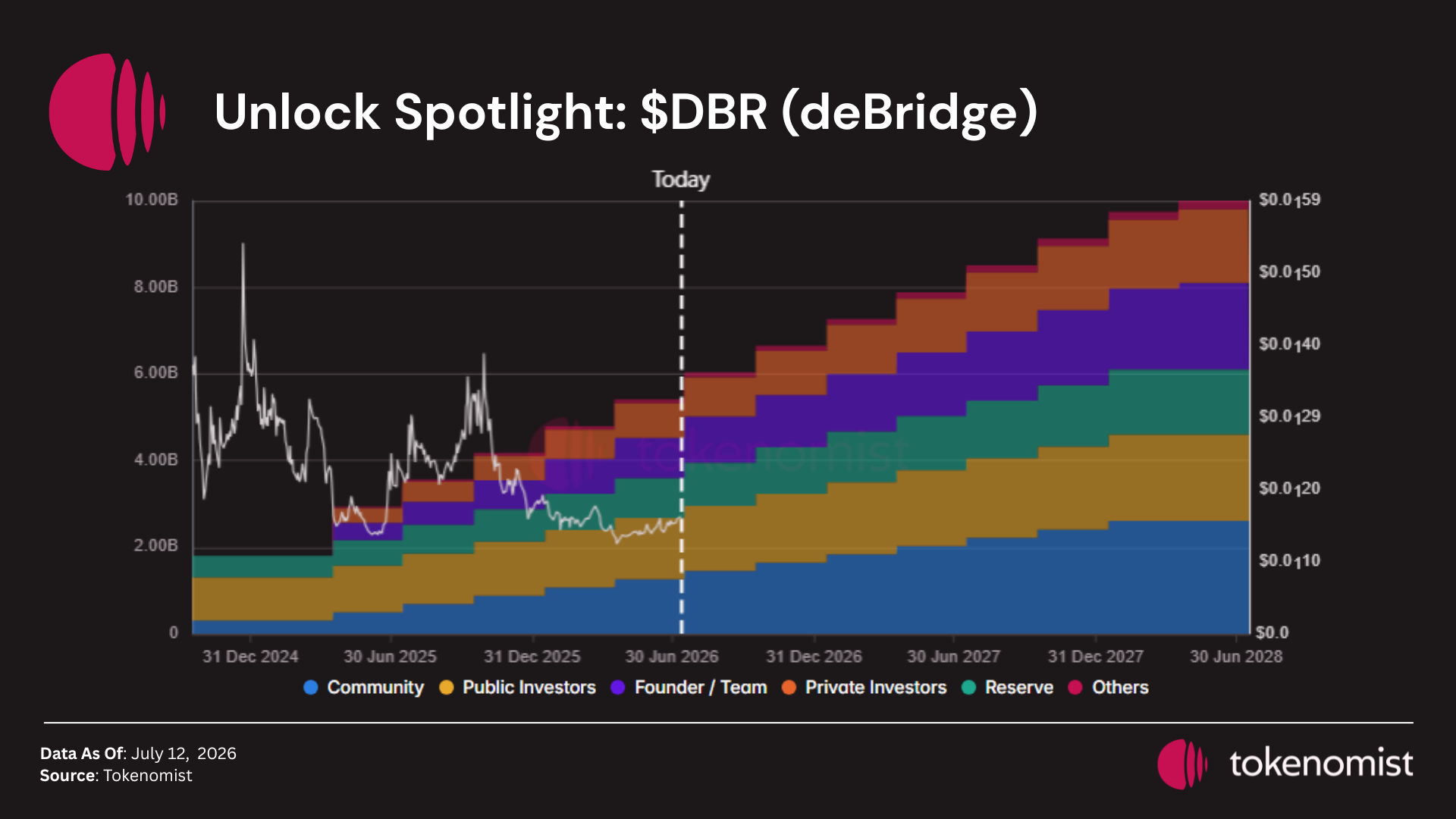
On the other side of the ledger, deBridge's Reserve Fund directs 100% of daily protocol earnings toward accumulating DBR, providing a structural, usage-linked source of demand. That mechanism has historically offset only a small fraction of unlock-driven dilution, so the net near-term impact will likely hinge on holder behavior — specifically how much of the cliff is staked or held by long-term-aligned parties versus sold. For context, DBR's October 2025 unlock (17% of circulating supply) preceded a roughly 28% drawdown over the following month despite active buybacks, a reminder that recurring cliffs of this size have moved price before.
Unlock Spotlight: $LAB (Linear Release)
- Release start: July 14, 2026
- Next 30 days: +13.56% of cir. supply (Private Investors 9.23%, Community 5.33%)
- Next 365 days: +90% of cir. supply
LAB is the native token of LAB Terminal, an AI-powered multi-chain trading platform spanning Solana, Ethereum, and BNB Chain. It has been one of the most-watched tokens of the quarter. After launching in October 2025 and trading below $1 for months, LAB surged several hundred percent through May and June to an all-time high, briefly pushing its FDV into the low-double-digit billions and lifting it into the top 25 by market cap. That advance reversed sharply in early July: last week, LAB fell roughly 85–90% from its highs and continued lower toward $0.55, erasing billions in nominal value.
1/ An investigation into the opaque private loans/OTC, unilateral vesting changes, market maker coordination, unknown float, and >95% supply control behind $LAB's recent pump to $6B FDV.
— ZachXBT (@zachxbt) May 14, 2026
Here's why @LABtrade_ represents everything wrong with the current meta of retail extraction… pic.twitter.com/L2U5kW1EUd
The unlock lands directly into that dislocation. On-chain investigator ZachXBT has alleged since May that insiders control upwards of 95% of LAB's effective float through OTC deals, private allocations, and team-linked wallets, and flagged further team-connected selling on July 10–11. The LAB team has attributed the decline to large market participants and unaffiliated trading firms, and says its roadmap is unchanged. These remain reported allegations and responses rather than settled facts, but they frame why the supply schedule matters here: when float is concentrated and liquidity is thin, incremental releases to private-investor and community wallets can meet limited natural demand.
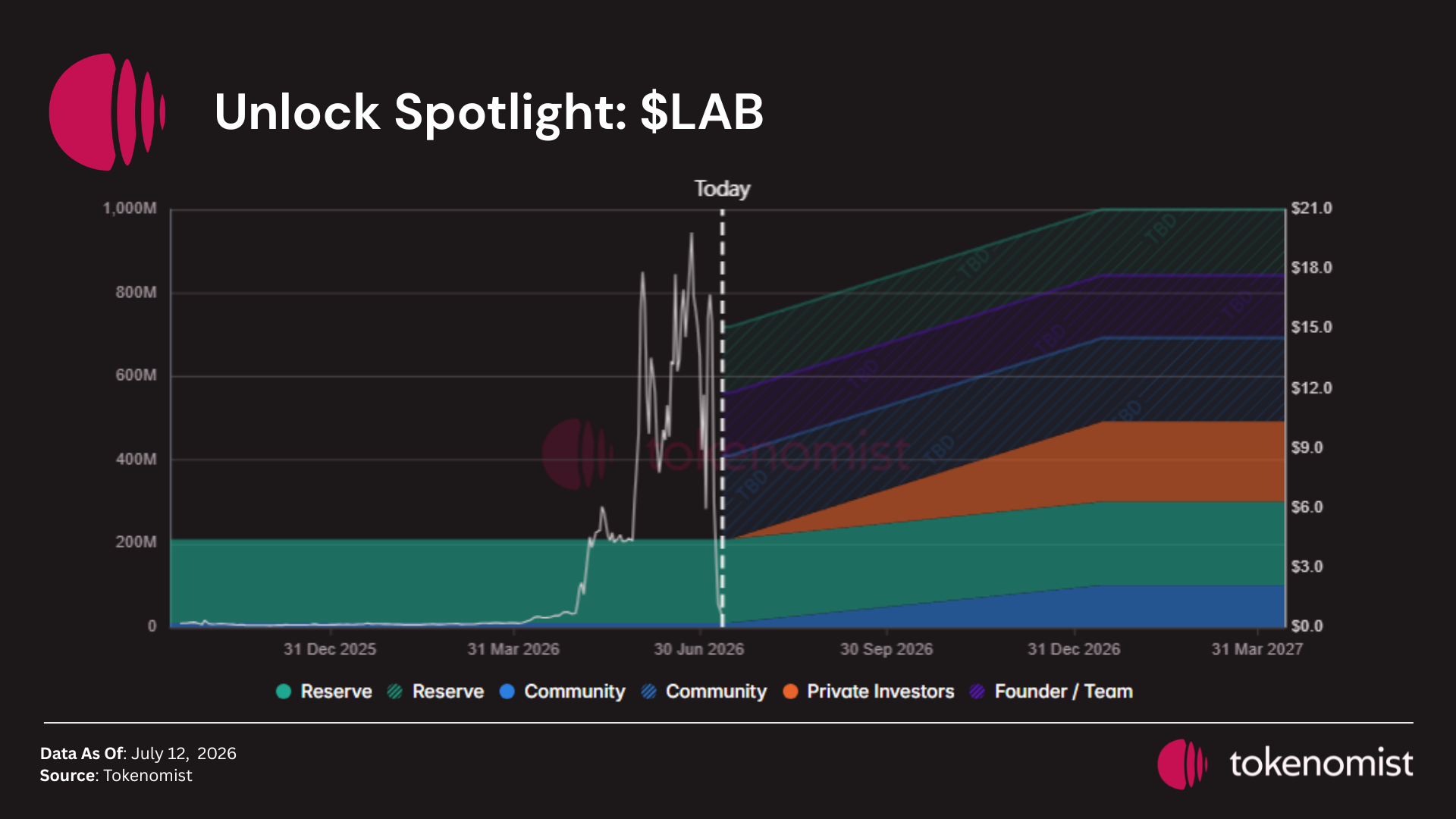
On the mechanics, the schedule is heavy. A 13.56% circulating-supply increase over 30 days adds a steady stream of newly tradable tokens while the market is still repricing the asset, and the ~90% expansion over twelve months represents substantial structural dilution against current circulating supply.
New TGEs on the Radar
GRVT — A hybrid on-chain exchange in the zkSync ecosystem
GRVT confirmed its Token Generation Event for July 21, 2026. The project's Season 2 allocation has been set at 18% of a fixed 1B-token supply, up from 12% in Season 1, with claim details, vesting schedule, and the full allocation breakdown expected in the days ahead. The larger Season 2 share points to a more community-weighted distribution at launch, though the eventual float and vesting cadence — not yet public — will determine how much of that supply actually circulates on day one. As with any exchange-token launch, the variables to watch are circulating supply at TGE and the pace of subsequent unlocks relative to the implied valuation.
The date is set and it's official.$GRVT goes LIVE July 21.
— Grvt (@grvt_io) July 3, 2026
Be there. pic.twitter.com/TteZHkb74K
Notable Tokenomics Update
BitTorrent ($BTT) — buyback-and-burn program
BitTorrent announced a buyback-and-burn program funded entirely by operating revenue, with the first burn scheduled for mid-October and quarterly burns thereafter. Under the framework, 100% of revenue generated by BitTorrent's decentralized services will be used to acquire BTT on the open market and send it to a burn address, with each round disclosing the amount destroyed, its share of total supply, and the on-chain transaction hash.
Tying supply reduction to protocol usage rather than treasury drawdowns is a structurally cleaner model, and it could gradually reduce circulating supply if service revenue holds up. Given BTT's very large token base, the near-term impact will depend on burn size relative to that supply.
📢 Announcement on the Launch of BTT Buyback Program
— BitTorrent (@BitTorrent) July 6, 2026
We are excited to announce the launch of BitTorrent’s long-term BTT Buyback Program starting in Q3 2026.
As part of this initiative, 100% of revenue generated from BitTorrent’s decentralized services will be allocated to… pic.twitter.com/h0hAMDLrRV
Recommend Article