NEAR's Two Inflation Cuts Keep About 196M NEAR Out of Supply by 2030

NEAR has cut its maximum inflation once and voted to cut it again. The first cut, 5% to 2.5% on October 29, 2025, held for a year of block data. The second ramps to 1.6% from 2027 but still needs a software release. Against the old 5%, the two keep about 196 million NEAR out of supply by 2030. Chain figures run to November 12, 2026.
Dollar figures are marked at $3.60 per NEAR on November 10, 2026.
Key Takeaways
- New supply halved, and stayed halved. Total supply grew about 170,000 NEAR a day in the 90 days before the cut and about 87,000 a day since.
- Holders who do not stake lose half as much. Their share of all NEAR shrinks by about 24 NEAR per 1,000 held a year, down from about 47.
- Burning is still a rounding error. Fees burned about 1,360 NEAR a day since the cut, 1.5% of the NEAR minted.
- A second cut has passed its vote, not yet the chain. House of Stake, NEAR's governance body, backed lowering the 2.5% to 1.6% over 24 months, which would mean about 37 million fewer new NEAR by 2030 than staying at 2.5%. It still needs a nearcore release that validators adopt.
Track supply changes like NEAR's on Tokenomist: token pages log each schedule change, and the Point-in-Time API returns any schedule as it stood on a past date.


What NEAR is and how NEAR works
NEAR Protocol is a layer-1 blockchain, a network with its own ledger on which developers run programs called smart contracts. NEAR is its token (Tokenomist NEAR page), and it has three jobs.
- Paying fees. Every transaction pays a fee in NEAR, called gas. Since November 4, 2026 the whole fee is burned, removed from supply for good. Before that, 30% went back to the contract that was called, as a rebate, and 70% was burned.
- Paying for storage. A contract locks 1 NEAR for every 100 kB of data it stores and gets it back when the data is deleted.
- Securing the network. Validators run the computers that process transactions, and holders stake (lock) NEAR with them. On November 12, 2026, 353 validators held 583.2 million NEAR, 44.5% of total supply.
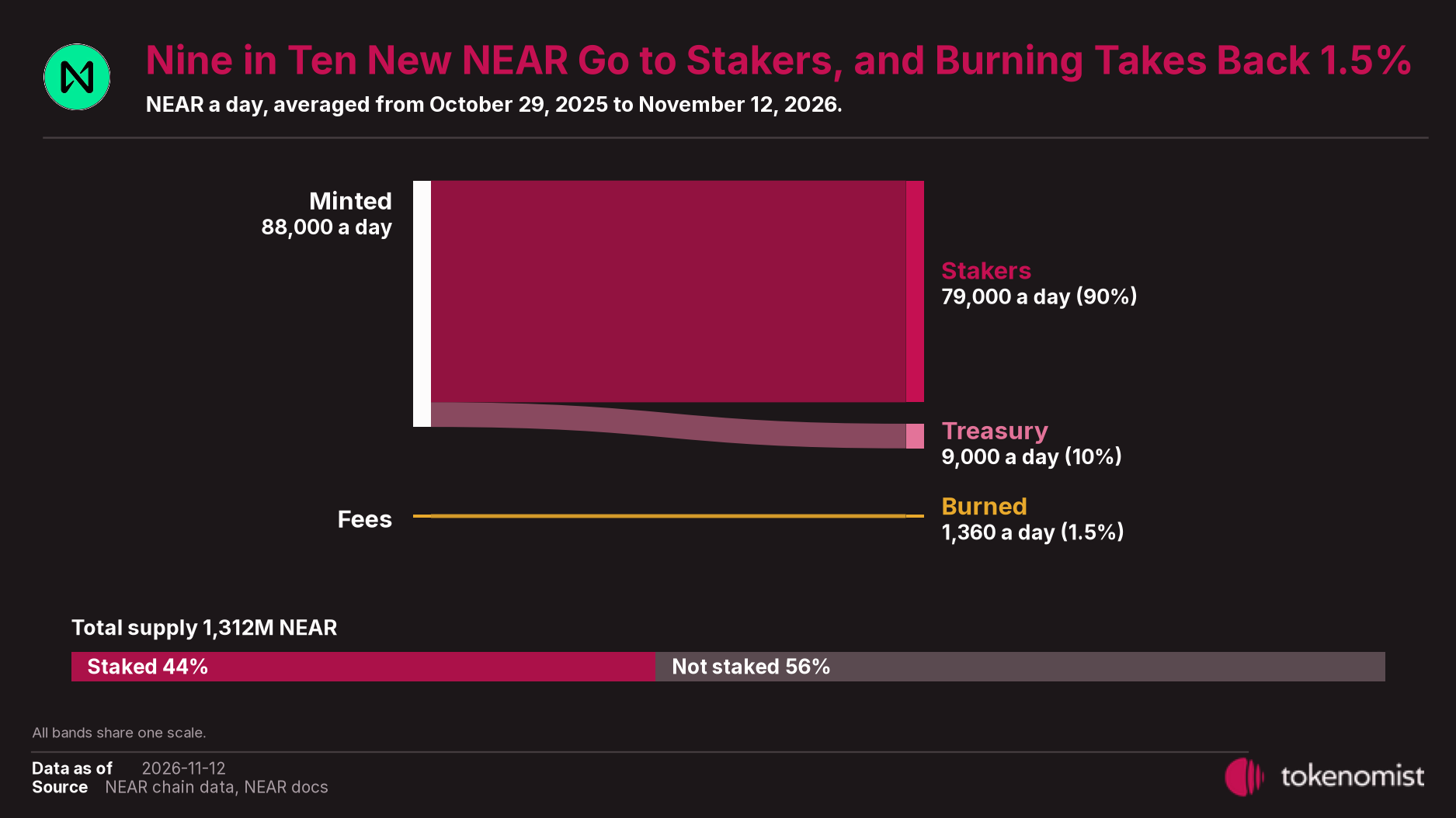
New NEAR is minted every epoch, a reward period of about seven hours, at 2.5% of total supply a year. 90% goes to validators and the holders who stake with them, and 10% to the protocol treasury. There is no maximum supply.
1. The cut went through validators, not the community vote
The cut took two attempts, and the second one worked.
- The community vote fell short. A proposal to halve inflation closed on August 1, 2025 with about 43% of staked NEAR voting yes, against the two thirds it needed.
- The software route worked. Near One, the team behind NEAR's core software, put the cut into nearcore 2.9.0, the node software validators run, on October 21, 2025. It took effect once validators holding 80% of stake had upgraded.
The chain switched on October 29, 2025. The protocol's maximum inflation setting changed that day from 1/20 of supply a year (5%) to 1/40 (2.5%). NEAR announced the completed upgrade on X the following day.
NEAR has successfully completed its halving upgrade on mainnet.
— NEAR Protocol (@NEARProtocol) October 30, 2025
This upgrade reduces the maximum annual inflation rate of NEAR Protocol from 5% to 2.5%, ushering in an era of more sustainable tokenomics and strengthening incentive alignment across the NEAR ecosystem. pic.twitter.com/KUGpUOyPeX
2. New supply halved to about 87K NEAR a day
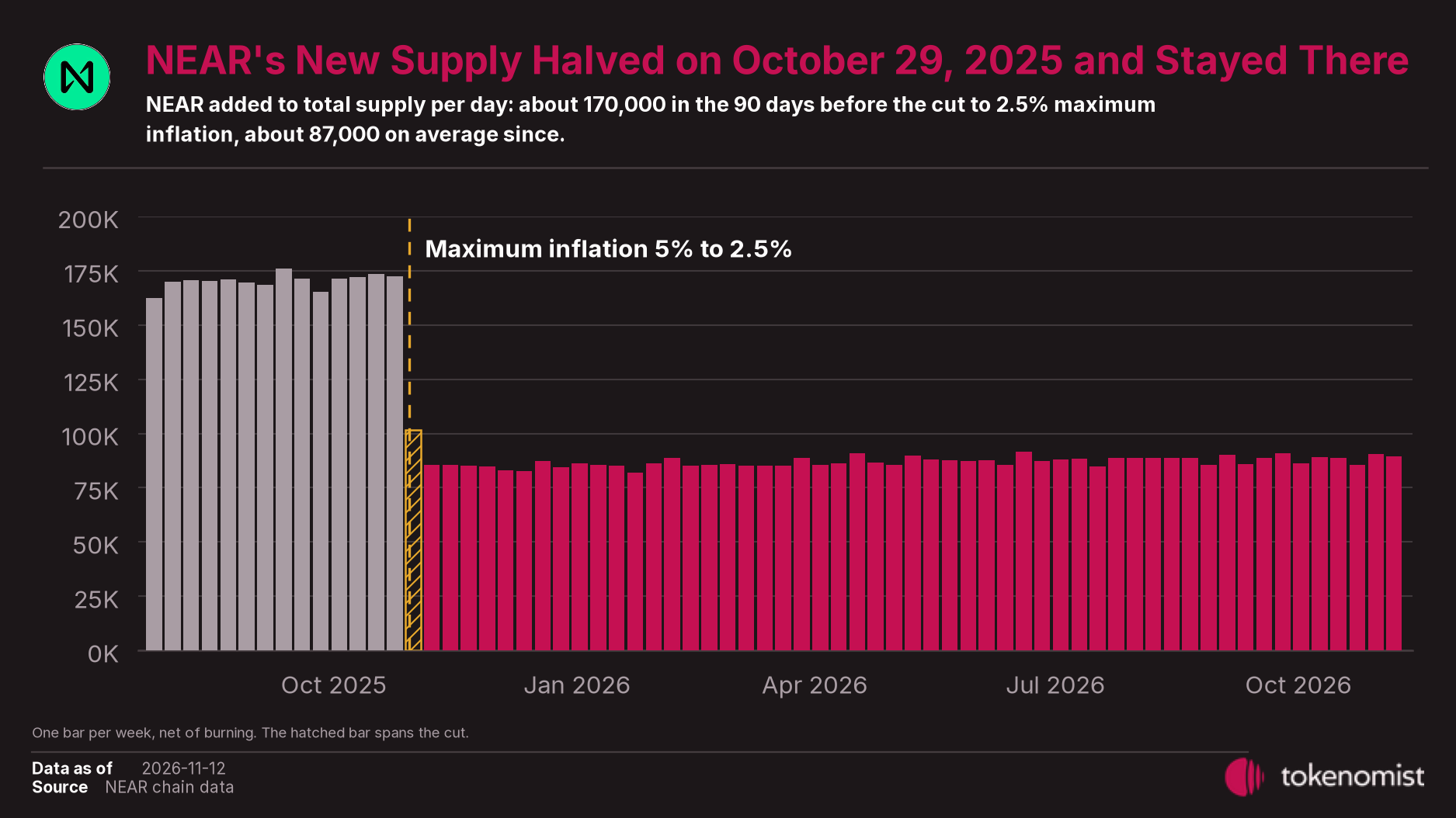
Supply growth fell from about 170,000 to about 87,000 NEAR a day at the cut and has stayed there. Total supply is written into every block, so the cut can be checked without trusting anyone's summary.
- In the 90 days before the cut, total supply grew about 170,000 NEAR a day, 4.9% a year, just under the 5% maximum then in force.
- Since the cut, it grew about 87,000 a day, 2.48% a year, just under the new 2.5%.
- The small gap below each maximum is mostly burning. Since the cut, about 88,000 NEAR a day was minted and about 1,360 burned, which leaves the 87,000.
The cut kept about 33.5 million NEAR out of supply by November 12, 2026. The chain minted about 33.5 million NEAR in that time. At the old 5% rate the same epochs would have minted about twice as much, so the cut avoided about as much again, worth about $121 million at $3.60. That counts supply never created, not money that changed hands.
Burning removed about 516,000 NEAR over the same period, so total supply still grew 33.0 million NEAR.
NEAR traded at $3.60 on November 10, 2026, down 32% over 30 days. The price is not what this article explains.
3. Dilution per 1,000 unstaked NEAR fell from 47 to 24
An unstaked holder of 1,000 NEAR now gives up about 24 NEAR of share a year, down from 47. Inflation works like a tax on holders who do not stake. New NEAR goes to stakers and the protocol treasury, so an unstaked holder keeps the same number of tokens but owns a smaller share of all NEAR each year.
Take 1,000 NEAR held for a year without staking:
- Before the cut, supply grew 4.9% a year. The 1,000 NEAR ended the year with the network share that about 953 NEAR had at the start. The tax was about 47 NEAR.
- After the cut, supply grows 2.48% a year. The same 1,000 NEAR ends the year with the share of about 976. The tax is about 24 NEAR.
Stakers sit on the other side. At the 2.5% setting, their 90% of new NEAR works out to about 5.1% a year on staked NEAR before validator commissions. That is about twice supply growth, so stakers gain share while unstaked holders lose it.
| Group | What changed | The number behind it |
|---|---|---|
| NEAR not staked (728.4 million, including exchanges, apps, storage locks and the treasury) | Dilution halved | About 24 NEAR a year per 1,000, down from about 47 |
| Stakers (583.2 million NEAR) | Reward per staked NEAR halved at the same staked share | About 5.1% a year before commissions, against about 10.1% at the old rate |
| Validators (353) | Take their commission from a pool half the size | A pool of about 29.0 million NEAR a year, from about 58.0 million |
| Protocol treasury | Its 10% halved with the rest | About 3.2 million NEAR a year |
| Apps that received the gas rebate | Unaffected by the cut, lost the rebate on November 4, 2026 | About 410 NEAR a day across all contracts, in the 30 days before it ended |
4. Burning removes about 1.5% of what is minted
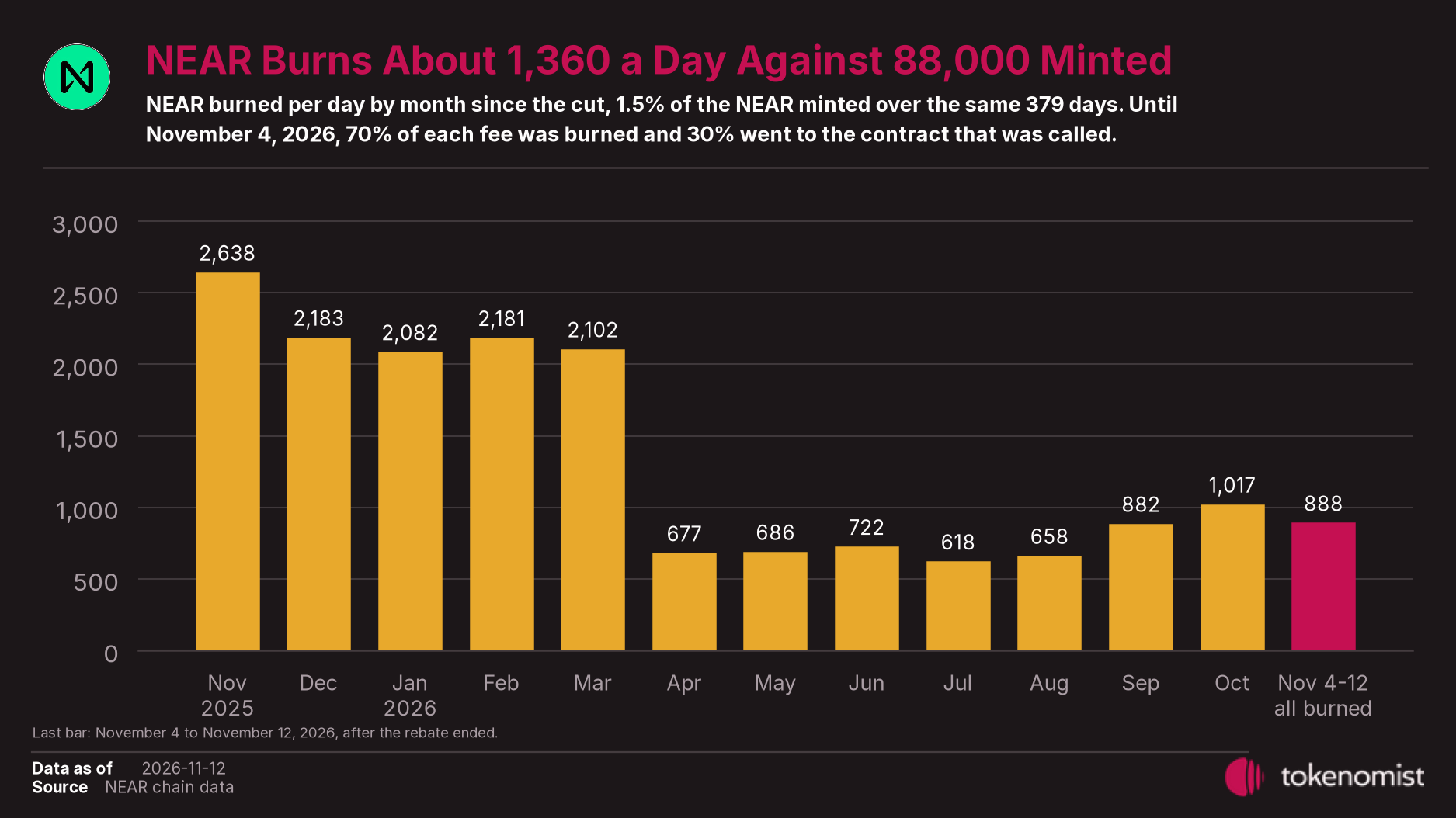
Burning has removed about 516,000 NEAR since the cut, against 33.5 million minted. Fees are paid in NEAR, and until November 4, 2026 70% of each fee was burned.
The burn rate moves with activity. From November 2025 to March 2026 it ran at about 2,100 to 2,600 NEAR a day. It fell to about 620 to 720 from April to August 2026, then rose to about 880 to 1,020 in September and October.
The gas rebate ended on November 4, 2026. House of Stake ratified proposal HSP-027 on July 3, 2026 to end the 30% rebate, so that part of each fee is burned too. nearcore 2.14.0 carries the change. On the chain, protocol version 87 took effect on November 4 and the rebate setting has read 0 since.
Eight days in, the change has not lifted burning much. From November 4 to November 12, fees burned about 890 NEAR a day. The 30 days before averaged about 960, but six busy epochs on October 10, 11 and 15 lift that figure; without them it was about 720. Burning all of each fee at those fees would have given about 1,030 a day, so fees paid were lower after the change. Eight days is too short to say more.
What it does to burning:
| Case | NEAR burned a day | Share of NEAR minted |
|---|---|---|
| 30 days to November 4, 30% rebated | About 960 | 1.1% |
| November 4 to 12, all of each fee burned | About 890 | 1.0% |
| All of each fee burned, fees ten times higher | About 8,900 | 10% |
Even at ten times those fees, burning would offset about 10% of issuance. NEAR's supply is set by its inflation setting, not by fees.
5. NEAR's 2.5% is below Solana and Cosmos Hub, above Aptos
NEAR issues less than Solana and Cosmos Hub, and about 44.5% of its supply is staked. Each chain's own data gives its protocol issuance and the share of its supply that is staked. The implied reward is that issuance, less any treasury cut, spread over the staked supply.
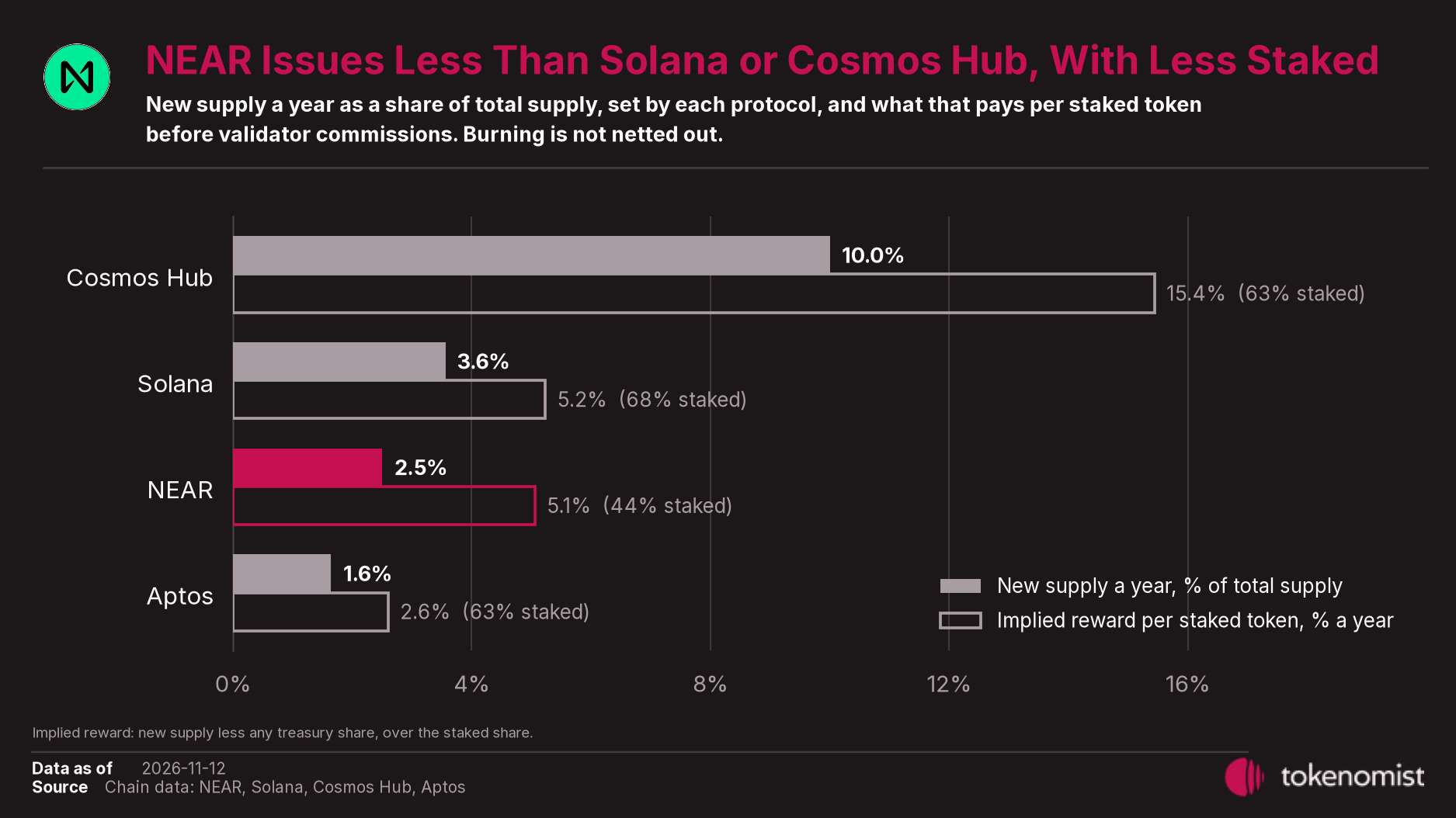
- Issuance. NEAR's 2.5% a year is below Solana's 3.6% and Cosmos Hub's 10%, and above Aptos's 1.6%.
- Staked share. About 44.5% of NEAR's supply is staked, against more than 60% on the other three. The same issuance shared by less stake pays more per staked token.
- Fees. NEAR and Solana burn part of each fee, Aptos burns gas fees, and Cosmos Hub pays fees to stakers.
For a holder who does not stake, NEAR's issuance now sits at the low end of this group. Only Aptos issues less.
6. By 2030, the two cuts keep about 196M NEAR out of supply
The second cut has won its vote. House of Stake closed the vote on HSP-029 on November 2, 2026 with 99.96% of the voting power cast in favor, from 36 voters. The Security Council has until November 16, 2026 to veto it; without a veto it is ratified automatically. Like the 2025 cut, it then needs a nearcore release that validators adopt. As of November 13, no such release is found.
The ramp is a straight line, not steps. The maximum falls about 0.0375 percentage points a month, adjusted every epoch, from 2.5% to 1.6% over 24 months. It starts a full quarter after ratification, which puts the earliest start at about February 16, 2027.
The table shows the most new NEAR each path can create, in millions, starting from 1,311.2 million NEAR on November 8, 2026. Each cell is the NEAR created that year, with the running total in brackets.
| Year | 5% (the old setting) | 2.5% (today) | HSP-029 ramp to 1.6% |
|---|---|---|---|
| 2026, from November 8 | 9.6 (10) | 4.8 (5) | 4.8 (5) |
| 2027 | 67.7 (77) | 33.3 (38) | 31.0 (36) |
| 2028 | 71.3 (149) | 34.2 (72) | 25.6 (61) |
| 2029 | 74.8 (223) | 35.0 (107) | 22.2 (84) |
| 2030 | 78.6 (302) | 35.9 (143) | 22.5 (106) |
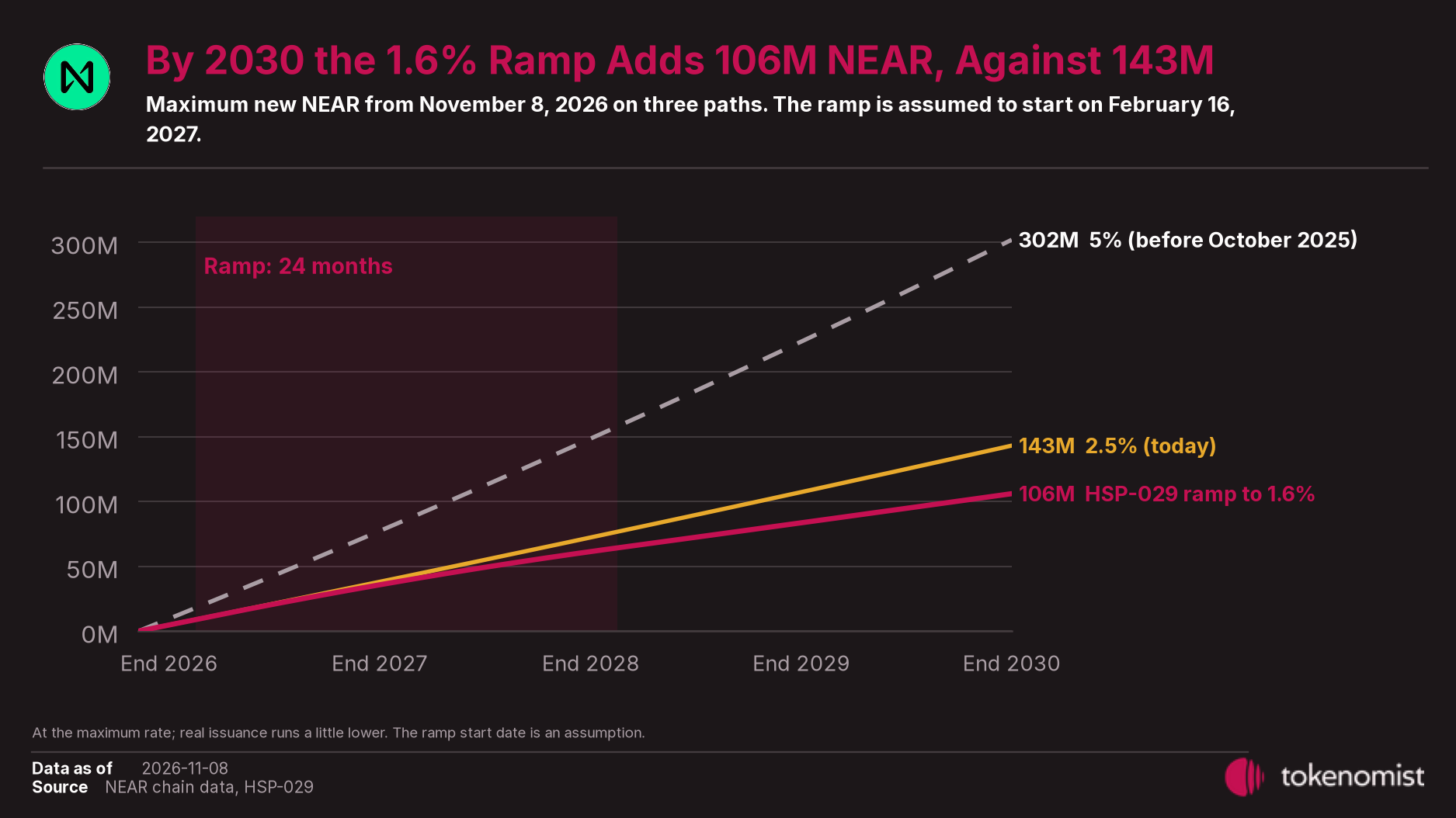
- The first cut did most of the work. It takes about 159 million NEAR out of that 2030 total and the second would take about 37 million, because it lowers the rate by 0.9 points, not 2.5. Both counts start on November 8, so they do not include the first year after the cut.
- A three-month delay costs little. If the ramp started three months later, about 34 million would stay out instead of 37.
- The tax per 1,000 unstaked NEAR keeps falling. At the maximum rate a year's dilution is about 49 NEAR at 5%, about 25 at 2.5% and about 16 once the ramp reaches 1.6%. These sit a little above the measured 47 and 24 earlier, which burning trims.
- Stakers take the same cut. At 1.6% and the November 12 staked share, their 90% share pays about 3.2% a year before commissions, against 5.1%.
7. What to watch
- November 16, 2026: the HSP-029 veto window closes. With no veto the proposal is ratified automatically. A veto would block it.
- A nearcore release that carries the ramp, then validator adoption. None is found as of November 13, 2026, and until one is adopted the chain's maximum inflation setting stays at 1/40. For scale, the 2025 cut reached the chain 8 days after its release.
- The first step, about February 16, 2027 at the earliest. From then the maximum should read 2.4625% a month in and 2.275% at six months, and daily supply growth should fall below the 87,000 NEAR a day of the past year.
- The staked share. It was 45.3% on October 27, 2026 and 44.5% on November 12, before any reward cut. A further fall after the ramp starts would show holders unstaking in response.
Sources
- nearcore 2.9.0 release notes (October 21, 2025)
- Near One: Enhancing NEAR tokenomics (October 21, 2025)
- NEAR: All you need to know about the proposal to reduce NEAR's inflation rate (July 2, 2025)
- NEAR on X: halving upgrade completed (October 30, 2025)
- House of Stake: HSP-027, remove the developer gas rebate (ratified July 3, 2026)
- nearcore 2.14.0 release notes (October 26, 2026)
- House of Stake: HSP-029, 24-month ramp to 1.6% (vote closed November 2, 2026; veto window to November 16)
- NEAR Docs: Storage staking
Methodology
- Supply and burn: NEAR archival RPC block headers and protocol configuration, November 12, 2026 at 18:58 UTC. Net growth is exact; burn is measured inside every sixth epoch (every epoch from October 5), each weighted by the time it stands for. The 2.5% setting starts after block 170,351,518; protocol version 87 from 11:46 UTC on November 4, 2026; the HSP-029 veto window closes at 16:48 UTC on November 16, 2026.
- Treasury share: the treasury account's balance at three epoch starts.
- 2030 paths: total supply of 1,311.2 million NEAR on November 8, 2026 at 14:44 UTC, compounded every epoch at each maximum rate with burning ignored. The ramp start is an assumption. Governance status was read on November 8, and nearcore releases on November 13.
- Peers: each chain's RPC, November 12, 2026; fee rules from Solana, Aptos and Cosmos Hub docs. Ethereum's issuance follows total stake, so it is left out.
- Price: CoinGecko, November 10, 2026 at 04:45 UTC.
- Not checked: validator commissions, demand for NEAR.
Disclosure: the author holds no NEAR and has no position in, or exposure to, the token or to NEAR Protocol. Tokenomist publishes this article and operates the NEAR supply and burn data it cites.
This is supply-side analysis for educational purposes. Not financial advice.
Frequently Asked Questions
What is NEAR's inflation rate in 2026?
NEAR's maximum inflation is 2.5% of total supply a year, down from 5% before October 29, 2025. Measured from block headers, total supply has grown 2.48% a year since the cut, a little under 2.5% because fee burning removes some of what is minted. 90% of new NEAR goes to stakers and 10% to the protocol treasury.
How does the inflation cut affect NEAR holders who do not stake?
It halved the dilution they pay. New NEAR goes to stakers and the treasury, so an unstaked holder keeps the same number of tokens but owns a smaller share of all NEAR each year. A holder of 1,000 NEAR gave up about 47 NEAR of share a year before the cut and about 24 after it.
What staking reward does NEAR pay after the cut?
With 2.5% of supply minted a year, 90% of it to stakers, and 44.5% of supply staked on November 12, 2026, stakers receive about 5.1% a year before validator commissions. The reward falls as more NEAR is staked, because the same issuance is shared by more stake.
Was the NEAR inflation cut approved by a vote?
Not by the community vote. That vote closed on August 1, 2025 with about 43% of staked NEAR voting yes, short of the two thirds it needed. The cut took effect through nearcore 2.9.0, which validators holding 80% of stake had to adopt, and it did on October 29, 2025.
Is NEAR deflationary?
No, its supply still grows. Total supply rose 33.0 million NEAR from the cut to November 12, 2026. Fee burning removed about 1.5% of the NEAR minted. The gas rebate ended on November 4, 2026, and in the 8 days after it burning offset about 1.0%.
Will NEAR cut inflation again?
A second cut has passed its vote. House of Stake proposal HSP-029 would lower maximum inflation from 2.5% to 1.6% in a straight line over 24 months, and the vote closed on November 2, 2026 with 99.96% in favor. It starts a full quarter after ratification, so not before about February 2027, and it still needs a nearcore release that validators adopt. By the end of 2030 it would create about 37 million fewer NEAR than staying at 2.5%.
Recommend Article
NEAR's Two Inflation Cuts Keep About 196M NEAR Out of Supply by 2030


NEAR's Two Inflation Cuts Keep About 196M NEAR Out of Supply by 2030
Weekly Unlock Digest: Nov 9–15, 2026 | Allora's First-Year Cliff


Weekly Unlock Digest: Nov 9–15, 2026 | Allora's First-Year Cliff
JUP’s 6 Unlock Schedule Versions: A Point-in-Time Data Example
JUP’s 6 Unlock Schedule Versions: A Point-in-Time Data Example
Unlocks Activity in November 2026


Unlocks Activity in November 2026
