SOL Supply After Genesis Unlocks: Issuance, Burns and Staking

All of SOL's original allocations tracked by Tokenomist have finished unlocking, but staking rewards still create new SOL. The vote to slow that creation passed, yet as of October 1, 2026 the change had not started. An empty unlock calendar says nothing about how fast new SOL arrives, how much is burned, or when holders sell.
Key Takeaways
- The unlock calendar is empty, but supply still grows. All nine original allocations are fully unlocked; new SOL now comes only from staking rewards, about 21.5 million SOL over the next year in Tokenomist's forecast, which appears to assume the current rule.
- The inflation cut has not started. The vote to make the inflation rate fall twice as fast, by 30% of itself each year instead of 15%, passed, but the network still ran the old rule on October 1, 2026.
- Only half of the base fee is burned. Priority fees go entirely to validators, so paying more to get in first does not burn more SOL.
- Less issuance means smaller staking rewards. Staking rewards are paid out of newly created SOL, and 69.38% of all SOL is staked, so slower creation pays those stakers less.
What Solana is and how SOL works
Solana is a blockchain for applications and payments. SOL pays transaction fees on that chain, and holders can stake it to help secure the network. The original token allocations were released under vesting schedules. The protocol creates new SOL separately, as staking rewards. Validators and the people who delegate to them receive those rewards, according to how much they participate and what commission they charge. Some transaction fees are burned, which reduces supply. Revenue earned by applications on Solana does not automatically flow back to SOL holders.

1. All of SOL's original allocations are already unlocked
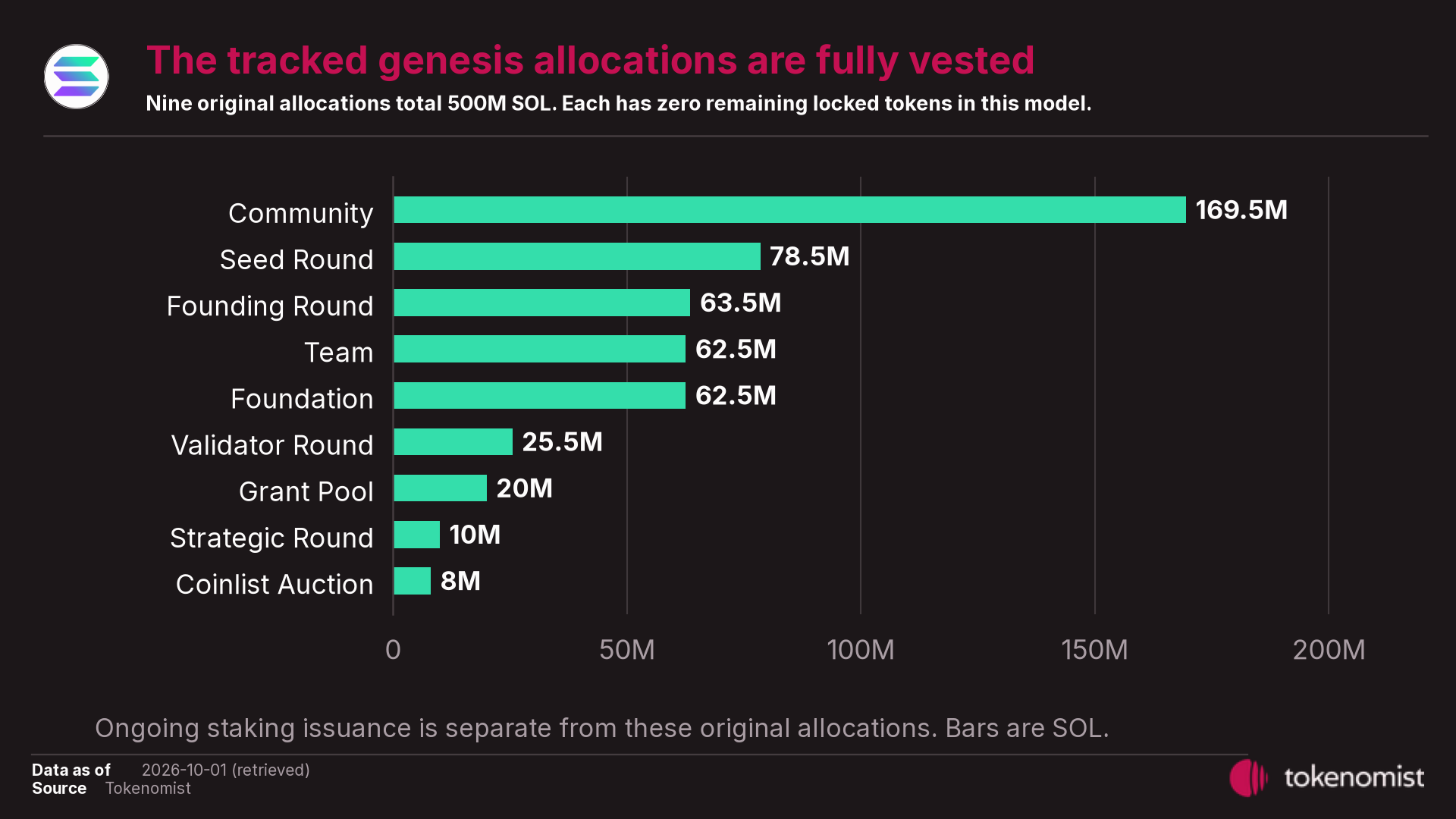
On October 1, 2026, Tokenomist's allocation page showed all nine of SOL's original allocations, 500 million SOL made at launch, with nothing left locked. This covers the allocations Tokenomist tracks, not every lock that exists on Solana.
| Allocation | Amount in Tokenomist's schedule | Still locked |
|---|---|---|
| Community | 169,500,000 SOL | 0 SOL |
| Seed Round | 78,500,000 SOL | 0 SOL |
| Founding Round | 63,500,000 SOL | 0 SOL |
| Foundation | 62,500,000 SOL | 0 SOL |
| Team | 62,500,000 SOL | 0 SOL |
| Validator Round | 25,500,000 SOL | 0 SOL |
| Grant Pool | 20,000,000 SOL | 0 SOL |
| Strategic Round | 10,000,000 SOL | 0 SOL |
| Coinlist Auction | 8,000,000 SOL | 0 SOL |
| Total | 500,000,000 SOL | 0 SOL |
Source: Tokenomist's Solana allocation schedule, read on October 1, 2026.
Solana's own records confirm the 500 million total. The split between investor rounds is Tokenomist's own breakdown: the Solana Foundation's 2020 transparency report gives 176,949,616 SOL for all early investors who bought under SAFT agreements (contracts to receive tokens later), against 177,500,000 across the Seed, Founding, Validator and Strategic rounds here, about 0.3% more.
Tokenomist's page also has an Inflation row. It is the new SOL expected from staking rewards, not coins held back for insiders, and its total is not a limit on how much SOL can ever exist.
Finished unlocks do not mean selling has stopped. Unlocked coins can still be moved to exchanges, and people who unstake can sell sooner, though neither creates any new SOL.
Four movements get called unlocks, and only one of them creates coins. A genesis unlock makes restricted coins available. Staking issuance creates new SOL. Unstaking frees SOL that already exists. A treasury transfer to an exchange changes who holds the coins. Treating all four as unlocks counts the same coins more than once.
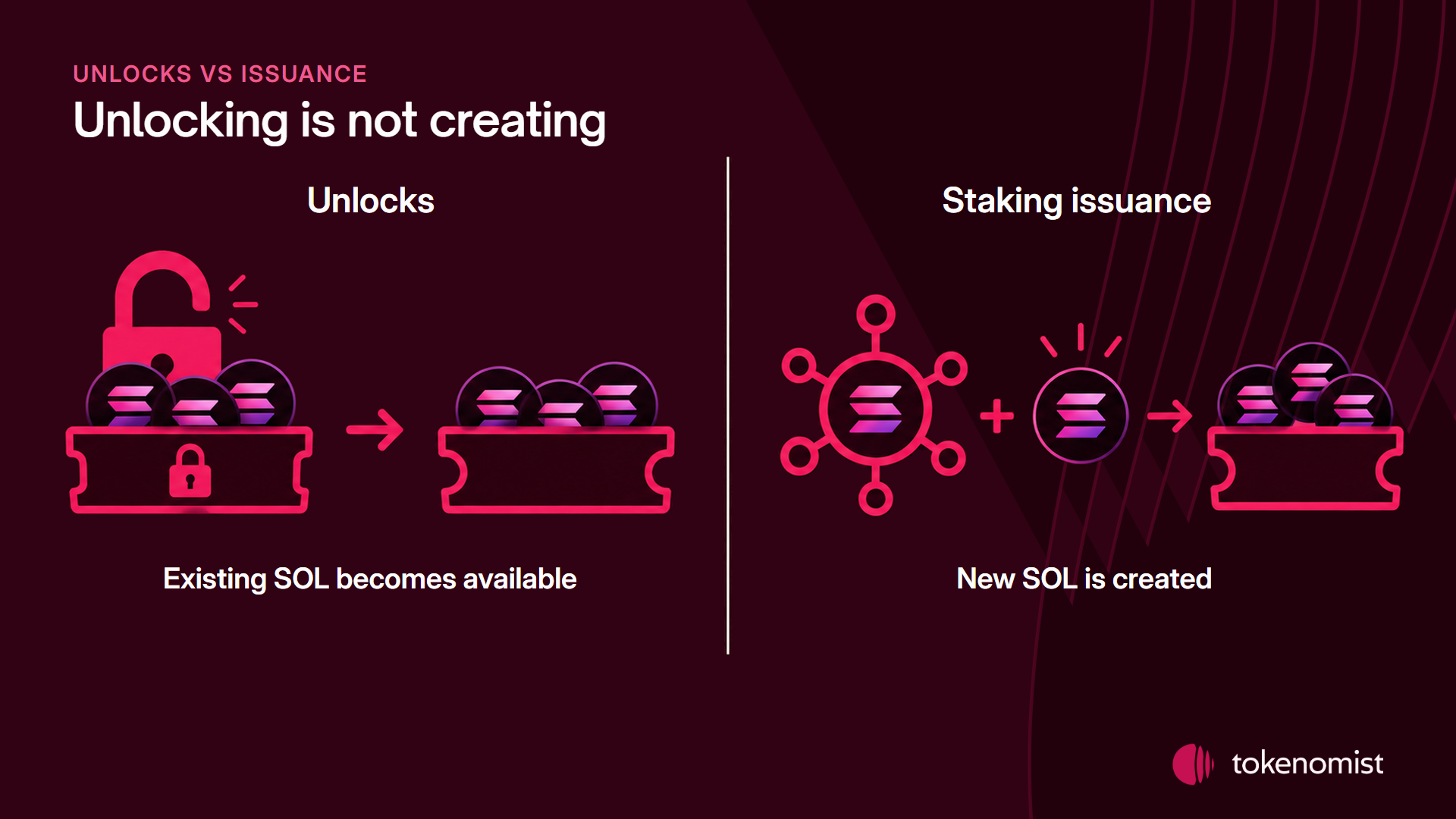
This is also why the unlock schedule's running total is not the same as the total supply on the chain. The schedule shows when coins were due to become available. The chain shows how many SOL exist when you check, after new issuance and burns. Neither shows how much holders plan to sell.
2. The current rule would create about 21.5 million new SOL by October 2027
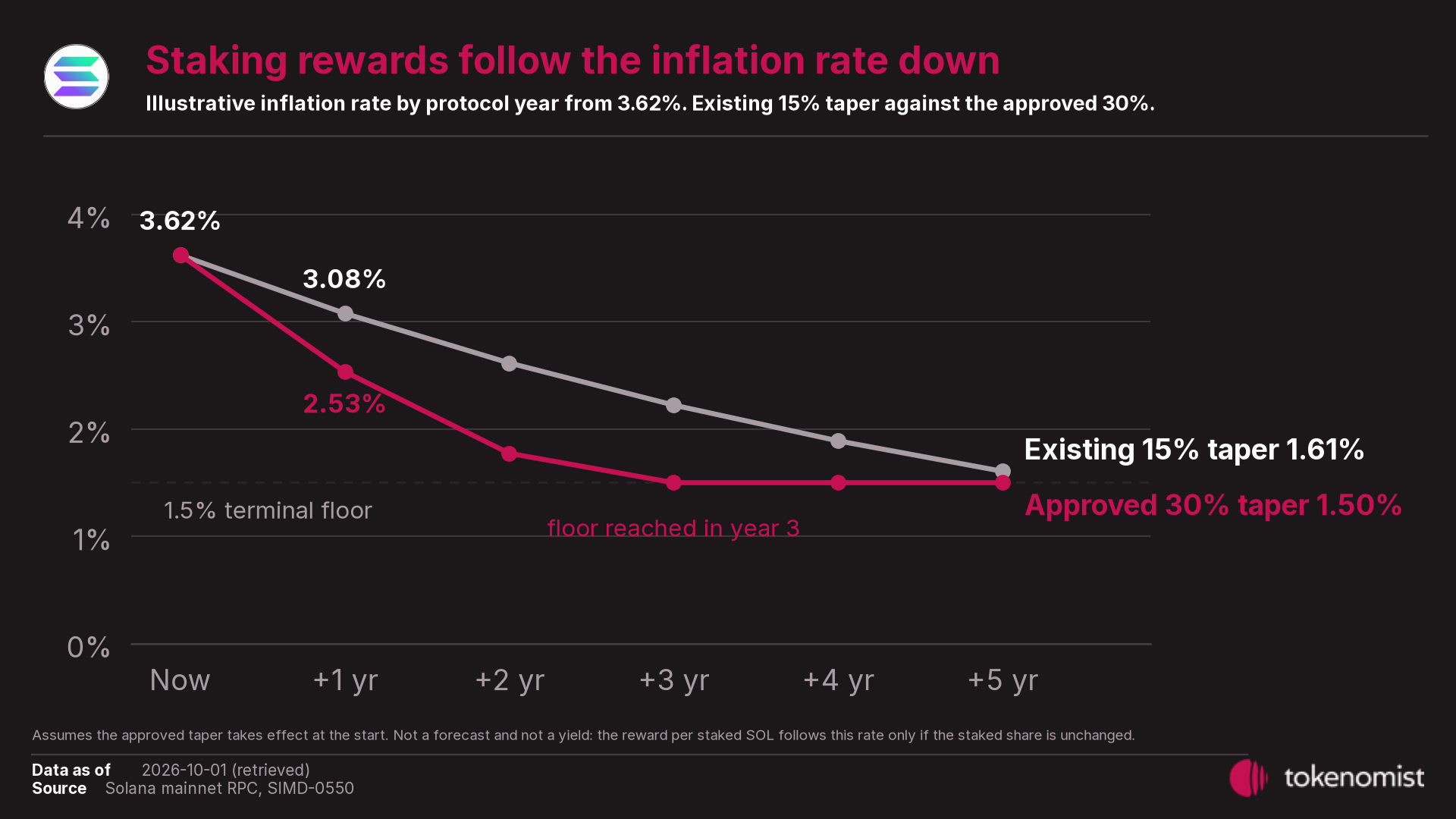
On October 1, 2026, the Solana network reported an inflation rate of 3.62% a year. The current rule lowers that rate by 15% of itself each year, so 3.62% becomes about 3.08% a year later (3.62% × 0.85). It keeps falling until it reaches a floor of 1.5%. The rate counts new SOL only; burns are not subtracted. Solana documents both the inflation rate and the rule that lowers it.
A falling rate means new SOL arrives more slowly, but supply still grows. Supply only shrinks when more SOL is burned than created.
Tokenomist's schedule, read on the same date, gives a longer view:
| Period | New SOL from staking rewards |
|---|---|
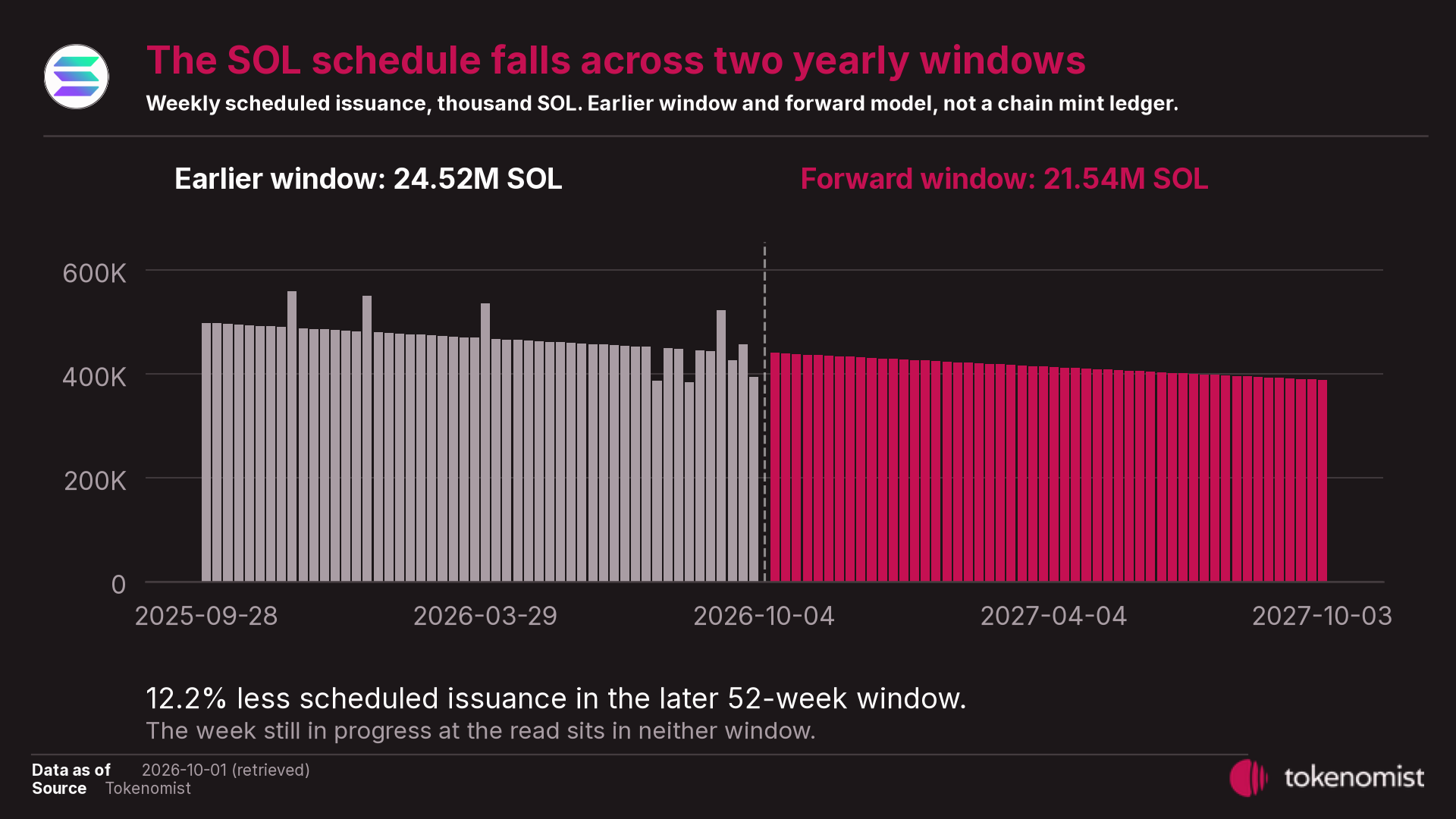
| September 28, 2025, to September 27, 2026 | 24,522,088 SOL |
| October 4, 2026, to October 3, 2027 (forecast) | 21,536,513 SOL |
The coming 52 weeks are expected to bring 12.2% less new SOL than the previous 52. The later figure is a forecast, not a finished year, and a rule change during it would change the result.
The rate and the yearly total are different measures. Multiplying the current rate by the current supply does not give the next year's new SOL, because the rate keeps falling and supply keeps growing during the year.
Tokenomist's forecast seems to use the current 15% rule, not the faster one that passed. A 12.2% fall is close to what the 15% rule gives once supply growth is counted. Tokenomist does not say which rule it uses. If the faster cut is switched on during the year, the real figure will be lower. The chart shows Tokenomist's modeled weekly amounts for both periods, and each yearly total adds up all 52 weeks. The week between the two periods, still in progress on October 1, 2026, is counted in neither.
3. Only half the base fee is burned, and priority fees are not burned at all
Every Solana transaction pays a base fee of 5,000 lamports per signature, according to Solana's fee documentation checked on October 1, 2026. A lamport is the smallest unit of SOL; one billion lamports make one SOL. Half of that base fee is burned and half goes to the validator that builds the block. Users can also pay a priority fee to be scheduled ahead of other transactions, and all of it goes to that validator.
A worked example shows the difference. Take one signature plus a priority fee of 10,000 lamports, a figure chosen for the example and not an observed market fee.
| Payment | Paid by user | To validator | Burned |
|---|---|---|---|
| Base fee | 5,000 lamports | 2,500 lamports | 2,500 lamports |
| Priority fee (example) | 10,000 lamports | 10,000 lamports | 0 lamports |
| Total | 15,000 lamports | 12,500 lamports | 2,500 lamports |
The user pays three times the base fee, yet the burn stays at 2,500 lamports. So "half of fees are burned" is true only for the base fee, not for everything a user pays.
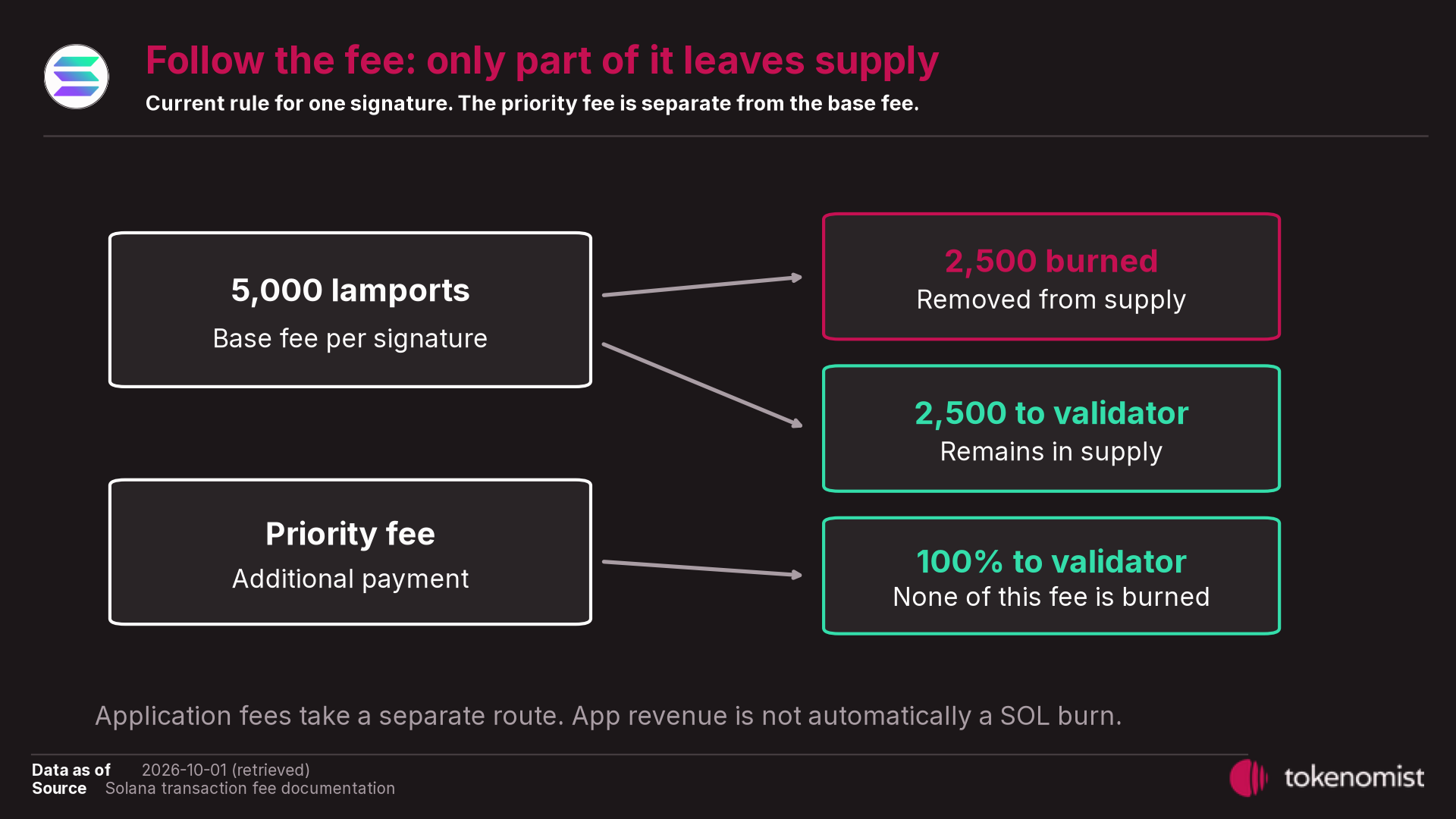
This is why higher fees do not mean more SOL is burned. An app can earn more, and users can pay more for priority, without a single extra lamport being burned; only more signatures add to the burn.
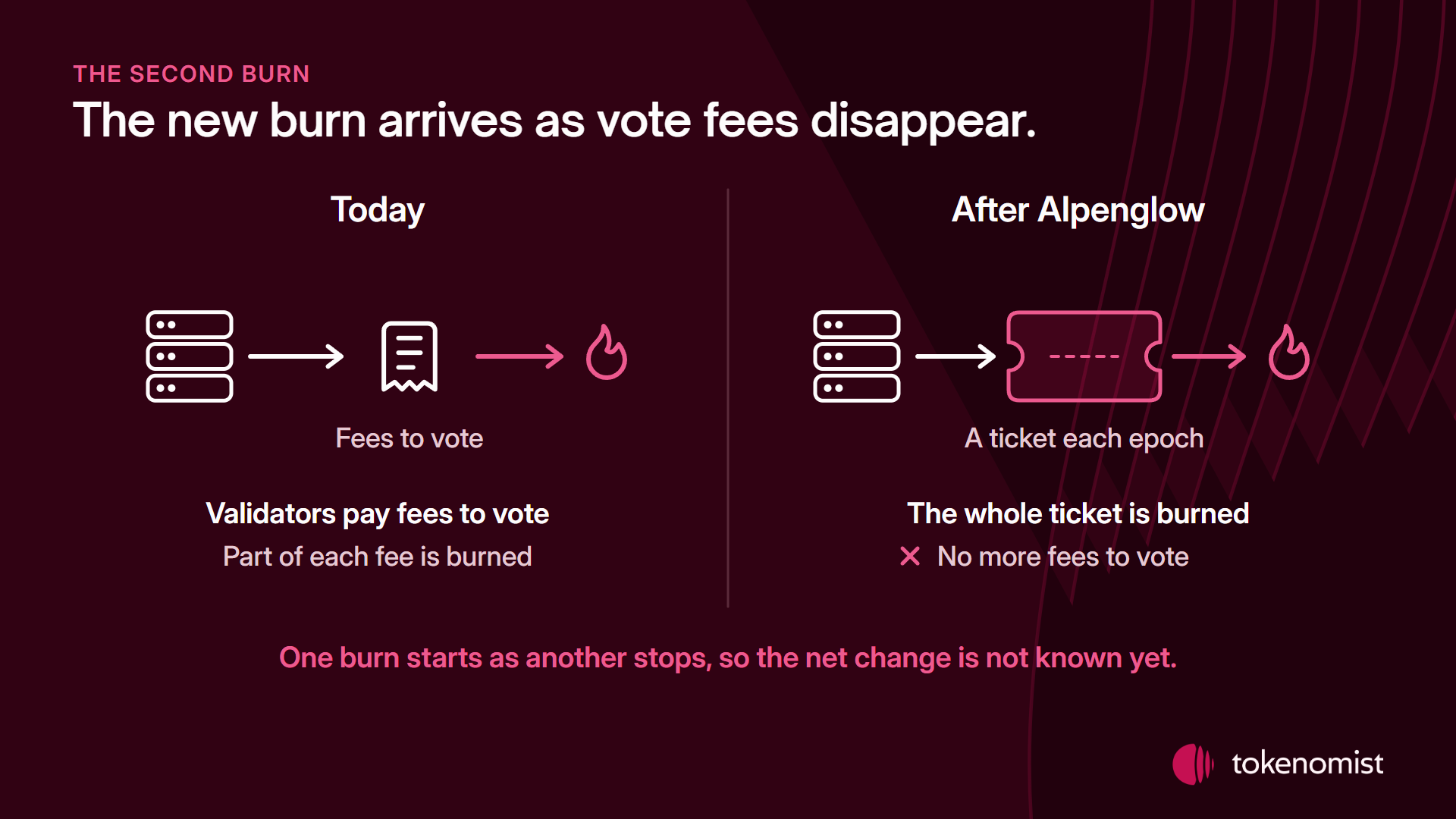
A second kind of burn is planned but has not started. Under Solana's Validator Admission Ticket rules, checked on October 1, 2026, each validator will pay 1.6 SOL every epoch, the period Solana uses to settle rewards, to stay in the validator set, and that SOL is burned. It starts only after Alpenglow, Solana's planned upgrade to how validators agree on blocks. The admission rules were already in force on October 1, 2026; the burn was not. Under the current rules, validators pay fees to vote, and part of each of those fees is burned. The same upgrade ends those fees, so the ticket burn replaces part of the current burn rather than adding to all of it.
Saying how much burning offsets new SOL needs actual burns measured over the same period. This article did not measure them on the chain, so it gives no offset figure.
4. The vote to slow inflation passed, but the cut has not started
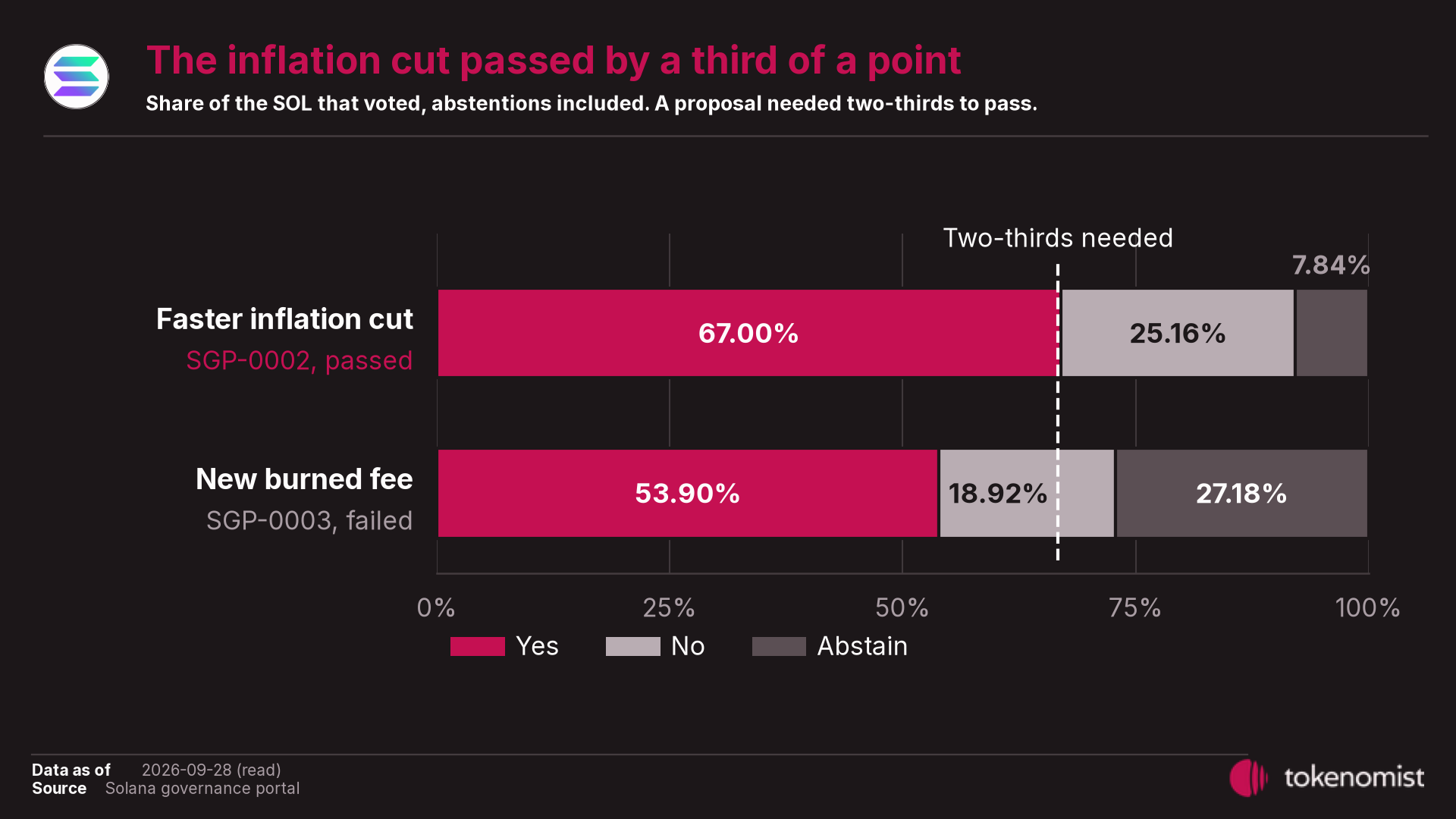
Solana's governance portal, checked on September 28, 2026, shows the final results of two votes on SOL supply, held in August 2026. The proposal to cut inflation faster passed; Solana calls the yearly cut in the rate disinflation, and this proposal doubles it. The proposal for a new fee that would burn more SOL failed. Each vote has an SGP number, for Solana Governance Proposal, and a SIMD number, for the technical document behind it. CoinDesk's post on the result described the community as passing the proposal to double the disinflation rate to 30%, "squeaking past the 66.67% threshold in the final hour".
JUST IN: @Solana votes to cut its own inflation curve in half.
— CoinDesk (@CoinDesk) August 28, 2026
The community passed a proposal to double $SOL's disinflation rate to 30%, squeaking past the 66.67% threshold in the final hour of voting.
18.9M $SOL ($1.47B) in issuance gets slashed over the next six years. pic.twitter.com/LZW1hCQK99
| Proposal | Voted yes | Outcome |
|---|---|---|
| SGP-0002 / SIMD-0550, Double Disinflation | 67.00% | Passed |
| SGP-0003 / SIMD-0553, Resource and Inclusion Fee | 53.90% | Failed |
The percentages are shares of the SOL that took part in each vote, counting abstentions. Under Solana's Constitution, a proposal needs two-thirds of that to pass, once at least a third of all staked SOL has voted. At 67.00%, the inflation cut passed by a fraction of a point.
SGP-0003's own text required two-thirds of yes and no votes only, leaving abstentions out, and set no quorum. On that test its yes share would have been 74.02%, enough to pass. It is recorded as rejected because the official count used the Constitution's rule, which counts abstentions; the Constitution itself was put to a vote in the same weeks.
SIMD-0550 does not cut the rate in half overnight. When it switches on, the rate starts from wherever it is and then falls by 30% a year instead of 15%. No start date has been published, and the network still ran the 15% rule on October 1, 2026.
The failed SIMD-0553 would have charged a burned fee based on how much computing a transaction uses. Its burn estimates were projections, not SOL that was actually burned.
One proposal slows how fast SOL is created; the other would have changed how much is burned. Only the first passed, so the burn side stays as it is.
To see the difference, start from the 3.62% read on October 1, 2026 and suppose the change took effect that day. After one year the rate would be about 3.08% under the current rule (3.62% × 0.85) and about 2.53% under the approved one (3.62% × 0.70). These are rates at the end of the year, not averages and not amounts of SOL.
| Rule | Starting rate | Rate after one year |
|---|---|---|
| Current 15% rule | 3.62% | 3.08% |
| Approved 30% rule, if started that day | 3.62% | 2.53% |
The real result depends on when the change actually starts.
5. Slower inflation means smaller staking rewards
On October 1, 2026, 440,549,645 SOL was staked, meaning delegated to a validator, out of a total supply of 634,995,422 SOL. That is 69.38% of all SOL. Total supply is above the 500 million SOL made at launch because staking rewards have added coins since then, minus burns. The staked figure includes validators that have stopped voting, and it counts SOL, not owners.
Stake is concentrated in a small share of validators. Of 683 validators, the largest 50 hold 55.09% of staked SOL and the largest 18 hold 33.53%. This shows where SOL is delegated, not who owns it: many separate holders can delegate to the same validator.
On October 1, 2026, the largest 18 were the smallest group of validators that together held more than a third of staked SOL. That share matters because Solana treats a block as final only when validators holding two-thirds of the stake agree, so if those 18 stopped at the same time, the network could not confirm new blocks.
The percentages in this article are shares of different totals, so they cannot be compared. 69.38% is a share of all SOL. 55.09% is a share of staked SOL. The 67.00% and 53.90% in section 4 are shares of the SOL that voted, a smaller total than either.
The same SOL can show up in several lists. SOL staked with a validator, the liquid staking tokens that stand for staked SOL, and a fund's staked holdings can all be the same coins. Adding these lists together counts some SOL twice and can give a total larger than all the SOL that exists.
Under Solana's staking model, staking rewards are paid out of newly created SOL. So if less SOL is created while the amount staked stays about the same, each staked SOL earns less. Slowing inflation and lowering staking rewards are the same change seen from two sides.
Validators feel the cut differently. They pay for servers and earn a commission, a percentage of the rewards they pass on, plus fees. How much a smaller reward hurts depends on each validator's commission, stake and costs. Whether some validators shut down will only show once the change is live.
SOL traded at $118.02 on October 1, 2026. That was up 14.2% over the previous 30 days, and 43.3% below its level one year earlier. The price sets the dollar value of the rewards discussed here. The token counts and the rules above do not depend on it.
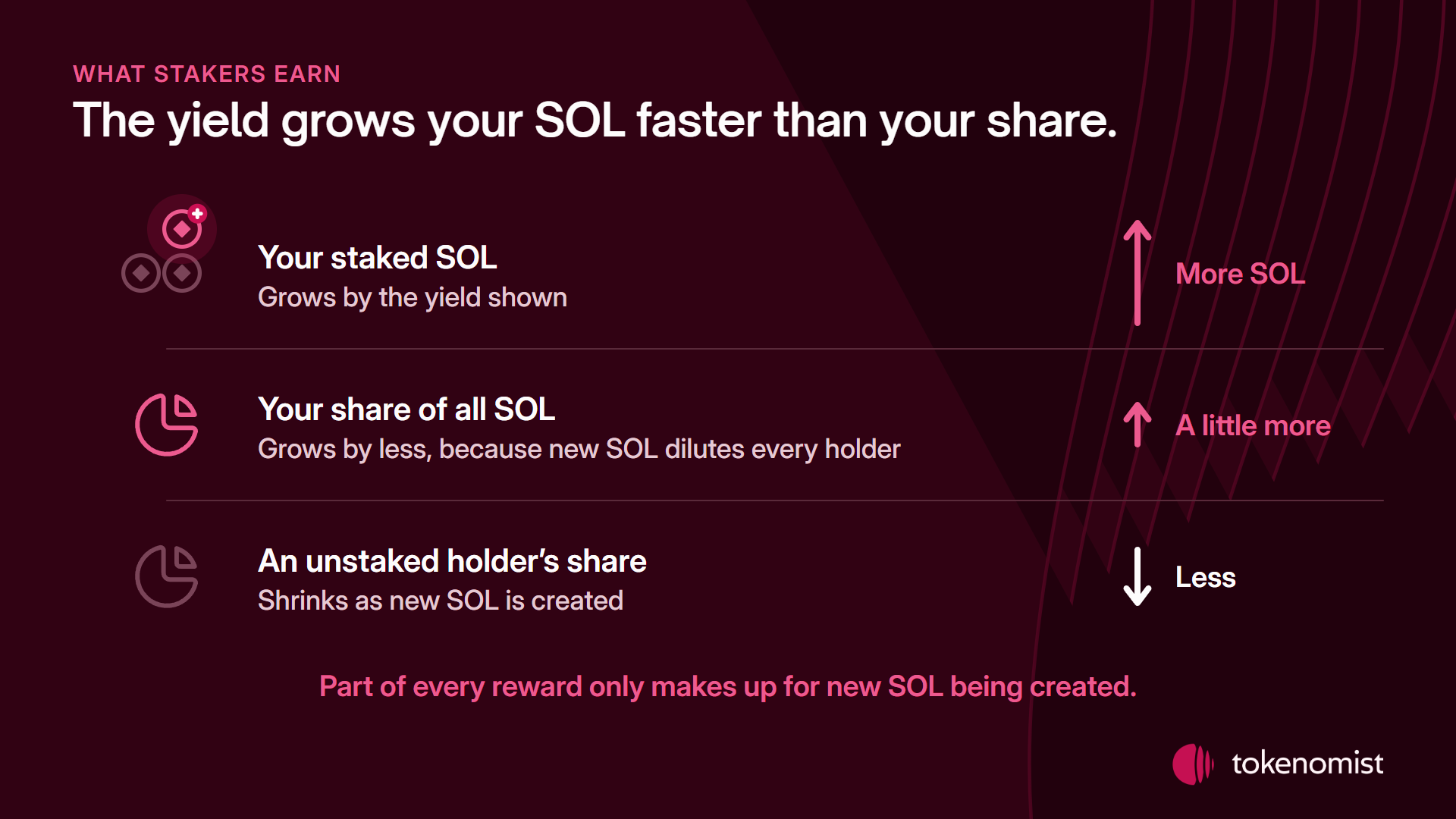
For a holder, the staking yield on screen is not the same as growth in their share of all SOL. Part of every reward only makes up for new SOL being created, so the yield shown overstates how much a holder's share of the network grows.
6. The software has shipped, but the cut is not switched on yet
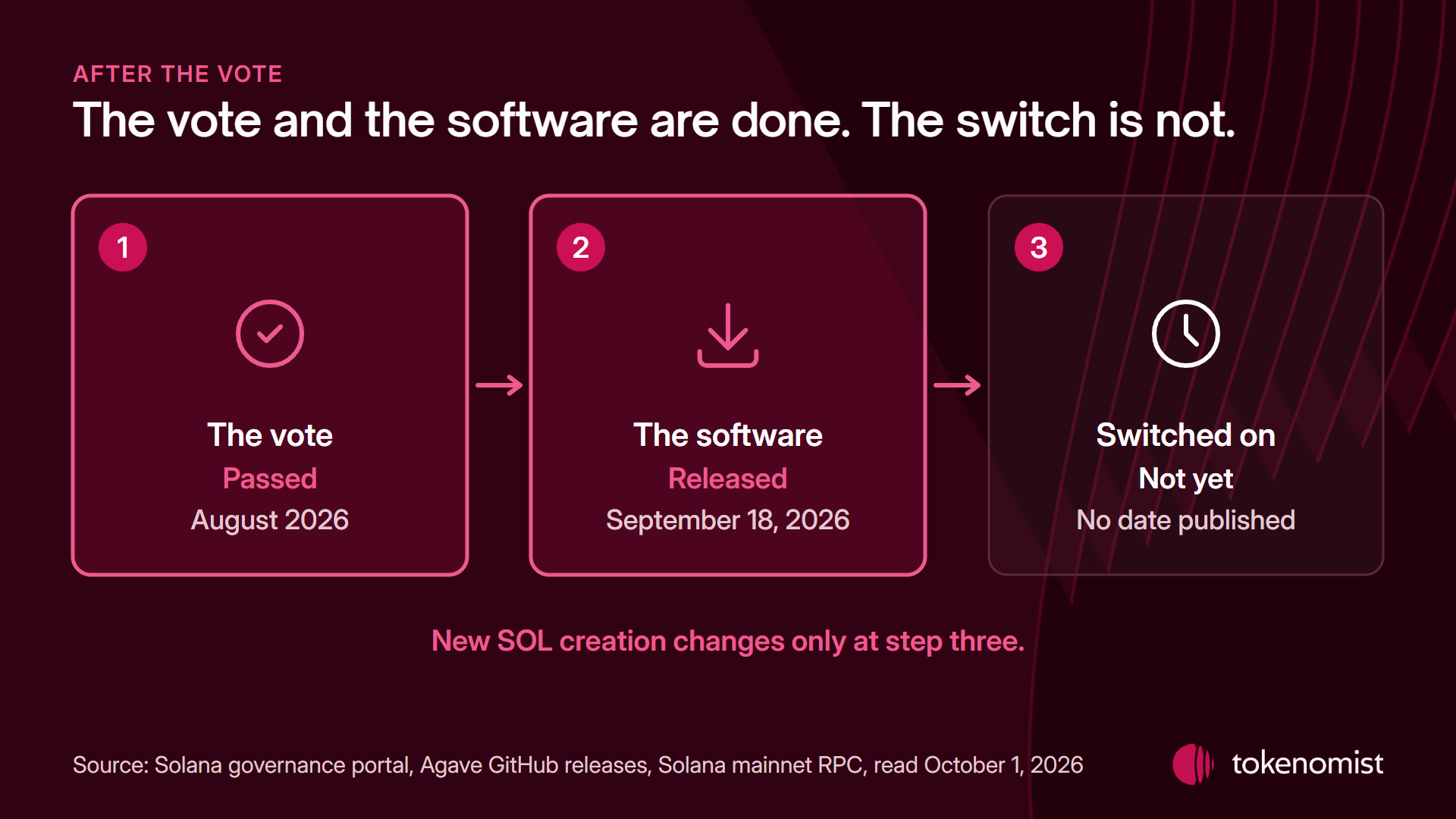
A passed vote is only the first of three steps. Next, the change has to ship in the software validators run, and then it has to be switched on for the network. The first two are done. Agave 4.3, the validator software that contains the change, was released on September 18, 2026, and validators holding 82.56% of staked SOL were running it on October 1, 2026. The switch had not been turned on, and no date has been published. Any forecast of future SOL supply should say which step it assumes, and the ticket burn in section 3 is waiting on the same kind of switch.
For the next SOL supply update, track these together:
- Issuance: how much SOL was created over a set period, and which inflation rule was active.
- Burn: how much SOL was actually removed over the same period, and any change in fee rules.
- Staking: how much is staked and what it earns, remembering that staked SOL is not the same as SOL owned or ready to sell.
- Activation: the date an approved change starts to affect rewards or fees, then revise the forecast.
The supply question that remains is how much SOL the protocol creates, how much it removes, and who holds what is left.
Methodology
- Allocation and schedule data: Tokenomist, retrieved October 1, 2026. The later 52-week window is a forecast.
- Chain data: Solana mainnet RPC, October 1, 2026 at 07:35 UTC, epoch 1046, including validator versions and rankings.
- Prices: CoinGecko, October 1, 2026 at 07:35 UTC, context only. The 30-day and one-year changes are rolling figures read at that minute.
- Not included: an activation date for the approved taper, and a burn series measured on the chain. So no dollar issuance total and no burn-offset ratio are given.
Sources
- Tokenomist: SOL allocation and issuance schedule, retrieved October 1, 2026.
- Solana protocol documentation: inflation rate, transaction fee mechanics, staking, Validator Admission Ticket, and the Agave 4.3.0 release.
- Solana governance: official proposal results, the ratified Solana Constitution, SIMD-0550 double disinflation, SIMD-0553 resource fee burn, and the SGP-0003 text. Vote outcomes and proposed designs are separate from mainnet activation.
Frequently Asked Questions
Does SOL still have token unlocks?
The nine original allocations tracked by Tokenomist had nothing left locked in the read of October 1, 2026. The protocol still creates new SOL through staking rewards. That does not rule out other locks, such as waiting periods to unstake or private agreements, or selling by people who already hold unlocked SOL.
Does lower Solana inflation mean the supply is shrinking?
No. A lower inflation rate means the protocol creates new SOL more slowly relative to its supply. Supply shrinks only when the amount burned is larger than the amount created over the same period. The inflation rate and the change in supply over a finished period measure different things.
Has the faster reduction in SOL inflation started?
The proposal passed the vote, and the validator software that contains it was released on September 18, 2026. The network check on October 1, 2026 still returned the existing 15% rule, because the change had not been switched on. When it starts, the rate falls faster from where it is, rather than halving rewards at once.
Do Solana priority fees burn SOL?
Under the fee rules checked on October 1, 2026, priority fees go entirely to the validator that builds the block. The base fee is split between that validator and burn. Higher spending on priority can therefore increase what validators receive without removing any more SOL from supply.
Why does reducing issuance matter to stakers?
Staking rewards are paid out of newly created SOL. If less new SOL is paid out while the amount staked stays about the same, each staked SOL earns less. Slower creation also dilutes holders less. So compare the staking yield with how fast supply grows, and allow for commissions, rather than reading the yield shown as the same increase in ownership.
Recommend Article
What the Market Does Around a Token Unlock


What the Market Does Around a Token Unlock
Weekly Unlock Digest: Nov 16–22, 2026 | LayerZero's $34.69M Cliff Lands Ahead of Zero Mainnet


Weekly Unlock Digest: Nov 16–22, 2026 | LayerZero's $34.69M Cliff Lands Ahead of Zero Mainnet
NEAR's Two Inflation Cuts Keep About 196M NEAR Out of Supply by 2030
NEAR's Two Inflation Cuts Keep About 196M NEAR Out of Supply by 2030
Weekly Unlock Digest: Nov 9–15, 2026 | Allora's First-Year Cliff
Weekly Unlock Digest: Nov 9–15, 2026 | Allora's First-Year Cliff
