Zcash's Shielded Balances and ETF Holdings Do Not Measure Locked Supply

Zcash's private pool balances swung by close to a million coins this year, and a September 8, 2026 SEC filing showed how its ETF received coins. Neither one shows that fewer ZEC are available to trade. A shielded balance does not say how long its owner will hold, and a fund's holdings do not say what it bought.
Key Takeaways
- Coins moving into private pools are not locked. The shielded balance fell 907,990 ZEC between April and July 2026, then recovered 643,655 of that by September 17; both moves show where coins sit, not whether anyone sold.
- One documented creation brought the fund coins, not cash. DCG International Investments, part of the fund sponsor's own group, delivered 85,705 ZEC for fund shares on September 8, 2026. That single event does not describe the fund's other flows, and that is the point: a holdings total cannot tell you which coins were bought.
- Neither number proves a supply squeeze. ZEC is up 176.6% over the thirty days to the September 18, 2026 close; pool and fund figures cannot show that fewer coins are for sale.
What Zcash is and how ZEC works
Zcash is a payment network that lets people send transactions with the financial details encrypted. Its native asset, ZEC, pays for transactions. New ZEC is created by the protocol itself, as block rewards to miners and as funding streams for development work. No investor vesting schedule is running today, and holding ZEC gives no share of the network's revenue. A founders' reward did run from 2016 until the first halving in November 2020, and it finished there.
What matters here is the difference between new coins being created and existing coins moving from one place to another. ZIP 1015 sets out how development funding is taken from the block subsidy. The NU6.3 rules, from the upgrade that activated Ironwood, the new shielded pool, describe the shielded pools.
| Component | What it does | What its balance does not tell you |
|---|---|---|
| Block subsidy | Creates new ZEC under the issuance rules | How much recipients will sell |
| Shielded pools | Record the total value held, with the details encrypted | How long holders will keep their coins |
| Development lockbox | Holds the share of new coins the protocol sets aside for development | That ordinary holders have locked any coins |
| ETF holdings | Record the assets held by the fund | Whether incoming coins were bought for cash or delivered in kind |
1. Shielding a coin does not mean the owner has promised to hold it
ZEC closed at $1,562 on September 18, 2026, against $341 at the close of April 16, 2026, where section 2 starts measuring the shielded decline. The move is weighted to the end of that span: 65.5% over the first four months, then 176.6% in the final thirty days. A rise like that invites the explanation that fewer coins are available to buy. That explanation is what this article examines. The price itself is not what it explains.
Shielding means moving ZEC into one of the protocol's shielded pools, where the sender, the recipient and the amount are encrypted. It hides the transaction; it does not put the coins on a vesting schedule. The holder can still spend or move them under the pool's rules. Wallet support, custody and temporary network restrictions can get in the way, but none of that makes the coins locked.
The blockchain shows how much ZEC each pool holds in total, while individual balances stay private. On September 18, 2026 the Zcash Dashboard reported 4,915,826 ZEC across the four shielded pools, Sprout, Sapling, Orchard and Ironwood, or 29.02% of reported supply, one reading at one moment. The saved historical chain series recorded 4,918,578 shielded ZEC at the close of September 17, 2026. The 2,752 ZEC between the two is one day of activity plus the difference between a live dashboard reading and a settled daily close, not a disagreement. The chart and the changes below use the closing series.
A larger shielded balance can mean coins migrating between pools, ordinary payments, or holders who simply want privacy. A smaller one can mean a transfer to a wallet as easily as a sale. Knowing which takes evidence of where the coins went and what actually traded.
2. Did the June security episode cause the balance decline?
The saved zecstats.com series, the only source for these daily closes, shows shielded balances falling from 5,182,913 ZEC on April 16, 2026 to 4,274,923 ZEC on July 27, 2026, a fall of 907,990 ZEC. By September 17, 2026 they had climbed 643,655 ZEC back from that low, to the 4,918,578 ZEC close above.
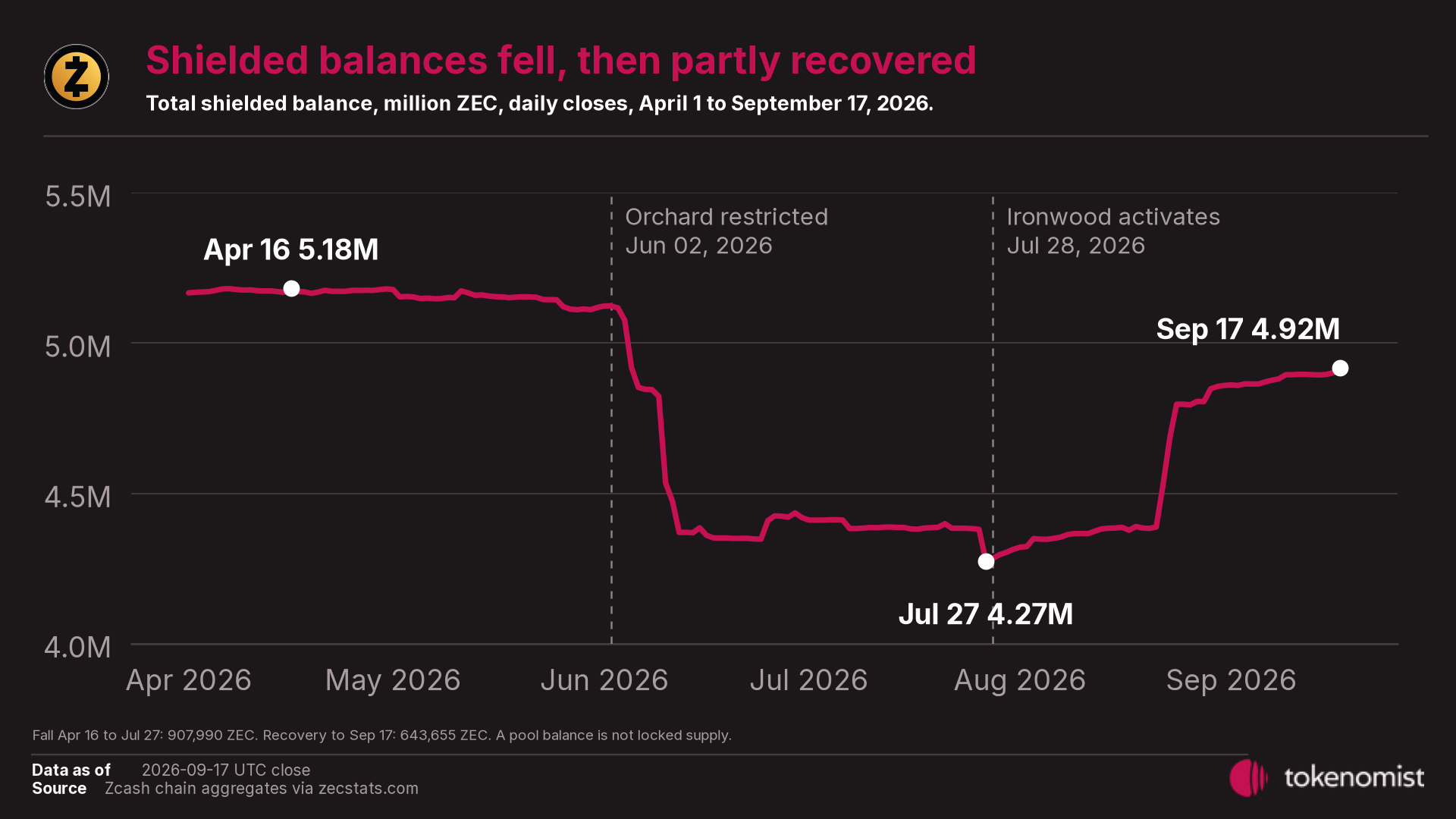
Much of the fall came around a vulnerability in Orchard, the shielded pool that held most of the balance at the time. Researchers found a flaw that could have let someone create fake value inside the Orchard pool. The zcashd security advisory records an emergency restriction on Orchard transactions on June 2, 2026, and a corrected circuit that re-enabled Orchard on June 3, 2026. Shielded Labs published its account on June 4, 2026.
Between the closes of June 3 and June 15, 2026, balances fell from 5,117,082 ZEC to 4,385,402 ZEC, a fall of 731,680 ZEC. That twelve-day fall sits inside the 907,990 ZEC April-to-July decline and is separate from the 643,655 ZEC recovery after July 27, 2026. Holders reacting to the incident would fit that pattern. The numbers still do not say why anyone moved coins, or that the coins were sold.
The size of the balance change is the finding. The data cannot say whether a future security event would bring the same reaction, or a faster one.
3. Ironwood restricts the old pool without proving whether the flaw was exploited
Ironwood introduced a replacement shielded pool and restricted the old Orchard pool. The official activation announcement confirms the July 28, 2026 activation at block 3,428,143. The NU6.3 rules describe the restrictions, although that page is still marked Draft.
Old Orchard takes no new deposits and allows no ordinary payments between addresses. Holders can still withdraw, and make the self-transfers that leaving the pool requires, under the migration rules. Coins leaving pass a check on the pool's running total, often called a turnstile, which stops the pool paying out more than went into it. It cannot tell a genuine coin from a counterfeit one.
The advisory says this lets node operators verify the circulating supply again. It does not prove that the flaw was never exploited. The same advisory says it is not possible to verify after the fact whether counterfeiting occurred during the exposure window. Shielded Labs puts the holder's side of it: users cannot independently verify that no counterfeit ZEC was created.
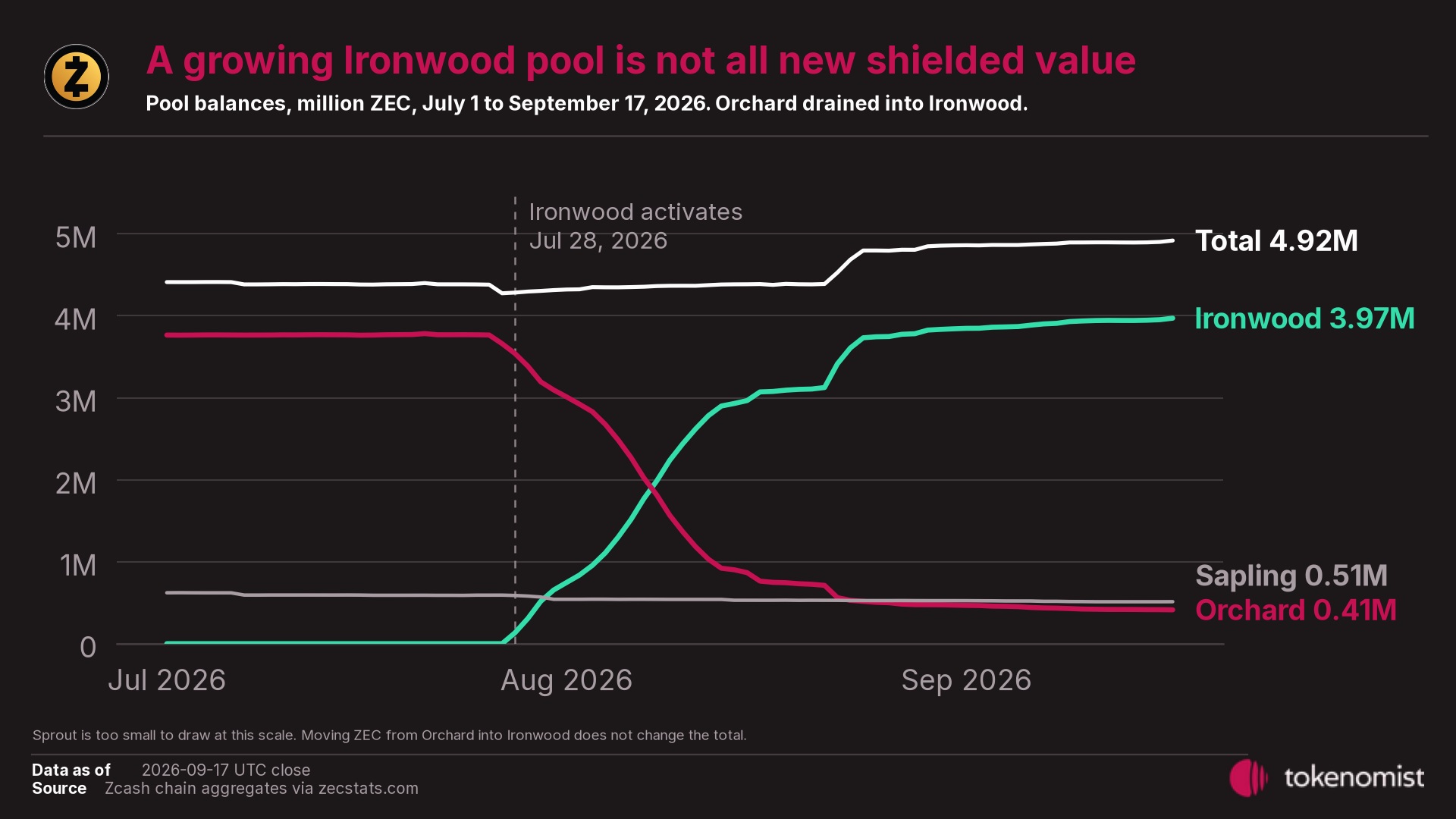
Moving ZEC from Orchard into Ironwood reduces one pool and increases another. That move does not change the total across the shielded pools, so the total shifts only when coins genuinely enter or leave them, by far less than either pool moves on its own. Growth in Ironwood is therefore not all new demand for privacy, and it is not evidence of new demand to buy ZEC.
The next upgrade, NU7, is targeted at mainnet for November 5, 2026, after a testnet activation on October 6 and a final decision on October 20. Its timeline post states that "New transaction formats do not appear in this network upgrade", so the pool rules above are the ones in force while that work proceeds.
4. The ETF received existing ZEC in exchange for shares
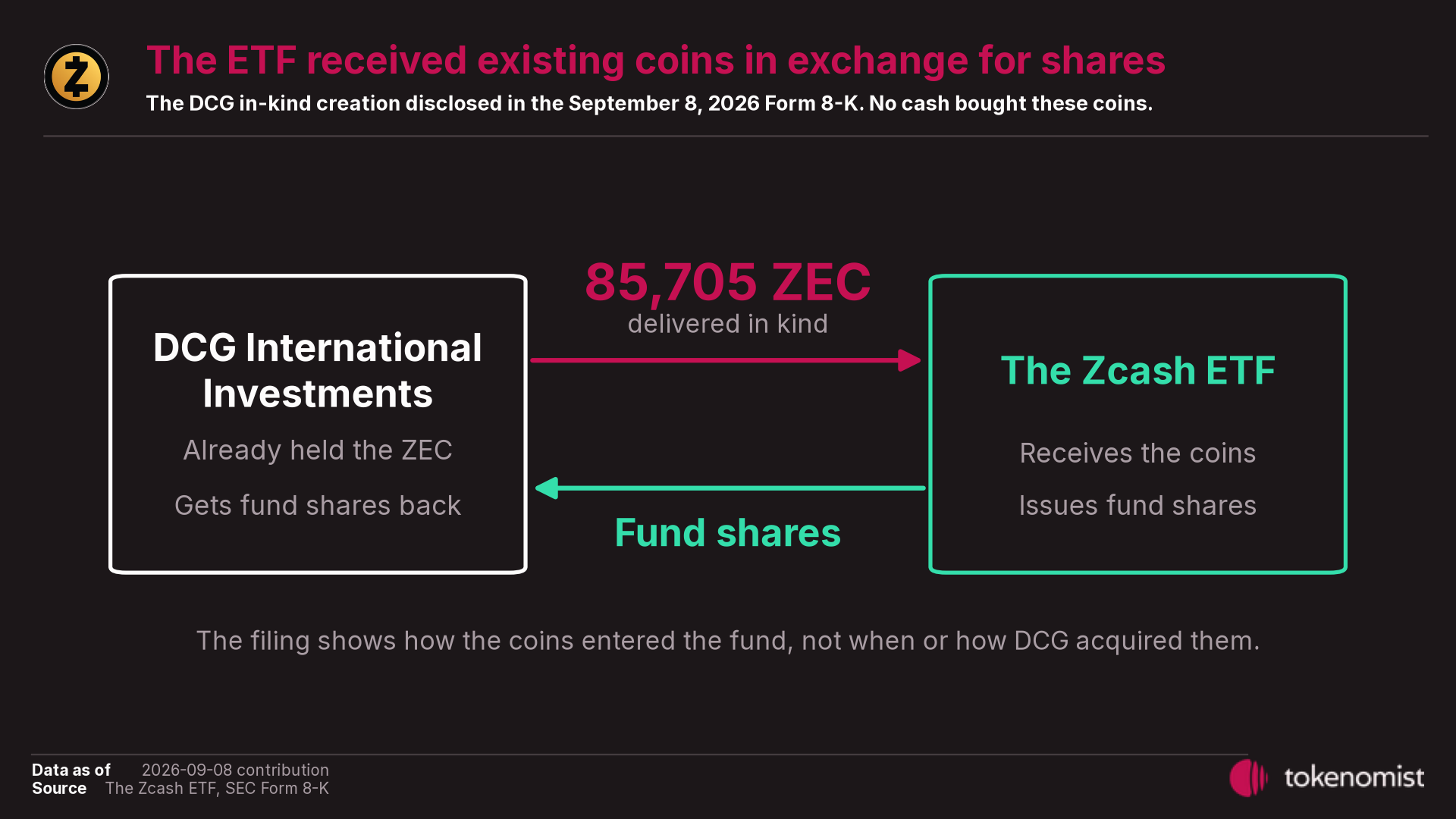
The Zcash ETF shows why a fund holding more coins is not the same as the fund buying coins. Its September 8, 2026 Form 8-K states that DCG International Investments acquired fund shares and delivered 85,705.32563297 ZEC in exchange. The exchange went through an authorised participant, which is a broker permitted to create and redeem ETF shares, or through a firm that broker designated.
Rounded to whole coins, that is 85,705 ZEC. The industry term is an in-kind creation: the investor handed over the coins themselves, not cash for the fund to invest. The filing shows how those coins entered the fund. It does not show when or how DCG acquired them.
The accompanying issuer release confirms the August 25, 2026 NYSE Arca launch, as does Grayscale's own post that day announcing that the fund "begins trading today".
The Zcash ETF - Built by Grayscale (Ticker: $ZCSH) begins trading today @ZcashETF.
— Grayscale (@Grayscale) August 25, 2026
The world’s first Zcash ETF offering exposure to $ZEC, now accessible from brokerage or investment accounts.
Why $ZEC?
⟶ Zcash shares key features with Bitcoin: a 21 million… pic.twitter.com/nuaR2HBTWx
The rest of a fund's holdings change the same way. Creations add coins, redemptions take coins out, and expenses reduce holdings too. Subtracting DCG's contribution from the fund's total change does not tell you what everyone else bought. That takes the creation and redemption records, with how each one was paid.
5. Can issuance, pool balances and fund holdings be added together?
Issuance increases the amount of ZEC in existence. Transfers between pools change where existing value is recorded. ETF creations change which fund holds the assets. A newly issued coin can later move between pools or enter an ETF, so adding these measures together counts the same coin more than once.
In the saved chain series, reported total supply rose 53,731 ZEC over the 30 days ending September 17, 2026. The April-to-July shielded decline was larger, but it covered a longer period and measured something different. That gives scale; it does not show that selling ran ahead of issuance.
A coin that leaves a shielded pool and later enters a fund is one coin. Counting the first move as selling and the second as a purchase counts it twice. So a useful analysis keeps issuance, pool balances and fund holdings in separate tallies, and adds transaction-level or market evidence when the claim is about actual buying, selling or liquidity.
Neither pool balances nor ETF disclosures measure tradable float, the coins available to trade. Testing that link takes three records over equal periods: the pool totals read together, so migration is not mistaken for new money; the transfers that actually reached an exchange; and the fund's creations, redemptions and expenses, with how each was paid. Even an exchange deposit only means a coin could be sold.
A claim that coins have become unavailable for sale needs more than a rising pool balance or a larger fund holding.
Methodology
- Pool balances and issuance: daily Zcash chain aggregates from zecstats.com, to the September 17, 2026 UTC close. Single-sourced. Two other series put the April high within about 1,700 ZEC of this one but on a day in the first week of April, so April 16 is where this piece measures from rather than a claim about which day was highest.
- Snapshot: Zcash Dashboard, September 18, 2026 at 21:10 UTC, kept separate from the daily series.
- Prices: daily closes from CoinGecko, each cross-checked against Coinbase's candle for the same UTC day. The thirty-day change runs close to close, August 19 to September 18, 2026. Context only. Unmined ZEC: about 4.06 million ZEC has yet to be mined, and this piece counts it as unissued. Some supply screens place it in a locked column, which means something different from the way this piece uses the word.
- None of these figures shows what is for sale, and they cannot be added together.
Sources
- Zcash: project and payment model, ZIP 1015 development funding, NU6.3 upgrade notes, ZIP 258, the NU6.3 Ironwood deployment and pool rules and ZIP 318 pool transfer rules.
- Zcash security team: Orchard remediation advisory; Shielded Labs: Orchard vulnerability disclosure.
- The Zcash ETF: September 8, 2026 Form 8-K and issuer release filed with the SEC.
- Zcash chain statistics: zecstats historical pool series, retained through the September 17 UTC close; zkp.baby live dashboard, separate point observation dated September 18, 2026, 21:10 UTC. Tokenomist: the ZEC allocation and unlock page at tokenomist.ai/zcash, which records no scheduled unlock events for ZEC. The pool balances, supply and issuance in this piece come from the chain series above rather than from that page.
Frequently Asked Questions
Does moving ZEC into a shielded pool lock it?
Shielding gives privacy, not a vesting commitment. The holder can still move the coins under the rules of the pool, although wallet support and network restrictions may affect the route. A pool balance therefore does not tell you how long its owners intend to hold, or whether they will sell.
Does a falling shielded balance mean ZEC was sold?
It means the total held in the measured pools declined. Coins may have moved out of those pools without any market trade, for example to transparent addresses. Showing a sale takes further transaction or trading evidence. Even a transfer to an exchange does not, on its own, prove that a trade happened.
Did Ironwood prove that Zcash was never counterfeited?
The upgrade lets node operators verify the circulating supply again, by restricting the old pool and capping how much can be withdrawn from it in total. That is different from proving that the original flaw was never exploited. The zcashd advisory says it is not possible to verify after the fact whether counterfeiting occurred during the exposure window.
Does an ETF creation always mean fresh buying of ZEC?
No. An in-kind creation exchanges existing coins for fund shares. DCG's September 8, 2026 contribution is a documented example. A cash creation settles differently. To judge market purchases, find out which settlement type was used, and separate gross creations from the net change left after redemptions and expenses.
Recommend Article