
Rootstock Infrastructure Framework RIF Tokenomics
Listed by PlumAI
Price

Burn
--
Buyback
--
Dynamic
No
Claim
--
Raise Amount
$0.00
Version 1
Announced: 25 Jan 2019
Competitor Analysis
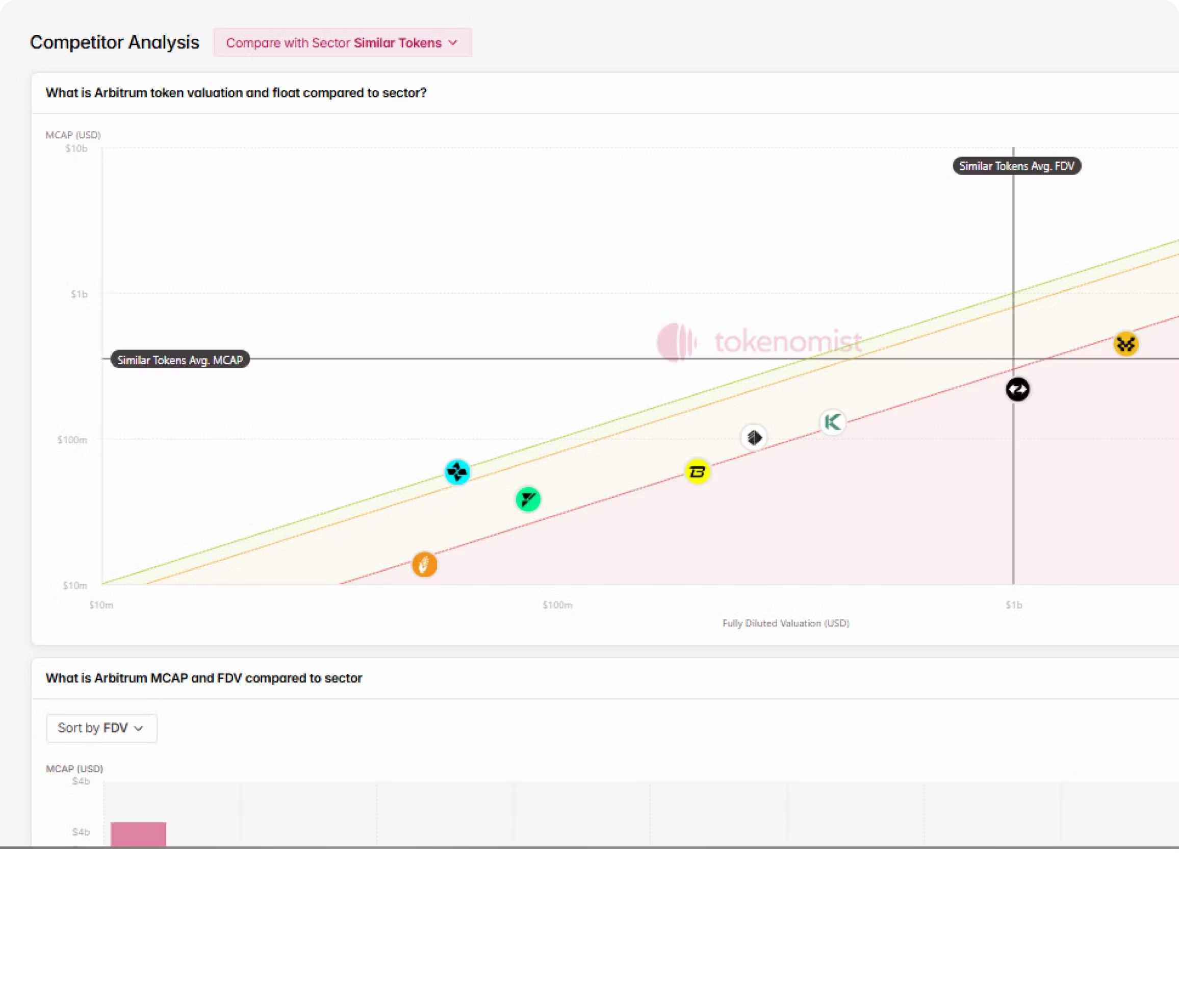
What is Rootstock Infrastructure Framework token valuation and float compared to sector?
Loading...

What is Rootstock Infrastructure Framework MCAP and FDV compared to sector
Sort by
Loading...
Detailed Valuation

Evaluate Tokens Against Competitors
Speed up your research game, get on Pro!
Compare to Sector or Similar Tokens
Low Float, High FDV Analysis
Token Valuation against Competitors
Ready to use Sector Average Metrics
Trending Tokens


Token Information
Last updated
What is the Rootstock Infrastructure Framework token vesting schedule?
Rootstock Infrastructure Framework followed a vesting schedule with allocations to the RIF Labs Promotion, Private Sale, RSK Labs Acquisition and Early Adopters Incentive. Most allocations were released through a cliff mechanism. The unlock schedule ended in 2023.
When is the next Rootstock Infrastructure Framework unlock?
Rootstock Infrastructure Framework has no upcoming cliff unlock scheduled. 2.10% of the supply is still locked and will continue to be released according to the vesting schedule.
How much Rootstock Infrastructure Framework supply is currently unlocked?
As of today, approximately 978,999,999 Rootstock Infrastructure Framework has been unlocked, which is 97.90% of Rootstock Infrastructure Framework’s total supply. Rootstock Infrastructure Framework has no fixed max supply, so float is 97.90% of projected supply in 2035 (excluding burned tokens). The remaining tokens are still locked and will be released according to the vesting schedule.
Is Rootstock Infrastructure Framework vesting cliff or linear?
Rootstock Infrastructure Framework uses cliff vesting, especially for RIF Labs Promotion allocations. This means tokens are released all at once after a set waiting period, creating a delayed but significant supply event.
What is the difference between Rootstock Infrastructure Framework circulating and total supply?
The circulating supply of Rootstock Infrastructure Framework is 1,000,000,000 tokens and the total supply is infinite, so Rootstock Infrastructure Framework has no max supply. Instead, we show the Supply Y2035 of 999,999,999 tokens. This is the projected supply of Rootstock Infrastructure Framework at the end of 2035.
What is Rootstock Infrastructure Framework's FDV (Fully Diluted Valuation)?
Rootstock Infrastructure Framework's FDV is $50,605,488 which reflects the market value if 0 tokens were unlocked in the year 2035. This figure helps estimate long-term dilution risks for Rootstock Infrastructure Framework which has an infinite supply.
How is Rootstock Infrastructure Framework allocated across stakeholders?
The Rootstock Infrastructure Framework allocation includes Early Adopters Incentive at 2.10%, RIF Labs Promotion at 40.00%, Private Sale at 37.90% and RSK Labs Acquisition at 20.00%.
Has Rootstock Infrastructure Framework price dropped after past unlocks?
Historically, Rootstock Infrastructure Framework has shown low volatility 7 days after the past unlock. The price impact depends on who receives the unlocked tokens and market conditions.
How can I track upcoming Rootstock Infrastructure Framework unlocks?
Tokenomist provides an up-to-date vesting chart and unlocks monitor that shows upcoming unlocks for Rootstock Infrastructure Framework, with visibility for each allocation and amount.
Tokenomist Research
Explore moreWhat the Market Does Around a Token Unlock
Across 846 unlocks from 2022 to 2026, the market changed before and after the date more than on it. Ahead of the biggest unlocks, the short side of the futures market paid more often to stay in. In the week after, price momentum faded. Market data through November 2, 2026.

Nov 17, 2026
16 min read

Chawapat Peechapat · Nov 17, 2026
What the Market Does Around a Token Unlock
Weekly Unlock Digest: Nov 16–22, 2026 | LayerZero's $34.69M Cliff Lands Ahead of Zero Mainnet
LayerZero's $34.69M ZRO cliff (5.82% of circulating supply) headlines over $113M in scheduled unlocks, after a week of a 13–14% Bitcoin drop, Predict.fun's TGE restart, Allora's six-month cliff delay and Katana's buyback plan.


Nov 16, 2026
7 min read

ali3nblue · Nov 16, 2026
Weekly Unlock Digest: Nov 16–22, 2026 | LayerZero's $34.69M Cliff Lands Ahead of Zero Mainnet




Tokenomist.ai provides a complete solution for supply-side tokenomics data. Analyze future token emissions, track vesting schedules, and compare standardized tokenomics and allocation across projects to gain actionable insights