Monad Offered Its Early Investors $60M to Leave. Almost Nobody Took It

On August 18, 2026, the Monad Foundation said it had finished a programme offering to buy locked MON from certain early investors at a discount, with up to $60 million set aside. Almost everyone approached declined. That has been read across crypto media as a conviction signal, and it might be one. But the Foundation withheld the discount it offered, and the discount is the only number that separates conviction from arithmetic.
In the two days after the news, MON rose 25%. That does not change the analysis below, and section 8 explains precisely why not, which turns out to be the most useful thing in this piece for anyone holding a locked token anywhere.
Key Takeaways
- MON's only claim on the chain it secures is the base-fee burn, and that burn is tiny. Apps on Monad collected $35.9M in fees since launch; the burn has returned about $1.0M and now runs at roughly $3.1M a year, a 0.96% yield on market cap.
- Locked tokens cannot be staked, so 85% of all MON earns nothing. 50.6B is barred by design and another 34.8B of eligible supply is simply not staked.
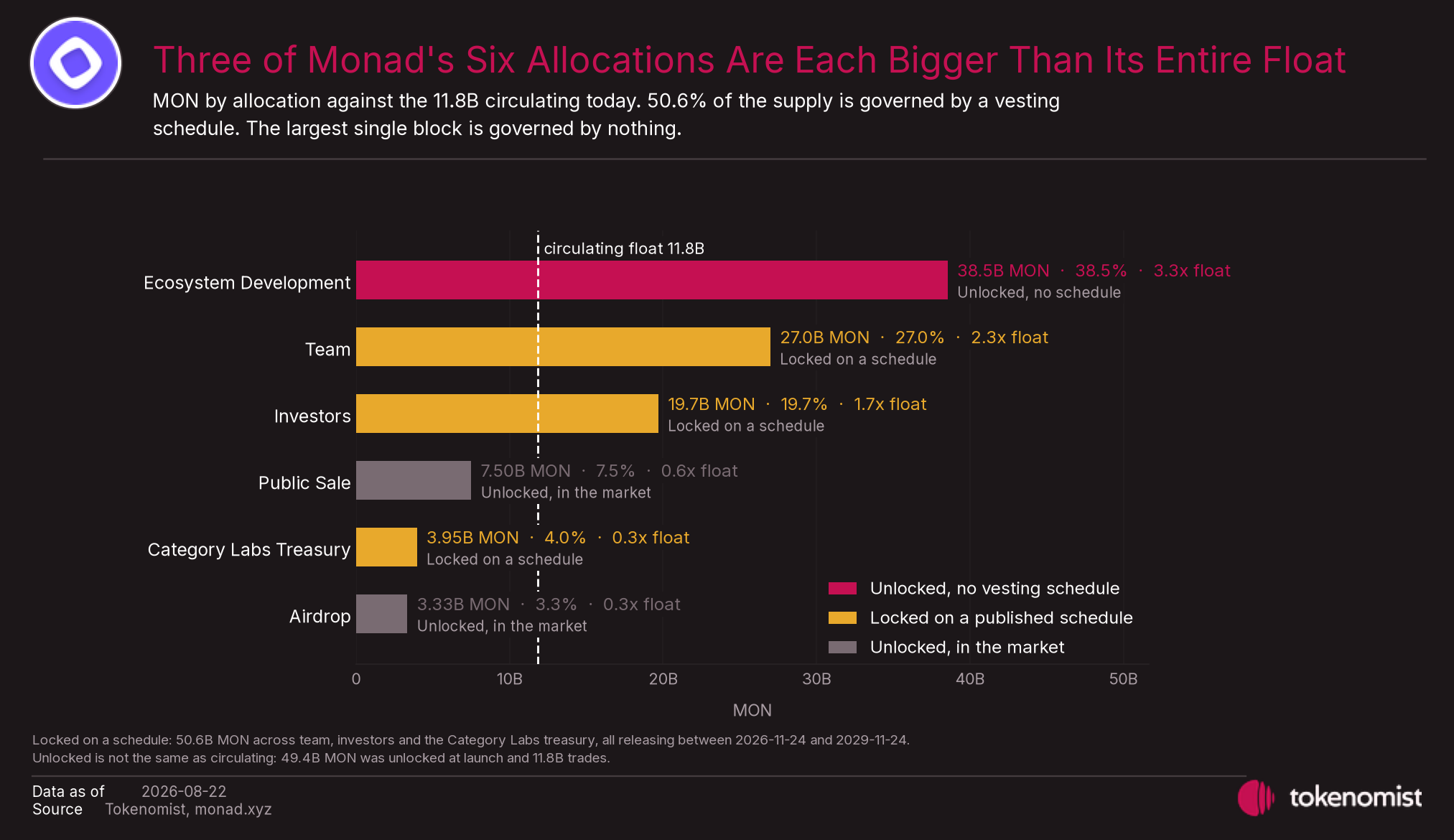
- Three of Monad's six allocations are each larger than its entire circulating float. Ecosystem Development holds 38.5B MON, the team 27B and investors 19.7B, against 11.8B circulating. The largest block, 38.5B, has no vesting schedule at all.
- On November 24, 2026, one day releases 6.66B MON, about $182M. That is 56% of the circulating float and 56% of market cap, followed by 1.24B MON every month until November 2029.
- A fair discount was 17% to 37%, and at 30% off an investor only wins by selling if MON falls another 15.5%. It rose 25% in the two days after the news instead. The offer arrived 98 days before the first unlock, buying the tokens moved no unlock date, and the tranche was too large to hedge.
1. What Monad is, and what MON is for
Monad is a layer-1 blockchain that runs the Ethereum Virtual Machine in parallel rather than one transaction at a time. It was built over roughly three and a half years by Category Labs, with the Monad Foundation as the independent steward of the token, and public mainnet launched on November 24, 2025.
The design targets, from Monad's own documentation: 10,000 transactions per second, 300ms block frequency and 600ms finality, on a proof-of-stake network with a validator set capped at 200, running consumer-grade hardware, 196 of those seats filled today. A validator needs 100,000 MON self-delegated and 10,000,000 MON of total stake to enter that set.
MON itself does three jobs, and it is worth being precise because only one of them returns anything to a passive holder:
- It pays for gas. Every transaction pays a base fee plus an optional priority fee.
- It secures the network. Holders delegate MON to validators through a staking precompile and earn a share of block rewards (Monad staking docs). The tokenomics page puts the block reward at 25 MON, roughly 2 billion MON a year (MON tokenomics overview), though Monad's staking reference says 18; section 2 works with the range.
- It captures value only through the burn. Base fees are burned and priority fees go to the block leader, per the same tokenomics page. Application fees stay with the applications. So the only mechanism that makes MON scarcer on behalf of someone who simply holds it is the base-fee burn.
There is no governance function attached to MON in Monad's published documentation, and no mechanism that routes application revenue to the token.
The supply frame, which the next three sections all build on: 100 billion MON at launch, split almost exactly in half. 49.4B unlocked on day one and 50.6B is locked on a published vesting schedule running to November 2029.
As for what the chain is actually used for, it is working. Total value locked has gone from $52M at launch to $941M, and applications on the chain are collecting fees at about a $75M annual rate. The activity skews heavily toward lending, which matters later.
Where the token stands as of August 22, 2026: $0.0273, a $322.9M circulating market cap against a $2.75B fully diluted valuation, 44.1% below the all-time high of $0.048829 set two days after mainnet, 9.3% above the $0.025 public sale price, and up 28% since the tender was reported. Every dollar figure in this piece is marked at $0.0273.
2. What MON earns from its own chain
Two mechanisms decide what a passive holder gets: whether their tokens can be staked, and what the fee burn returns. Both are worse than they look.
Locked MON cannot be staked, so 85% of the supply earns nothing
Monad committed before mainnet that locked tokens may not be delegated, which is unusual enough to be worth reading in the original:
LOCKED MONAD TOKENS ARE NOT STAKEABLE
— Keone Hon (@keoneHD) November 6, 2025
Monad has been built painstakingly over the past 3.5 years. We take a long term view and aren’t afraid to do things differently from others.
Today, ahead of the launch of the Public Mainnet, I’d like to share an important element of the…
That commitment is genuinely holder-friendly. It also has a second edge.
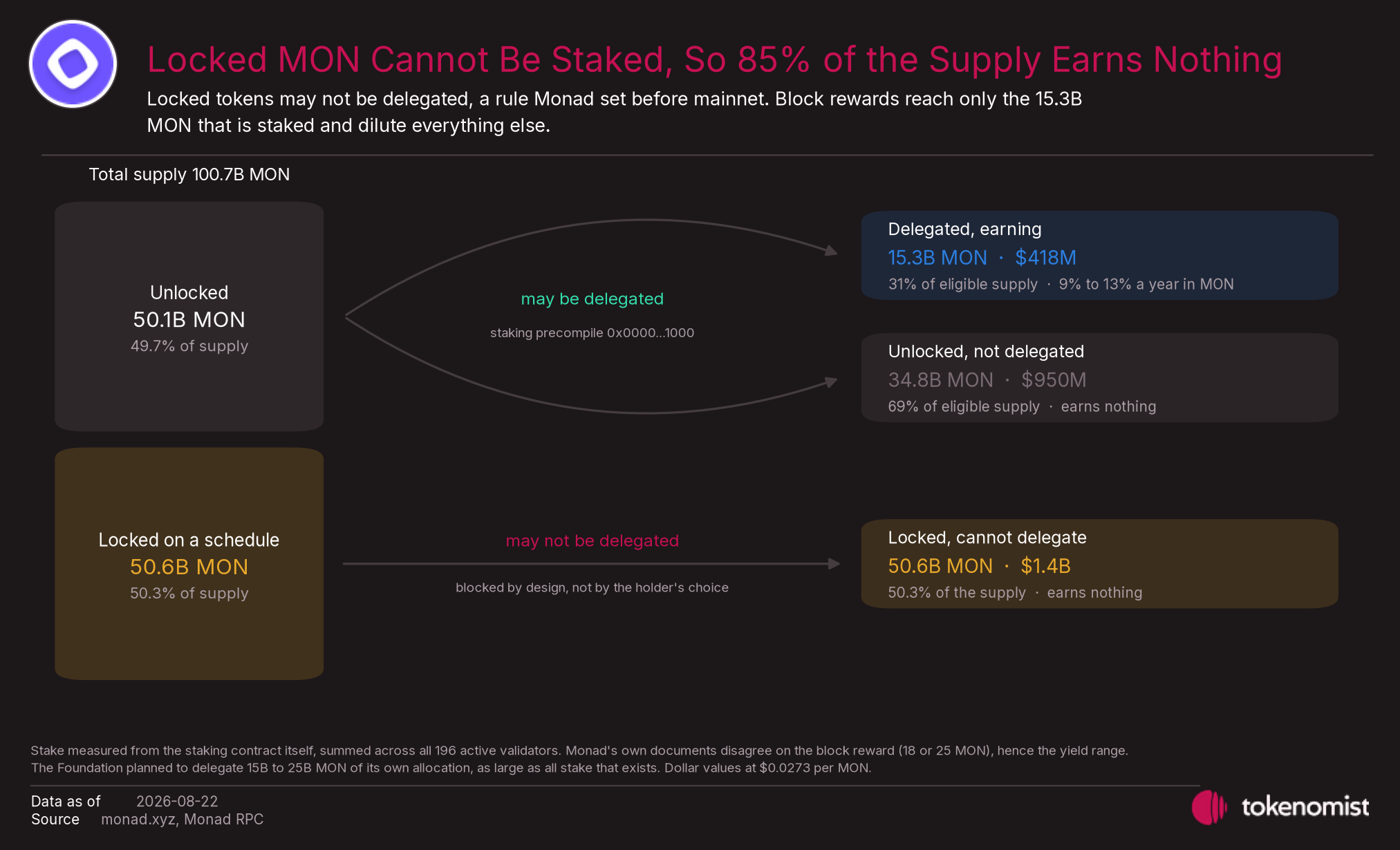
The rule splits the supply three ways. 50.6B MON is locked and barred from staking by design, not by its holders' choice. Of the 50.1B that is eligible, 49.4B unlocked at launch plus roughly 0.7B of block rewards issued since, only 15.3B is actually staked, measured from the staking contract itself across all 196 active validators, and 34.8B is not. Block rewards flow to the validators and delegators of that 15.3B, roughly 9% to 13% a year in MON before commission. Everything else, 85% of the supply, earns nothing and is diluted.
The yield is a range because Monad's own documents disagree: the tokenomics page says the block reward is 25 MON, the staking reference in its docs says 18, which puts issuance between roughly 1.4B and 2B MON a year. Measuring it from the reported total supply is not an option either: that figure reads 100,682,925,000 on both CoinGecko and Nansen and has not moved while blocks were being produced, so it is a periodically published number, not a live one.
And the Foundation planned to delegate 15B to 25B MON of its own ecosystem allocation in the first year (Validator Delegation Program), while all the stake that exists on the network is 15.3B. If it followed through on even the low end of that plan, essentially every staked MON is the Foundation's. Barring locked tokens from staking protects retail from insiders farming yield on tokens they cannot sell. It does not stop the Foundation from earning on the largest unlocked block in existence, while the dilution lands on everyone else.
The burn is small, and it is growing
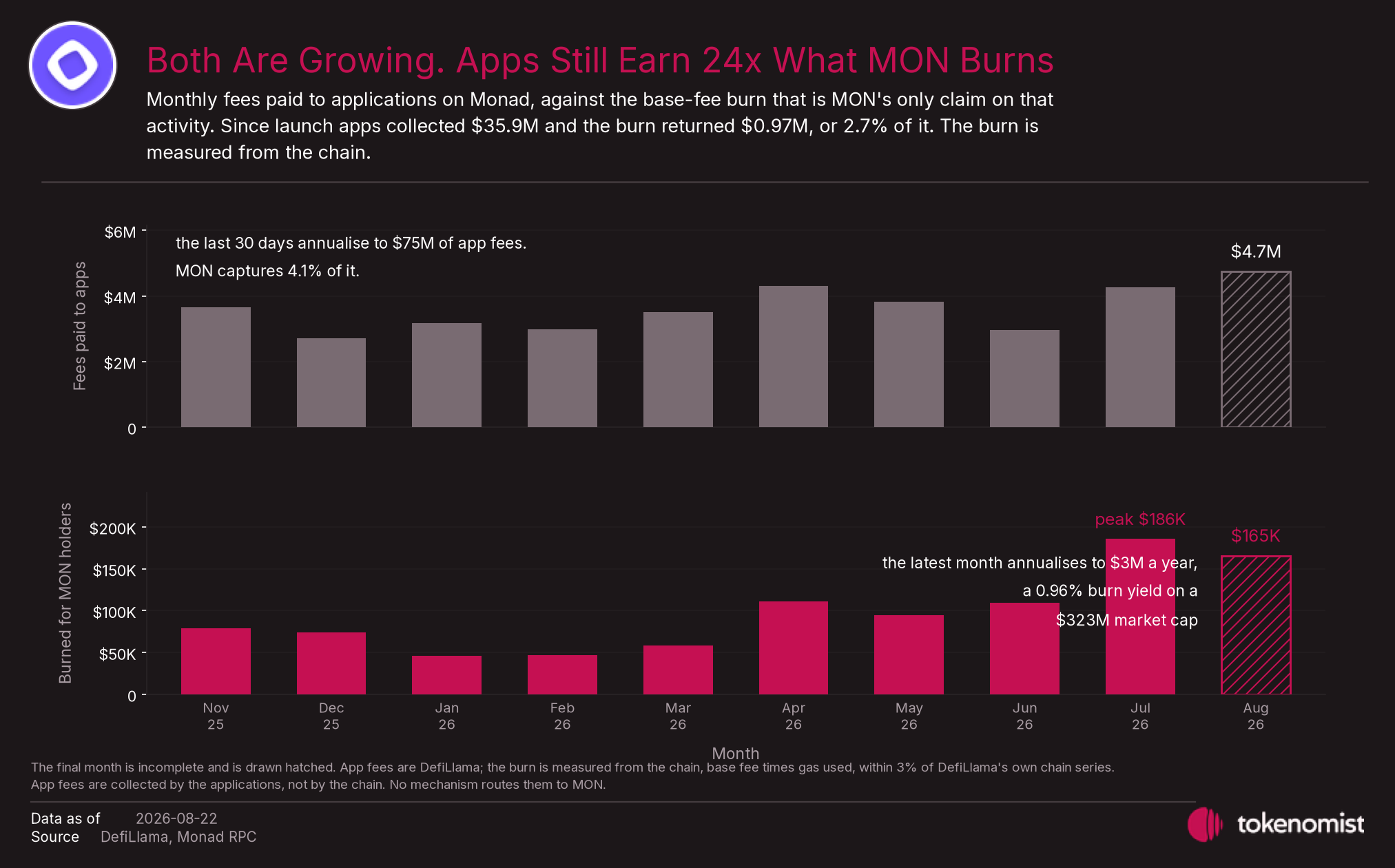
January was the low, not the peak. Gas used per block has risen about 3.6 times since, and the burn with it: the latest month annualises to $3.1M a year. Against a $322.9M market cap that is a 0.96% burn yield. Against the $2.75B fully diluted valuation it is 0.11%.
Meanwhile the chain is busy. Applications on Monad collected $35.9M in fees since launch and the last 30 days annualise to roughly $75M. MON captures about 4% of it.
| Protocol | Category | Fees, 30 days |
|---|---|---|
| Accountable | Uncollateralized lending | $2,615,756 |
| Aave V3 | Lending | $819,375 |
| Morpho Blue | Lending | $464,359 |
| Euler V2 | Lending | $407,482 |
| Perpl | Derivatives | $348,812 |
| Curvance | Lending | $326,028 |
| Hyperithm | Risk curators | $322,716 |
| Monad, the chain itself | Chain | $232,033 |
Two things stand out. Lending is 93% of the top six by fees, and lending deposits are the most yield-sensitive, most mobile capital in crypto, which is one reason TVL can climb while the token does not. And the chain itself, at $232,033 over 30 days, earns less than the seventh-largest application running on it. Most of that $232,033 is the base fee, and the base fee is burned: the chain burned about $204K worth of MON over the same 30 days. Priority fees paid to block producers are the remainder.
Set the burn against issuance and the scale of the problem is clear. Against block rewards of 1.4B to 2B MON a year, the 113M MON now burned annually offsets 6% to 8% of new supply. Gas activity would have to rise 13 to 18 times before MON stopped being inflationary, before doing anything for the price.
3. Who holds MON
Monad's allocation, exactly as the table in its own tokenomics overview gives it:
| Allocation | MON | Share | Status | Multiple of today's float |
|---|---|---|---|---|
| Ecosystem Development | 38,544,142,854 | 38.5% | unlocked at launch, no vesting | 3.3x |
| Team | 26,989,187,887 | 27.0% | locked 1 year, then 3 years of releases, modelled as 36 equal monthly | 2.3x |
| Investors | 19,683,237,451 | 19.7% | locked, 4 years, 1-year cliff, 1/48 monthly | 1.7x |
| Public Sale | 7,500,000,000 | 7.5% | unlocked at launch | 0.6x |
| Category Labs Treasury | 3,952,848,412 | 4.0% | locked, same terms as investors | 0.3x |
| Airdrop | 3,330,583,396 | 3.3% | unlocked at launch | 0.3x |
The token counts sum to exactly 100,000,000,000. The percentages are Monad's own rounding, which is why the treasury's 3,952,848,412 displays as 4.0%.
Three of those six blocks are individually larger than everything trading today.
The distinction that matters is not locked versus unlocked. It is scheduled versus unscheduled. 50.6B MON is locked on a published calendar with dates anyone can price. Of the 49.4B that unlocked at launch, the 7.5B public sale and 3.3B airdrop went to the market. The 38.5B ecosystem allocation did not: it sits with the Foundation, unlocked, with no vesting schedule and no release dates. At $1.05B that single block is 3.3 times the entire float, and it will never appear on an unlock calendar.
Unlocked is not the same as circulating. 49.4B MON was unlocked at launch and 11.8B trades.
On chain, the two largest balances are effectively Monad's own. The biggest, 15.8B MON, sits in the staking contract rather than anyone's wallet (Monad developer docs), 15.3B of it stake active in consensus, and the second, 17.1B MON, is unlabelled but consistent with a Foundation wallet. Together they are roughly 2.8 times the circulating float, across 107,442 holders in total.
4. The release schedule and the November cliff
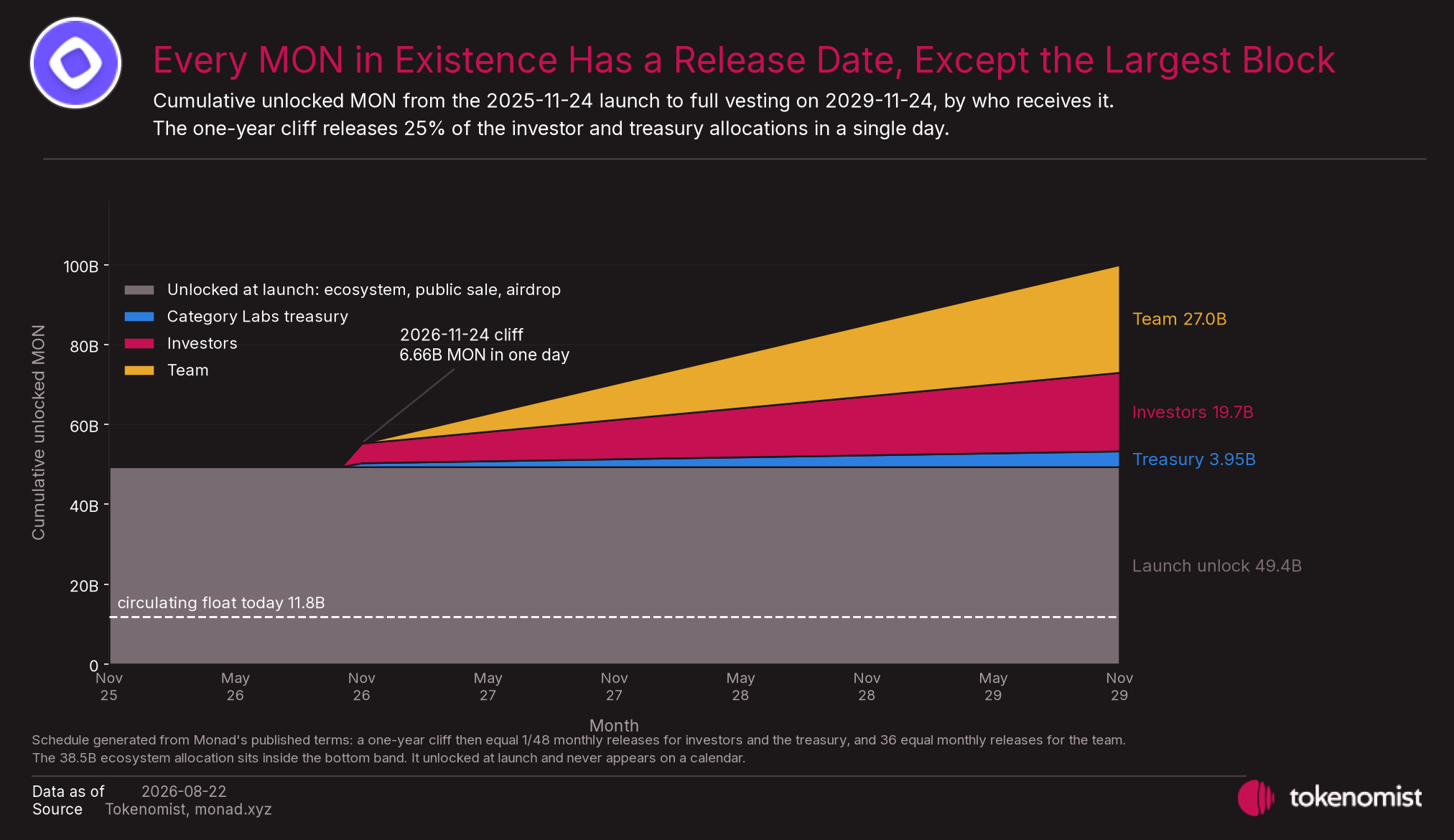
Investors and the Category Labs treasury are on a four-year lock with a one-year cliff and equal 1/48 monthly releases after it, which means the cliff releases 12/48, or 25% of each allocation, in a single day. The team is locked for one year, then releases over the following three years. Monad publishes no tranche shape for that block, and says individual schedules are typically tied to each member's start date, so this piece models it as 36 equal monthly tranches.
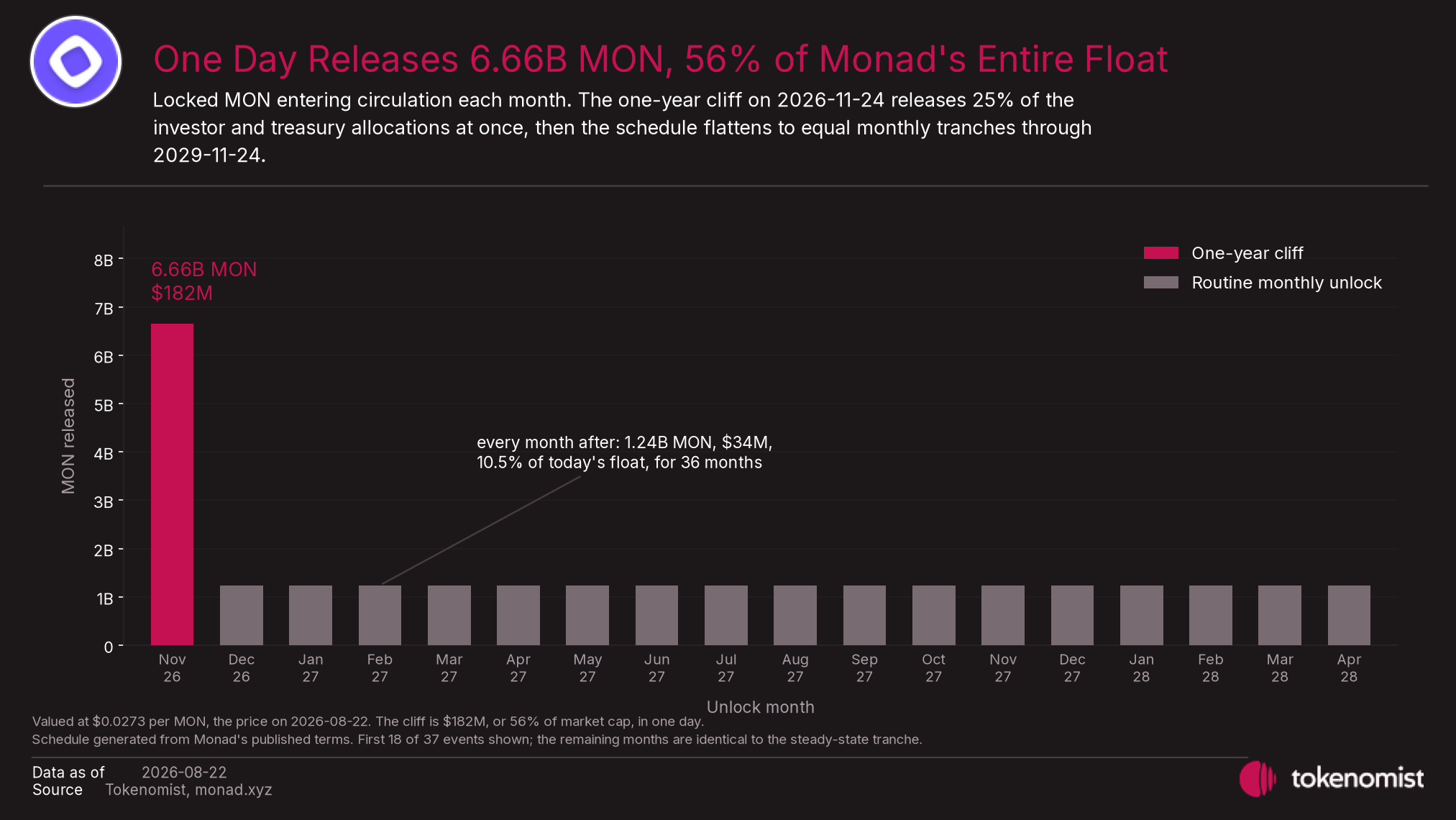
November 24, 2026. Investors 4.92B, team 750M, Category Labs treasury 988M. Total 6.66B MON, about $182M. That is 56% of the circulating float and 56% of market cap in one day, or 6.8 days of trading at the 30-day average.
Every month after, to November 2029. 1.242B MON, about $34M, which is 10.5% of today's float per month.
| Twelve months from the cliff | MON released | Value at spot | Versus today's market cap |
|---|---|---|---|
| Year 1 | 20.32B | $555M | 172% |
| Year 2 | 14.91B | $407M | 126% |
| Year 3 | 14.91B | $407M | 126% |
| Year 4 tail | 0.49B | $13M | 4% |
Unlocked is not sold, and much of the cliff belongs to a team and to funds that have just declined to sell at a discount. But the schedule sets the ceiling on how much can be sold, and for three years that ceiling exceeds the entire market capitalisation annually.
5. The tender: what Monad disclosed, and what it did not
That is the machine the tender landed in. Everything known about the tender comes from one place: the Monad Foundation's statements to CoinDesk, published August 18. Monad has never posted about the programme on its own channels, and every other outlet traces back to that one story or to an unlinked screenshot.
To CoinDesk, the Foundation confirmed four things: the programme is complete, the cap was $60 million, it targeted certain early investors holding locked MON, and any tokens it bought remain locked on the original schedule. Its stated purpose was to give investors whose circumstances had changed a way out. Almost all of those approached said no.
It did not disclose the price offered, how much of the $60 million was spent, or how many investors participated.
The tender facts are single-sourced to that one CoinDesk story and weighted accordingly. Everything else in this piece, the supply, the schedule, the holders and the fees, is measured from primary data.
One clarification, because the coverage blurs two different programmes. This is the Monad Foundation buying locked MON privately from investors, capped at $60 million. It is not the separate Category Labs programme to buy liquid MON on the open market, capped at $30 million and described as discretionary with no guaranteed quantity. The first changes who holds locked supply. The second removes float.
6. What the investors were actually choosing between
Nothing in this section comes from an analyst or an outlet. It is calculated here, from three inputs anyone can check: Monad's published vesting terms, MON's own price history, and the open interest quoted across derivatives venues. The methods are not ours either: charging for a wait is ordinary discounting, and the option method below is the Chaffe model that valuation practice has used to price locked stock for three decades. Where an input is a judgment call, the tables show the answer at several settings instead of one, so what follows is a range to argue with, not a point to take on trust. The formulas are in the methodology.
The fair discount was 17% to 37%
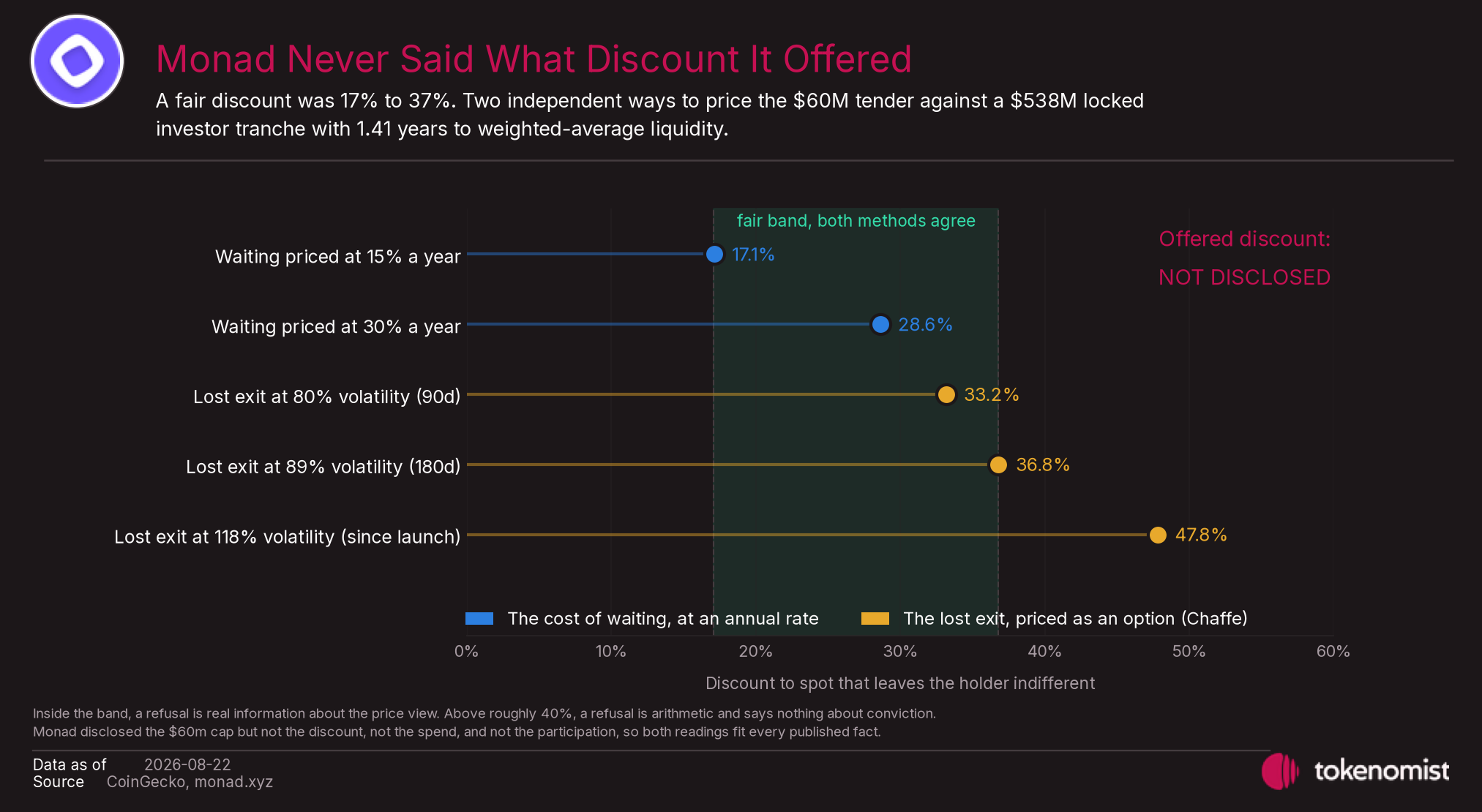
A locked token is worth less than a liquid one, and the gap is calculable. Two ways to calculate it, built on different logic, and they land in the same place.
Method one: charge for the wait. Locked tokens are money you cannot touch yet, and money you get later is worth less than money in hand today. How much less depends on one choice: what a year of waiting costs you. Charge 15% a year, a patient fund's rate, and the locked package that would fetch $538M if it were sellable now is worth about $446M today, which is 17% less. Charge 30% a year, a venture fund's rate, and it is worth $384M, 29% less. That percentage is the fair discount: the price cut that exactly pays the buyer for taking over the wait.
| What a year of waiting costs you | What the locked $538M package is worth today | Fair discount |
|---|---|---|
| 0% per year | $538M | 0% |
| 15% per year | $446M | 17.1% |
| 30% per year | $384M | 28.6% |
Method two: price what the lock takes away. A lock takes away exactly one thing: the ability to sell at today's price. Insurance that guaranteed today's price until the tokens free up would cost money, and what that insurance costs is the discount. Its price depends on how wildly MON moves, and MON moves a lot: 81% annualised volatility over the last 90 days, 90% over 180. Priced on those (the Chaffe method; the formula is in the methodology):
| MON's volatility | Fair discount |
|---|---|
| 81%, last 90 days | 33% |
| 90%, last 180 days | 37% |
| 119%, since launch | 48% |
Two methods arriving in the same neighbourhood is what makes the band credible rather than convenient. Below roughly 17% the Foundation overpays for illiquidity. Above roughly 40% no holder who can run the numbers transacts.
Sell now, or hold and sell at the unlock
That band is the answer to a question most readers would rather see asked directly: is the cash better than the tokens? Same maths, drawn as the choice itself.
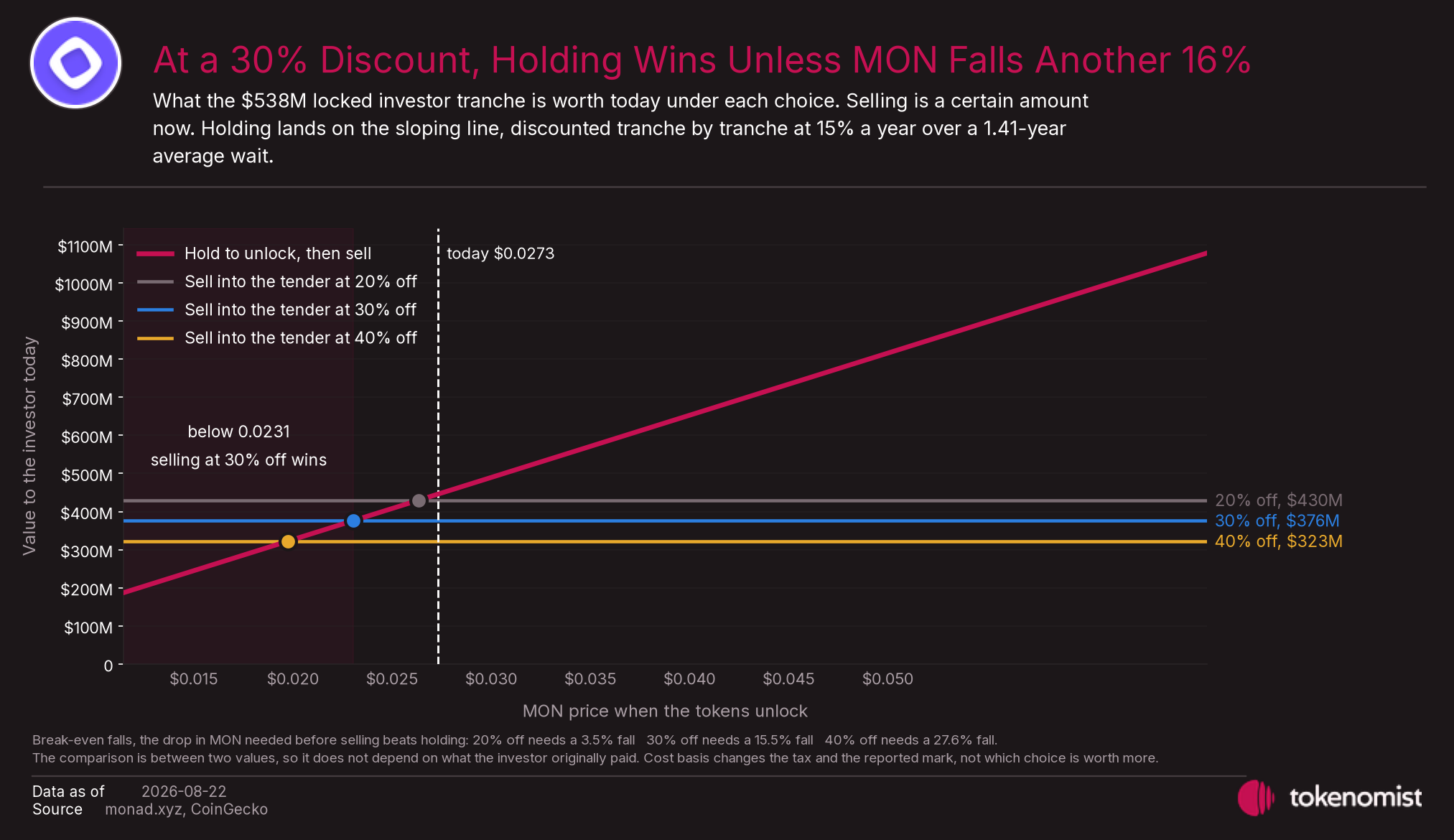
Selling is a certain amount now, $376M at 30% off. Holding is worth whatever 19.7B MON fetches when it unlocks, with the same 15% a year waiting charge from above applied. The chart marks where each pair crosses, and the crossing is the only number that matters: how far MON has to fall before the cash wins.
| Discount offered | MON must fall by more than this before selling wins |
|---|---|
| 20% | 3.5% |
| 30% | 15.5% |
| 40% | 27.6% |
| 50% | 39.7% |
So at a 30% discount an investor who thinks MON simply goes sideways is better off holding, and only someone who expects a further 15% decline should take the cash. At 50% off, they would need to expect MON to lose another 40%.
One thing this comparison deliberately does not include is what the investor paid. It weighs one value against another, so cost basis never enters it. Seed and Series A holders faced exactly the same table. That matters for section 7.
The clock had almost run out
The programme landed 98 days before the cliff, and the cliff hands each investor a quarter of their tokens.
Selling early at a discount is just paying to skip a wait. Take the tokens that unlock in November: sell a dollar's worth today at 30% off and you get 70 cents, instead of the full dollar 98 days later. Handing over 30 cents to be paid three months sooner is, restated as an interest rate, borrowing at 278% a year. Nobody with any other option borrows at 278%.
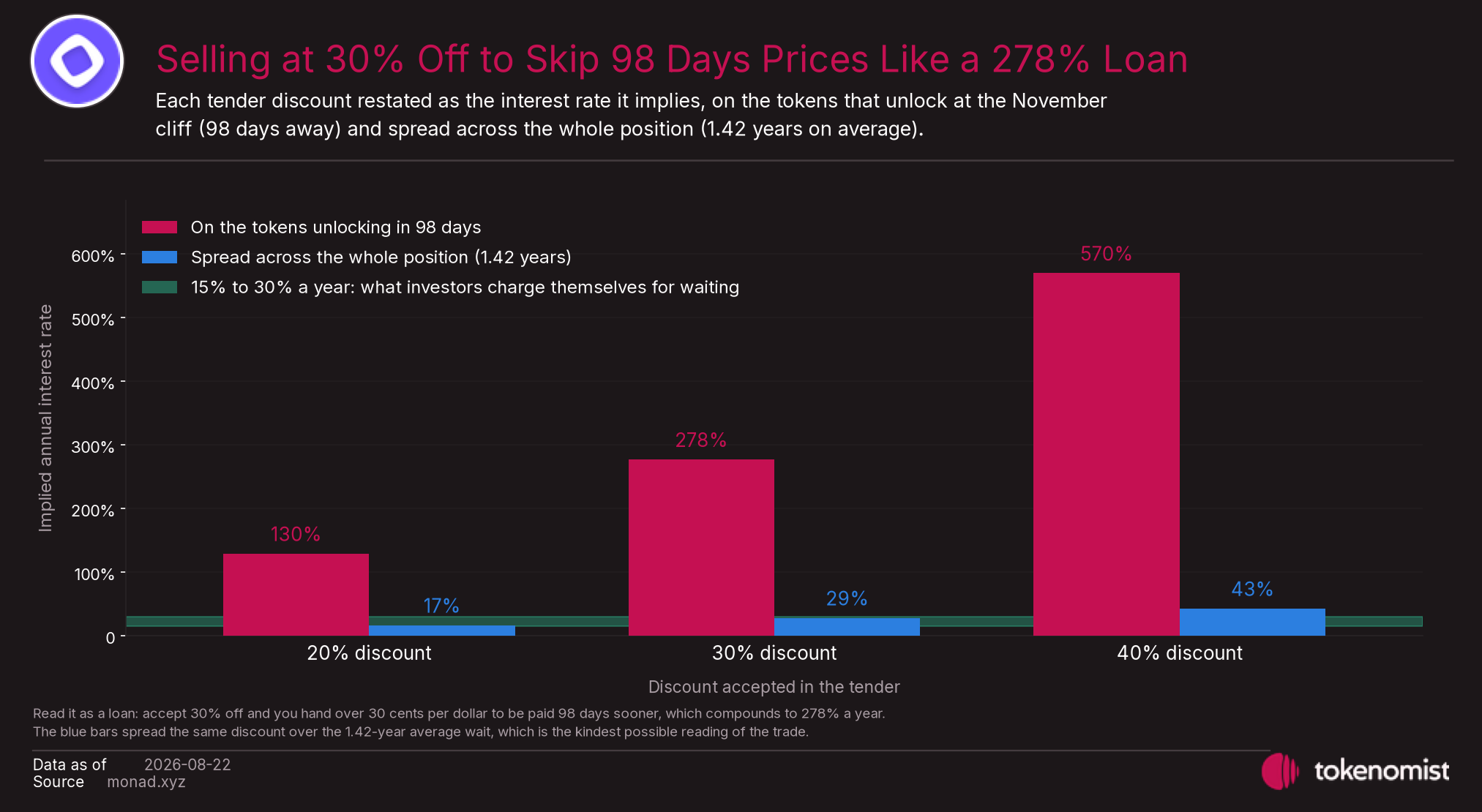
In dollars: the investor tokens unlocking at the cliff are 4.92B MON, worth about $134M today. Selling that slice at 30% off means handing back about $40M in exchange for being paid roughly three months sooner.
The tender priced the whole position at one discount, and spread over the full 1.42-year average wait the same 30% works out to a far more reasonable 29% a year. But an investor does not have to average: they can see that a quarter of what they are selling is almost free already, and that quarter alone makes the whole package expensive.
There is a structural point underneath. The marketability discount on a locked position decays as the unlock approaches, and it decays fastest at the very end. If the goal was take-up, the Foundation chose close to the worst possible moment. The same offer in February 2026, when MON hit its all-time low of $0.0164 and ten months of lock remained, would very likely have found more sellers. Which raises a question the published facts cannot settle: was the objective to buy tokens, or to be able to say the offer had been made and refused?
And they could not hedge instead
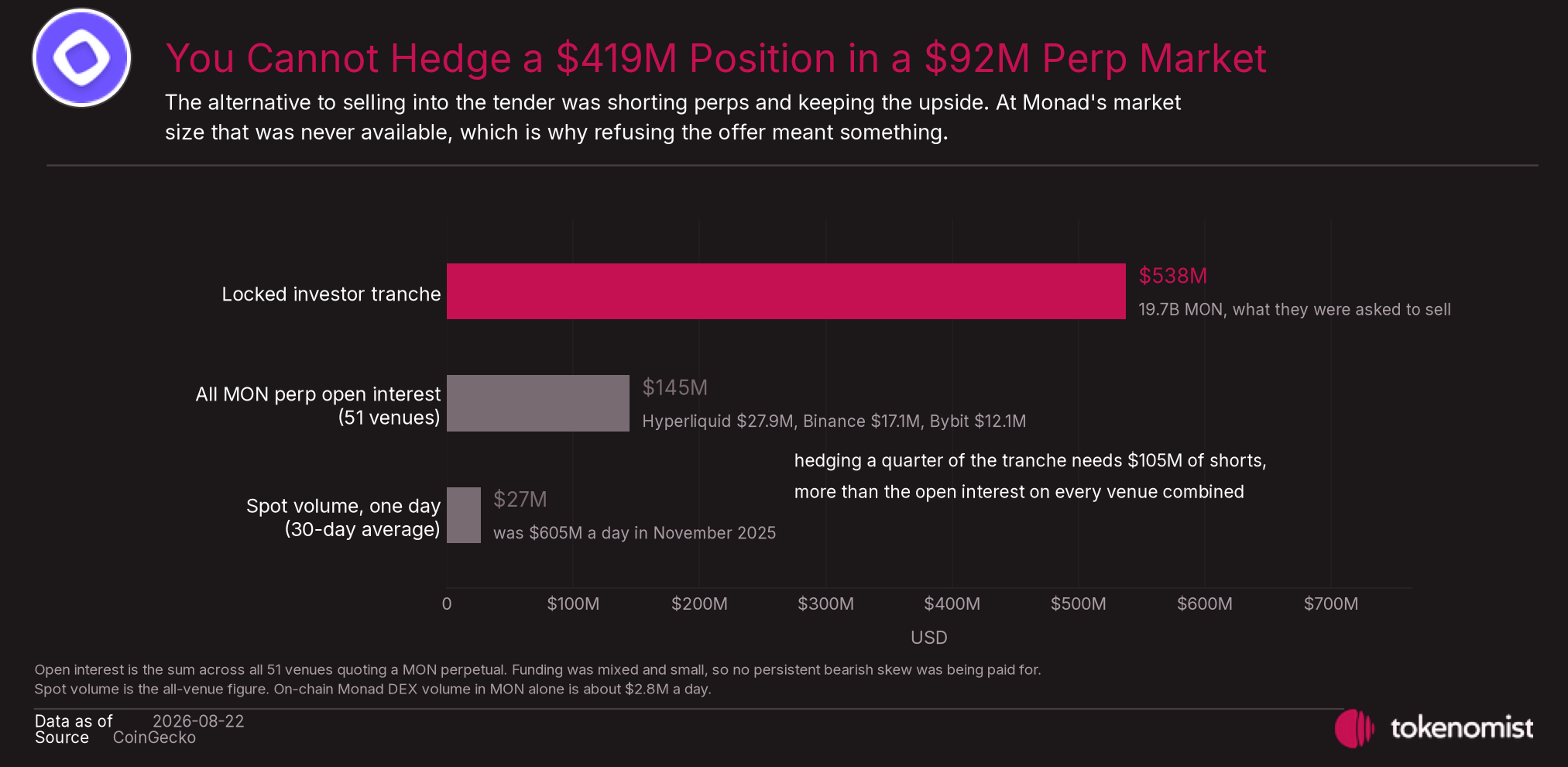
The standard alternative to selling into a tender is to keep the locked tokens and short perpetuals, capping the downside while keeping the upside. At Monad's market size, that was not available.
Total MON perpetual open interest is $145M across 51 venues: Hyperliquid $37.4M, Binance $27.1M, Bybit $19.9M, and a long tail. Spot volume averages $27M a day over 30 days, down from $605M a day in the launch month.
| Share of tranche hedged | Shorts required | As a share of all existing open interest |
|---|---|---|
| 10% | $54M | 37% |
| 25% | $134M | 93% |
| 50% | $269M | 186% |
Hedging a quarter of the position means opening almost as much short interest as exists across every venue combined. You become the market, funding moves against you, and you push the price down as you build the position you are trying to protect.
There is a worse problem than size. Locked tokens cannot be posted as collateral, so the hedge has to be margined with fresh cash. If MON rallies, the short takes margin calls while the asset it hedges still cannot be sold to meet them. A hedge you cannot fund by liquidating the hedged asset is not a hedge. Anyone who had shorted into the two-day 25% rally would have found that out.
Two things follow. The tender genuinely was the only exit available at scale, and they still declined it, which is the strongest single argument for the conviction reading. And with open interest at $145M against a $182M cliff, the derivatives market is still not positioned for November.
7. Why the refusal means less than it looks
Buying the tokens changed no unlock date
$60 million is 11.2% of the $538M investor tranche at par. Even fully subscribed, the arithmetic barely moves.
| Offered discount | MON $60M buys | Share of tranche retired | Still held by investors |
|---|---|---|---|
| 20% | 2.75B | 14.0% | 86% |
| 30% | 3.14B | 15.9% | 84% |
| 40% | 3.66B | 18.6% | 81% |
The mechanism matters more than the size. A tender normally works on a prisoner's dilemma: if you hold while everyone else sells, you are left with the least liquid claim, so you sell first. Here the repurchased tokens stay locked on the original schedule, not one unlock date moves, and a holder who declines is in exactly the same position as before. All that changes is whether a fund or the Foundation owns the locked claim, and the Foundation is free to sell at vesting just as a fund is.
Two cohorts, one answer, opposite reasons
Monad's cap table spans a $19M seed led by Dragonfly Capital in February 2023, a $225M Series A led by Paradigm at a $3.0B valuation in April 2024, a strategic investment from OKX Ventures of undisclosed size the following month, and a $0.025 public sale in November 2025 that drew $269M of commitments for the $188M allocated.
Monad Labs is excited to announce a $225M fundraise, led by @paradigm pic.twitter.com/cRchQd506k
— Monad (@monad) April 9, 2024
The MON token sale on Coinbase is complete
— Monad (@monad) November 23, 2025
$269M committed by 85,820 participants
Next up: Mainnet launch on Monday
Series A holders are still underwater against their round's mark: today's $2.75B fully diluted valuation is 8.4% below the $3.0B valuation, an equity number whose token terms were never disclosed, so the comparison is indicative rather than exact. Seed holders are far ahead on any reasonable allocation assumption. And as section 6 showed, the sell-versus-hold table was identical for both, because what an investor originally paid never enters it. So the split in motives is accounting, not economics:
- For the Series A fund, selling converts a soft mark into a realised loss, and sets a reference price that makes the rest of the position harder to carry.
- For the seed fund, the discount hands banked gains to the Foundation for the sake of 98 days.
Two flavours of not wanting to transact, not one shared thesis about Monad, which is why a near-universal refusal is weaker evidence of conviction than the headlines suggest. One honest limit: the private rounds' per-token cost basis is not public. The cohort split holds either way.
8. What would move MON up, and what the rally already shows
Five candidate sources of demand, in rough order of how much work each could do:
- The Category Labs open-market buyback. Up to $30M, about 9% of the float, and external capital rather than recycled fees. The largest identified source, but discretionary, unconfirmed on timing and size, and so far sourced only through aggregators.
- Gas demand scaling into the burn. The designed mechanism, and it needs a 13x to 18x rise in burn just to cancel issuance. The design fights itself here: cheap transactions are the pitch, and cheap transactions are why the burn is small.
- Routing app fees to the token. About $75M a year flows to applications and about 1% reaches MON. Any mechanism that changed that would outrun gas growth immediately. None exists today.
- Staking absorbing float. Only 15.3B MON is staked, about what the Foundation alone planned to delegate. Plenty of room to grow mechanically, but rewards are paid in MON and most of the flow is likely the Foundation's own.
- The valuation gap closing. TVL has gone from $52M to $941M, so the chain secures 2.9 times its token's market cap. This is the holders' argument, and the rally already closed part of it: the ratio was 3.6 before the move.
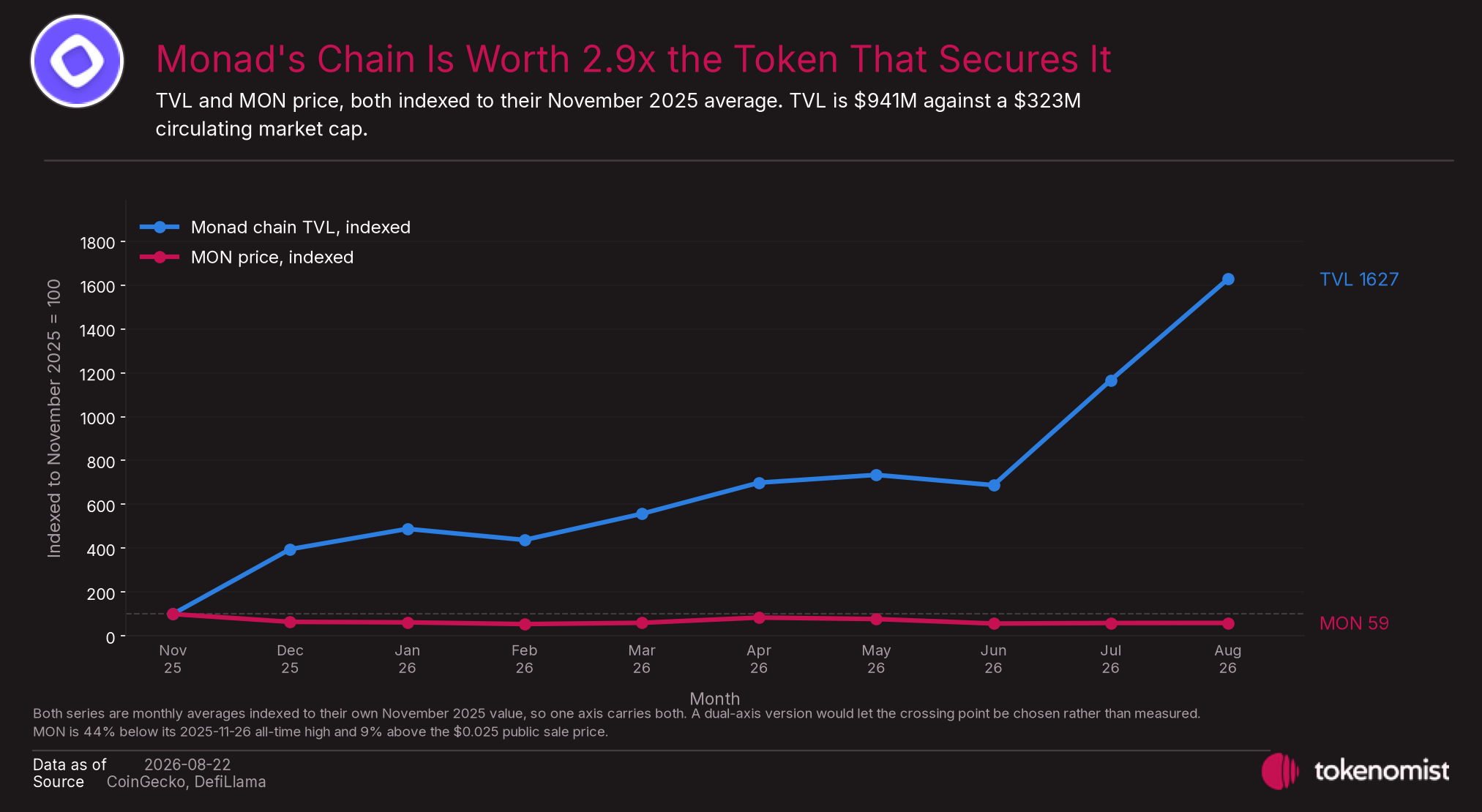
MON's 25% jump in the two days after the tender is a live test of exactly these paths, and of what in this piece depends on the price at all.
Almost nothing does. The cliff and the market cap are both denominated in MON, so the cliff is 56% of market cap at $0.0213 and 56% at $0.0273, and year one is 172% either way. A rally never shrinks the overhang in relative terms; it only grows the dollar figure, $142M then, $182M now. What a rally does change is the market's capacity to absorb it. MON traded $605M a day in its launch month, $27M a day over the last 30 days, and $88M in the last 24 hours. Against those, the cliff is 6.8 days of volume at the 30-day average, 2.1 days at the rally's pace, and a third of a day at launch-month volume. That is the entire bull case on the supply question: not that less supply arrives, but that a deeper market can take it. The burn improves with activity too, which is why it has tripled since January, but it is still an order of magnitude short of cancelling issuance.
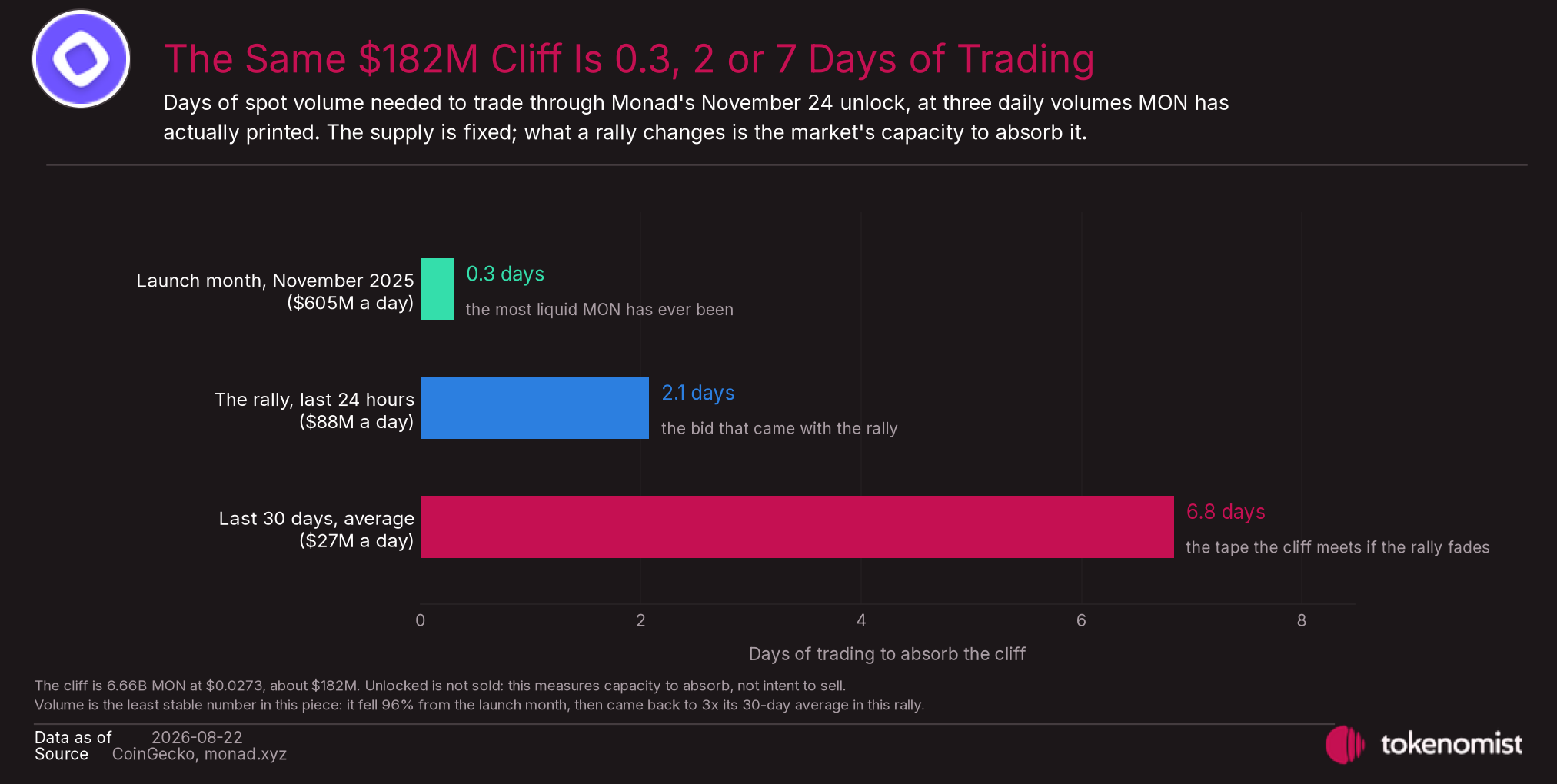
The refusers already look right. Selling at 30% off the August 18 price returned about $0.0149 per MON, which is 45% below today's mark, and the break-even from section 6 asked for a 15.5% fall that never came. The uncomfortable half: the same rally grows the dollar overhang and hands every locked holder a better exit than they had a week ago, 98 days before 6.66B MON becomes sellable. A bull run does not make the unlock stop mattering; it makes it stop mattering only while turnover stays high, and turnover is the least reliable number in this piece. It has already fallen 96% from the launch month once.
9. Conclusion
Monad offered its early investors the only liquidity door available to them at scale, three months before that door was going to open anyway, at a price it has not disclosed, for tokens that would have stayed locked either way. Almost nobody walked through it, and two days later the token was up 25%.
Every one of those clauses reduces the informational content of the refusal. A near-complete lockup makes waiting cheap. A schedule that does not change removes the fear of being last. And the sell-versus-hold arithmetic says that at any discount of 30% or more, holding wins for anyone who does not expect MON to fall further, which is most people who own a token voluntarily.
What survives is narrower but real: these holders could not hedge, could not sell, and turned down cash anyway. If the discount was inside 17% to 37%, that is a genuine statement about where they think MON trades in 2027. If it was 50%, it is a statement about nothing at all.
Monad can settle that with one number. The rest is already on the calendar: 6.66B MON on November 24, 50.6B locked on a published schedule behind it, 38.5B that was never on a schedule at all, and a token whose only claim on a $75M-a-year fee base currently returns $3.1M.
Frequently Asked Questions
What is Monad, and what is MON used for?
Monad is a layer-1 blockchain that executes the Ethereum Virtual Machine in parallel, targeting 10,000 transactions per second with 300ms blocks and 600ms finality. Public mainnet launched November 24, 2025. MON pays gas, secures the network through delegated staking to a validator set capped at 200, and accrues value to holders only through the burning of base transaction fees.
What did the Monad Foundation actually offer?
To buy locked MON from certain early investors at a discount to the market price, with up to $60 million allocated. The programme is complete. Tokens it bought stay locked on the original four-year vesting schedule. The discount, the amount spent and the number of participants were not disclosed.
Does the buyback reduce the amount of MON that will unlock?
No. The Foundation confirmed repurchased tokens remain locked on the original schedule. The unlock calendar is unchanged. Only the identity of the holder changes.
Was selling into the tender a good deal?
Not so far. At 20% off, MON only had to fall 3.5% before selling beat holding. At 30% off it had to fall 15.5%, and at 40% off, 27.6%. MON instead rose 28% between the report and August 22, so a seller at a 30% discount has given up about 45% of the current mark.
Does a rally reduce Monad's unlock risk?
Not in relative terms. The cliff is 56% of market cap at any price, because the unlock and the market cap are both denominated in MON. What a rally changes is liquidity: at the 30-day average volume the cliff is 6.8 days of trading, and at the last 24 hours it is 2.1 days.
Can locked MON be staked?
No. Monad committed before mainnet that locked tokens may not be delegated. That means 50.6B MON is barred from staking by design, and with 34.8B of eligible supply also unstaked, about 85% of all MON earns no block rewards.
Who holds the most MON?
By allocation, Ecosystem Development at 38.5B, the team at 27B and investors at 19.7B. On chain, the largest single balance is the staking contract, holding 15.8B MON, of which 15.3B is stake active in consensus, rather than any investor's wallet.
When do Monad investor tokens start unlocking?
November 24, 2026, one year after mainnet launch. That date releases 25% of the investor and Category Labs treasury allocations at once, roughly 6.66B MON including the team's monthly tranche, then equal monthly releases run to November 24, 2029.
How does MON capture value from the Monad chain?
Through the base-fee burn only. Priority fees go to block producers and application fees go to the applications. Measured from the chain, the burn has returned about $1.0M since launch against $35.9M of application fees, and now runs at roughly $3.1M a year, a 0.96% yield on the circulating market cap.
Methodology
Data. Chain design figures, staking rules and vesting terms are Monad's own documentation and tokenomics page. Allocation token counts are the exact figures from the table in that overview, and they sum to exactly 100,000,000,000. Price, volume, volatility and the open interest summed across all 51 venues quoting a MON perpetual are CoinGecko; TVL and application fees are DefiLlama; the base-fee burn is measured from the chain, base fee times gas used, and cross-checked against DefiLlama's chain-level series; holder balances are Nansen, cross-checked against the chain, and the staked total is read from the staking contract's own view functions over Monad RPC. Everything is as of August 22, 2026, dollar values are marked at $0.0273 per MON, and run rates annualise the trailing 30 days.
Calculations. The unlock schedule is generated from Monad's published terms and exact allocation counts, a 25% cliff at one year then equal 1/48 monthly releases to year four, so it runs to the schedule's true end on November 24, 2029. The team block is modelled as 36 equal monthly tranches from the first anniversary; Monad states only that it releases over the three years that follow. Present values discount each tranche at the stated annual rate assuming a flat price. The waiting cost compounds each discount over the wait it buys out: (1/(1-d)) raised to 365/w, minus one. The option method is a Chaffe at-the-money put over the 1.41-year average wait, at the stated volatility and a 4% risk-free rate. Sell-versus-hold compares the tender proceeds today against the tranche sold at the scenario price, discounted the same way.
Limits. Monad's documents disagree on the block reward, 25 MON on the tokenomics page against 18 in the staking reference, so issuance and staking yield are given as ranges; the reported total supply is not a live figure and cannot settle it. DefiLlama's headline Monad fee number is application fees, not the chain's take, and the two are kept separate here. Nansen double-counts delegated native balances and reports cumulative inflows for the staking contract itself, so its figure for that address is not used; no cumulative concentration is quoted and no wallet is attributed to a named fund or exchange. The private rounds' per-token cost basis has never been published, so none is given.
Updated
August 24, 2026. The burn figures in this piece are now measured directly from the chain, base fee times gas used, sampled across every month since mainnet. They previously came from a third-party fee index which, on inspection, tracks revenue accruing to the applications deployed on Monad rather than MON being burned by the chain.
The corrected figures: the burn has returned about 40 million MON since launch, roughly $1.0M, and runs at about 113 million MON a year, roughly $3.1M at the $0.0273 mark used throughout, a 0.96% yield on the circulating market cap. January was the low, not the peak. Section 2 has been updated throughout, including its heading. The measurement agrees with DefiLlama's chain-level series to within 3%.
Sources
Monad's own material
- MON tokenomics overview, including the allocation table this piece takes its exact token counts from
- Monad documentation: performance targets, staking overview, staking precompile, Validator Delegation Program
- Keone Hon, November 7, 2025: locked Monad tokens are not stakeable
- Monad, April 9, 2024: $225M fundraise led by Paradigm
- Monad, November 23, 2025: MON token sale complete, $269M committed by 85,820 participants
Reporting and data
- CoinDesk, August 18, 2026: Monad offered early investors up to $60 million to cash out, the single source for every tender fact here
- Monad Labs press release, February 14, 2023: $19M seed led by Dragonfly Capital
- OKX Ventures, May 2024: strategic investment in Monad Labs
- Market, unlock and chain data: Tokenomist and DefiLlama
Recommend Article