Why Your Project Needs a Market Maker

Your project is launching a token. Users need to buy it, and holders need to sell when they choose. An exchange listing gives them a place to trade, but not a guarantee that buyers and sellers are waiting. A market maker can fill that gap by keeping buy and sell orders available.
Key Takeaways
- Make your token easier to trade. A market maker can help people buy and sell by keeping orders available.
- Understand what your project provides. Read the inventory terms separately from the fee or option that pays the firm.
- Check the work after signing. Agree on measurable targets and a way to see whether the firm meets them.
Your token needs a market people can use
Picture the day your token is listed and its market opens. Users try to buy it, and early holders try to sell.
But there may still be few orders available. Someone trying to buy could struggle to find enough tokens at the price they expected. Someone trying to sell could have to accept lower prices to complete the trade. Buyers and sellers do not always arrive at the same time or want the same amount.
For your project, that makes the token harder to buy and harder to sell.
Your project therefore needs enough buying and selling interest in the market. This matters most when trading first opens or when you add an exchange, where your token's market is still forming.
A market maker can supply those orders. It keeps cash ready to buy from sellers and tokens ready to sell to buyers. If existing liquidity already meets your needs, you may not need one. Hire a firm to fill a trading gap you can identify.
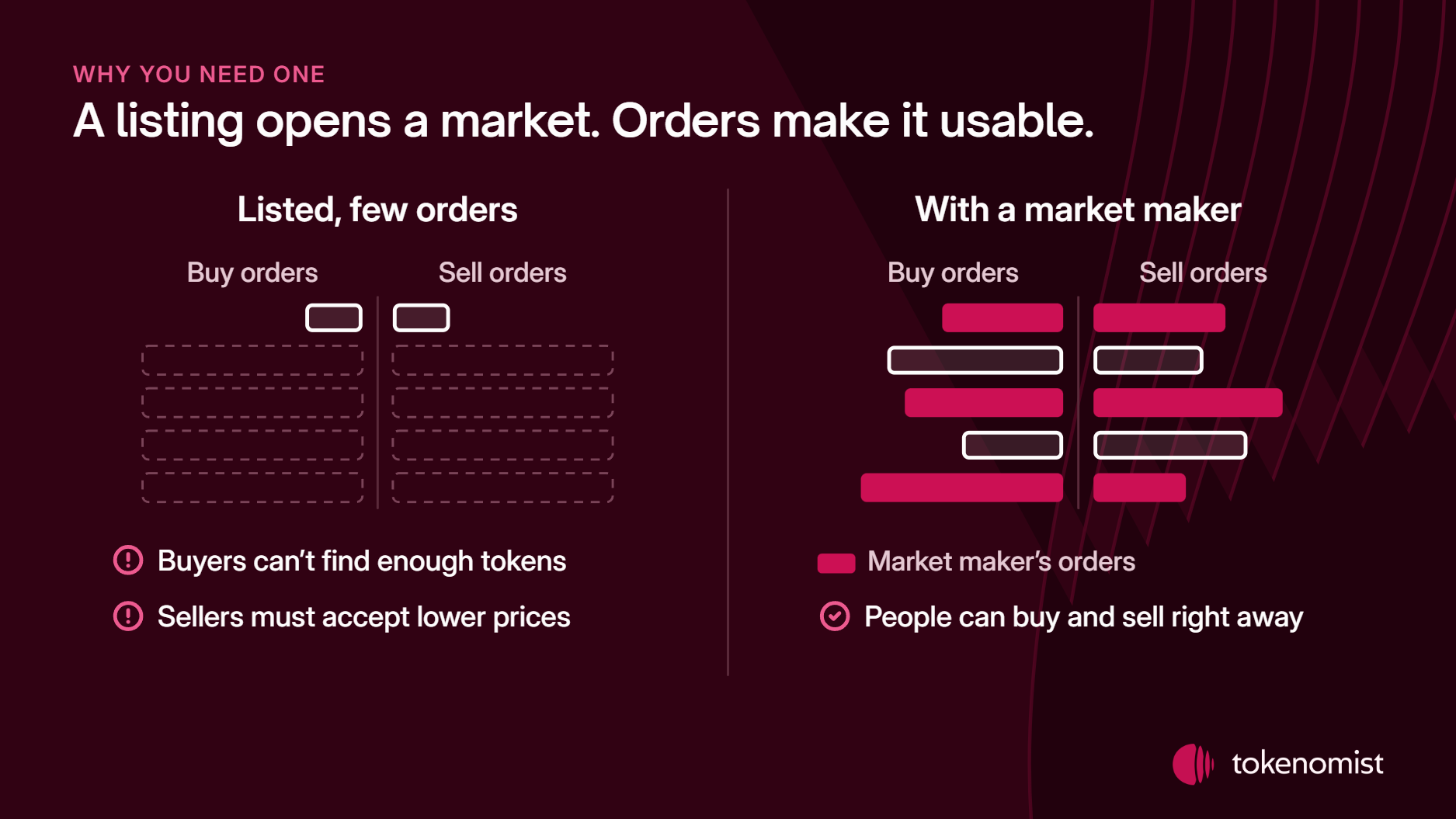
How a market maker keeps trading moving
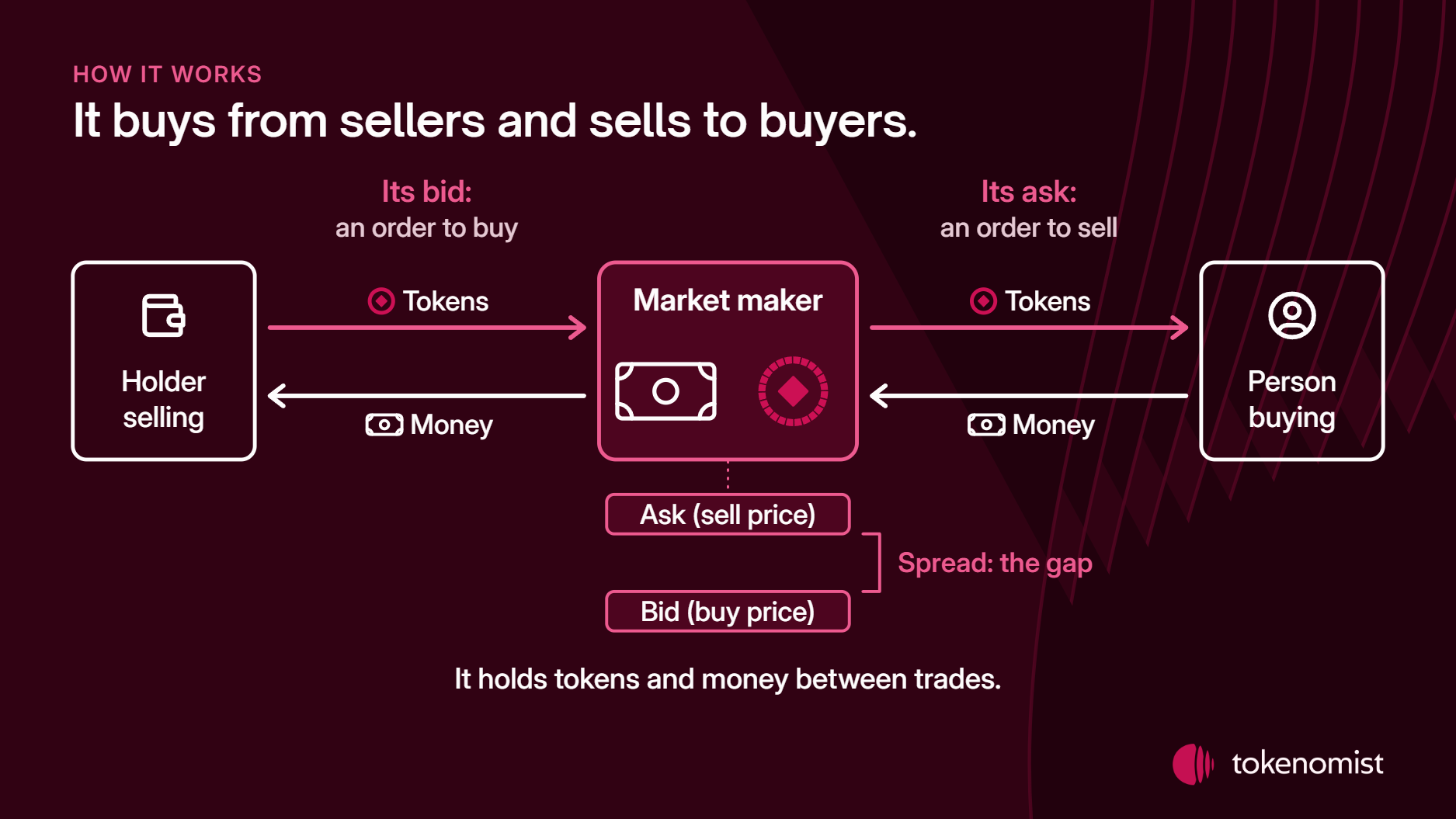
Think of a currency exchange counter. It shows one price to buy and one to sell. A market maker does the same for your token by placing orders on an exchange.
Its buy order is called a bid. Its sell order is called an ask. Each states a price and an amount. Together with other traders' orders, they form the order book, the list of orders waiting to trade.
Follow one sequence. A holder wants to sell, and no other buyer is on the book at that moment. The holder sells into the firm's bid, so the firm pays cash or stablecoins and receives the tokens. The firm now holds those tokens as inventory. Later, a new buyer arrives and buys from the firm's ask, so the tokens go out and cash comes back. Neither person had to wait for the other.
In that sequence the firm bought at its bid and sold at its higher ask. The gap between the best buy and sell prices on the book is the spread. The amount of tokens waiting to trade at or near the best buy and sell prices is depth. A smaller spread and more depth mean your holders trade closer to the price they expected.
If the holder's market sell order is larger than the amount available at the best bid, the rest may fill against lower bids, if there are any. This is slippage. More depth can reduce it.
The work continues as orders fill and prices move. The firm replaces orders, adjusts quotes and manages its tokens and cash on each venue. Profit from the spread is not guaranteed. If the price falls after the firm buys, it can lose money on the tokens it holds.
Your agreement should turn that work into measurable commitments. It should name the venues, the spread and depth to maintain, and how consistently the firm must meet them. Binance sets similar rules. Its March 9, 2025 notice requires authorized market makers to place both bid and ask orders, keep sufficient order size within specified depth levels and hold a healthy, stable spread.
What your project can expect
You are paying for trading conditions people can use. You should be able to check that the agreed orders were there, on the agreed exchanges, for the whole contract period.
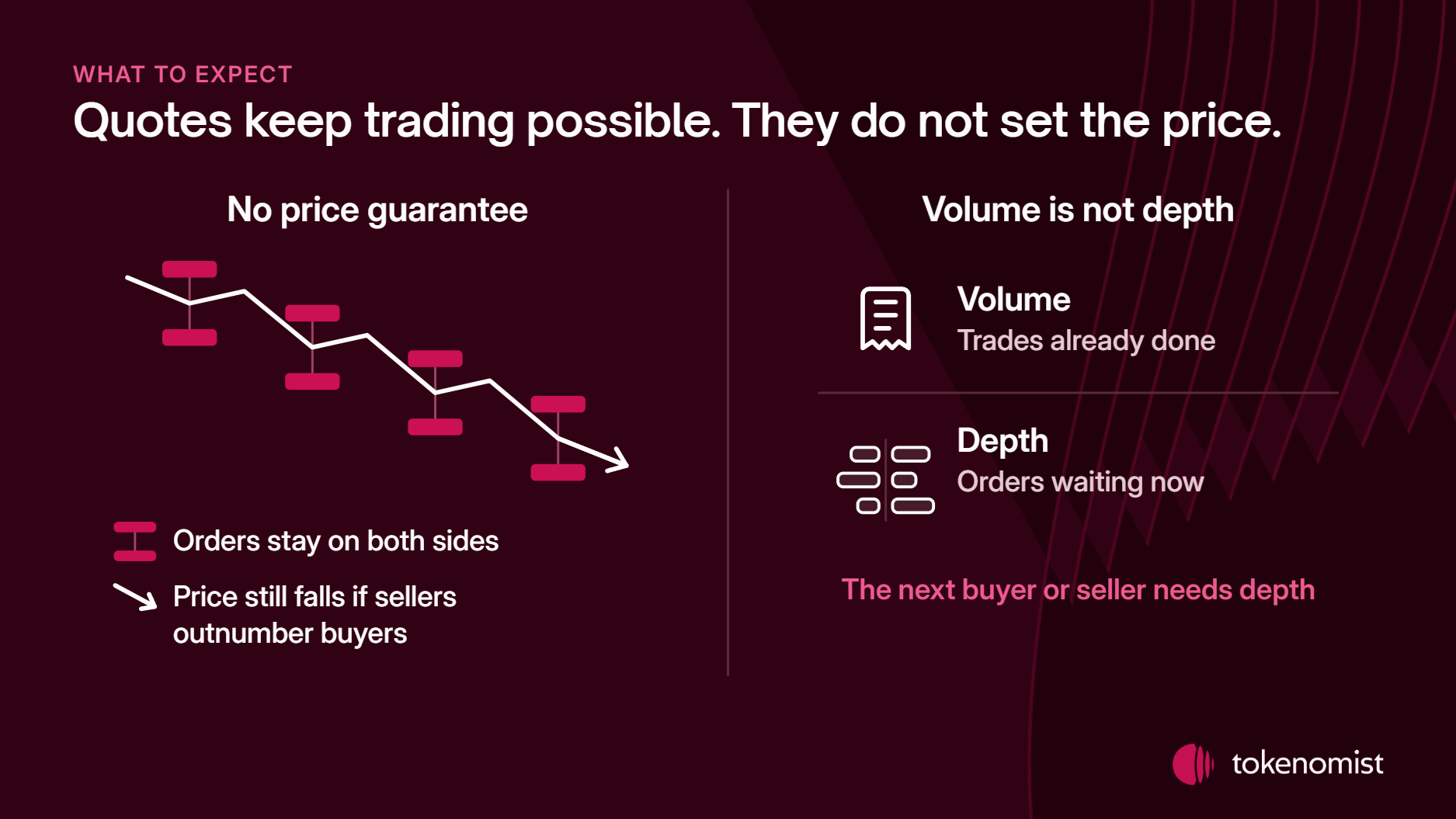
A market maker cannot guarantee a higher token price. It can keep quoting while the market falls. If more people want to sell than buy, the price still drops. Judge the firm against its agreement, and judge the token price separately.
Trading volume does not tell you the whole story. Volume counts completed trades. Your holders also need orders waiting when they arrive. A busy day does not prove there is enough depth for the next buyer or seller.
That gives you a concrete hiring goal: agree on the liquidity your market needs and how you will check it. Next come the assets and payment the service requires.
What your project provides and pays
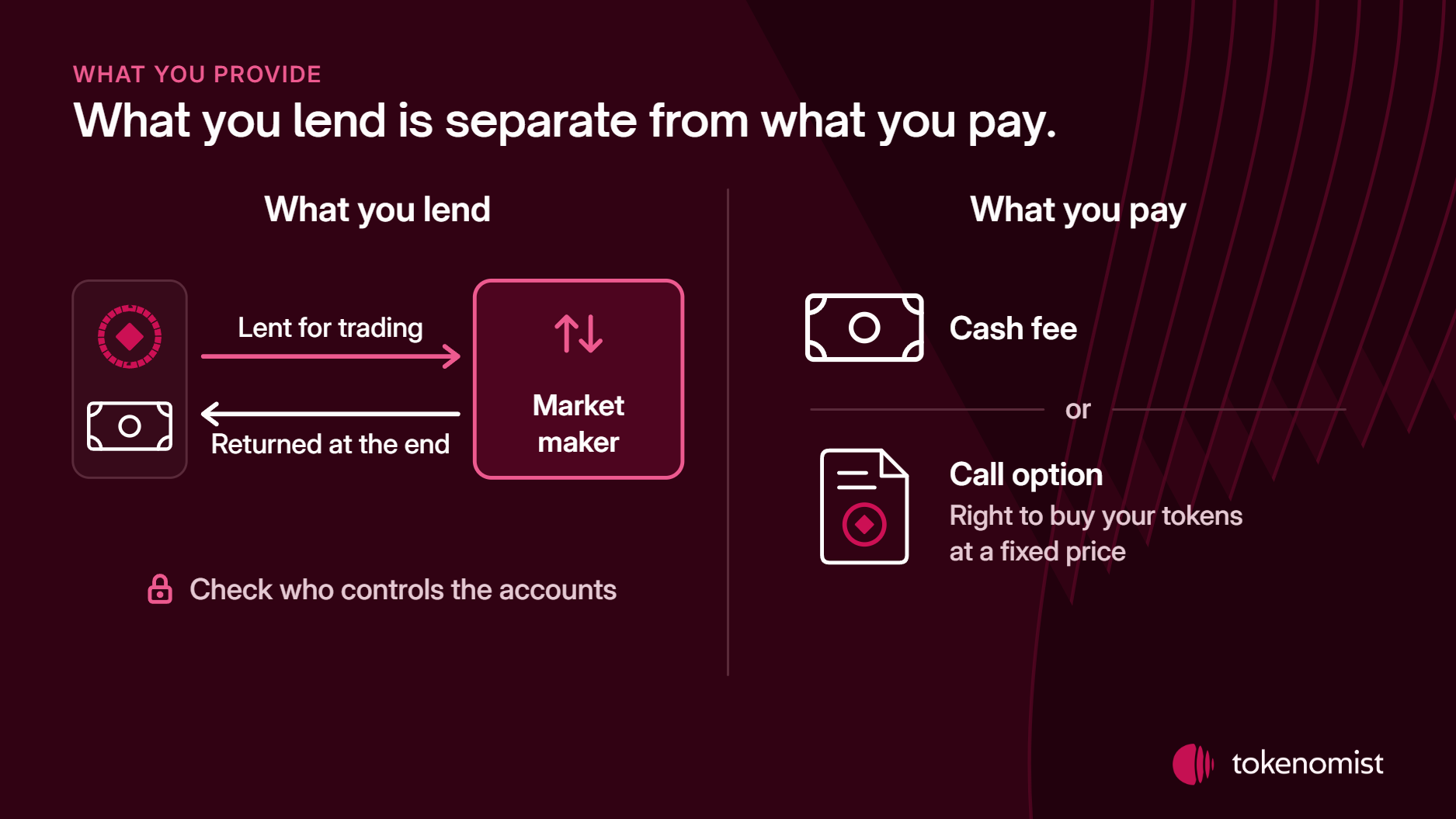
To keep both sides available, the firm needs tokens to sell and cash or stablecoins to buy with. Your agreement must say who supplies each, who controls the accounts and how the assets come back at the end. It has two separate parts:
- Working assets. The tokens and cash the firm trades with, and the terms for returning them.
- Payment. The cash fee, or the right to buy tokens, that the firm earns for the service.
The lent tokens are not the fee. In a loan-and-call deal, the firm either returns the lent tokens or exercises the option and buys them at the agreed price.
Your tokens. Under a token loan, you lend the firm tokens to trade with, and you may also need to supply cash or stablecoins. A transfer from your treasury may be part of that loan. It does not show that the tokens were sold; trading records show how they were used.
The fee. A retainer is a regular cash fee. Other deals give the firm a call option, the right to buy an agreed amount of your tokens at a fixed price.
If the market price rises above that price, the option lets the firm keep part of the upside. That is a cost to you even without a cash fee, and it gives the firm a reason to care about the token's price.
Whatever the structure is called, read the agreement itself for the option's size, exercise price and expiry, and for how the loan ends. To see which structures a firm offers, open its detail panel on the Market Maker Performance Index and check Engagement Options on the Profile & Engagement tab. For the full feature on Forgd, including a filter by engagement type and a market maker RFQ, go to Forgd's own leaderboard.
Before transferring assets, ask to see the accounts and reports you will receive. Decide how your team will reconcile inventory, review trading and raise a breach. Access agreed before trading starts is worth more than a promise to investigate later.
When market making goes wrong
Once you hire a firm, your project depends on it to deliver the service and handle your assets. These three cases show why the relationship needs ongoing checks, on both trading behaviour and the firm's ability to keep operating.
GPS: Binance intervened after misconduct
In the same March 9, 2025 notice quoted earlier, Binance announced action against an unnamed market maker serving GPS and SHELL. It said it removed the firm, barred it from market making on Binance and confiscated its proceeds for compensation. The notice cited misconduct but did not name the firm, say what it did or link it to the price drop.
Binance announcement, March 9, 2025.
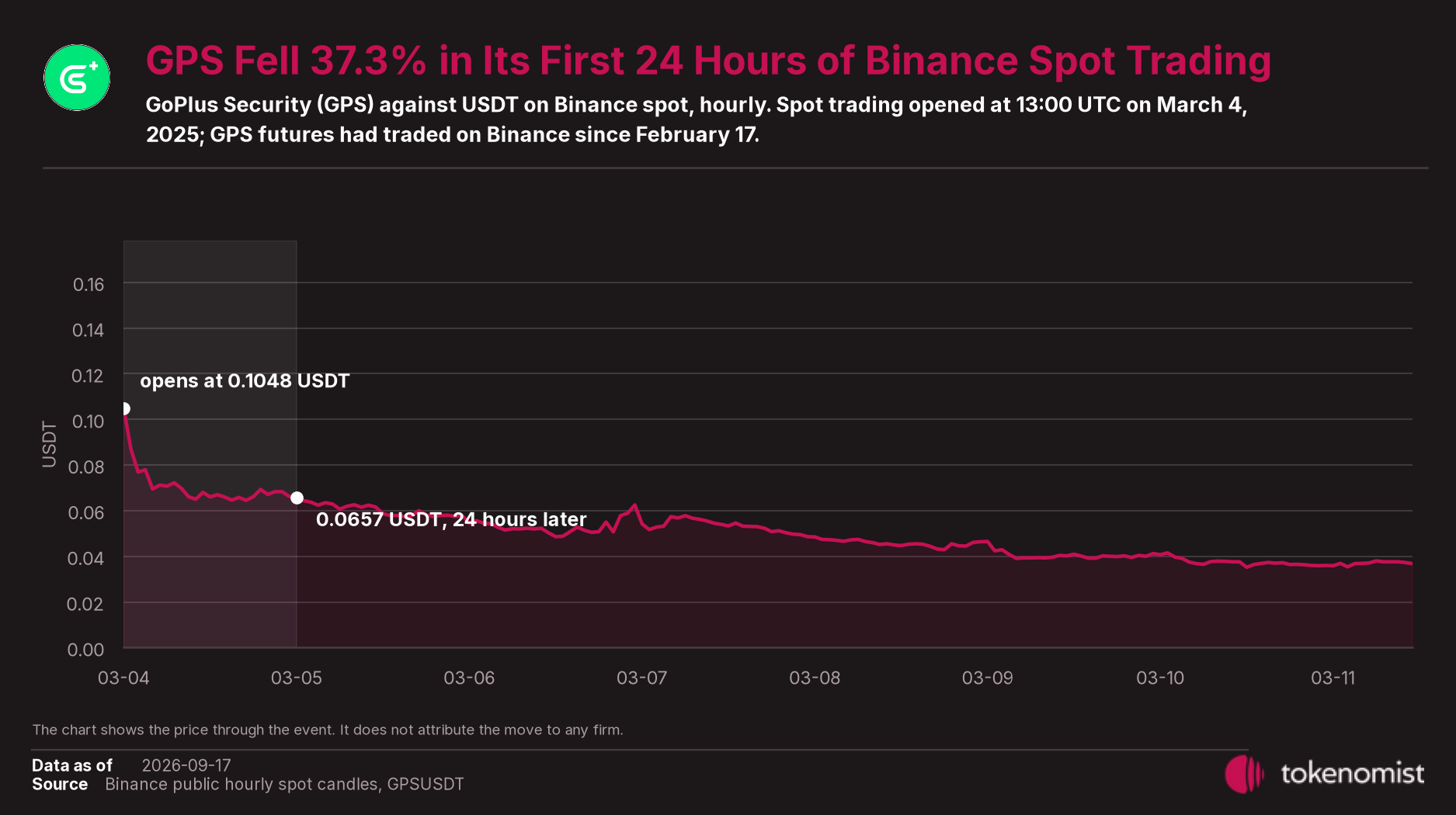
GPS had already experienced a sharp price decline. In the Binance spot candles used below, the hourly opening price was 0.1048 USDT at 13:00 UTC on March 4, 2025. At the same hour on March 5, 2025, it was 0.0657 USDT. That is a 37.3% decline.
For a founder watching that chart, price and conduct are separate questions. The price shows what happened in the market. To assess the firm, you need the orders it kept, the trades it made and what it promised to deliver.
Ask for the account history for that period. Separate buy and sell activity, and compare quoting against the contract. A price drop is a reason to investigate, not proof of what the firm did.
MOVE: heavy selling came with few buy orders
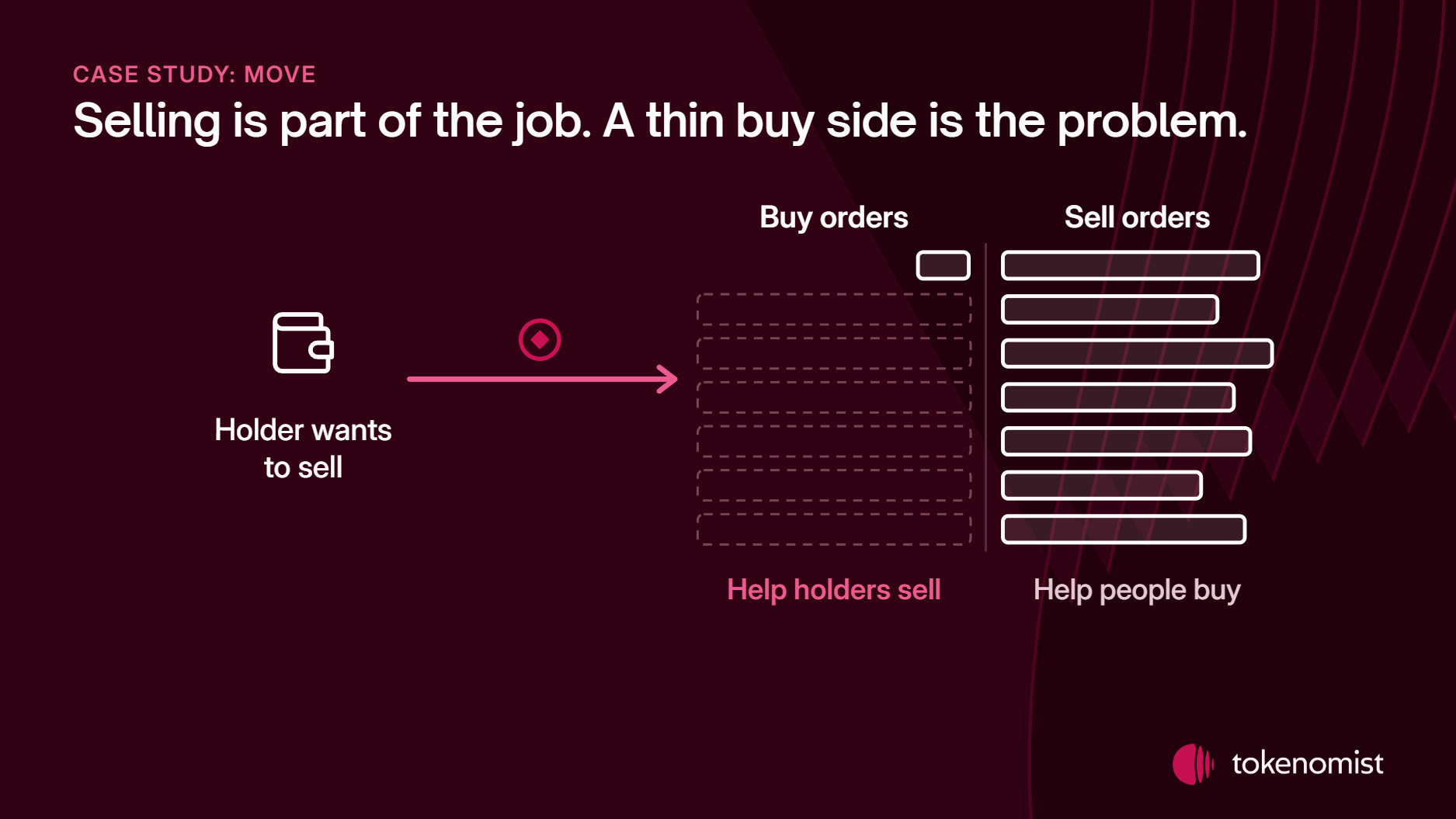
The MOVE case shows why heavy trading is not the same as support for holders who want to sell. In its March 25, 2025 notice, Binance said a market maker sold about 66 million MOVE on December 10, 2024, with few buy orders. It put the firm's eventual net profit at 38 million USDT before it was removed on March 18, 2025.
Binance said it notified the Movement Labs and Movement Foundation teams and froze the proceeds for user compensation. It also barred the firm from market making on Binance. The notice did not name the firm. The profit figure is not the size of the token loan or of the cash supplied.
Binance shared its decision in this March 25, 2025 post.
We've taken action against a market maker following detected irregularities.
— Binance (@binance) March 25, 2025
Our priority is to ensure a fair and orderly market for all participants.
More information 👉 https://t.co/QfCf8lETjN pic.twitter.com/k7t8zJ22gI
Selling alone is not the problem. Selling to buyers is part of ordinary quoting, and the firm must also offer liquidity to sellers under its mandate. Binance describes a large sale alongside little buying interest from that firm.
Go back to the holder from the earlier example, who wanted to sell. Tokens on the ask side help someone buy, not that holder exit. The holder needs bids backed by cash. High reported volume does not show whether the firm supplied the buy-side liquidity it agreed to.
For your own engagement, ask for buy and sell orders separately, with executed trades and inventory movements over the same period. Write access to those records into the agreement so your team can raise an imbalance as it happens.
Kronos Research: a liquidity provider went offline
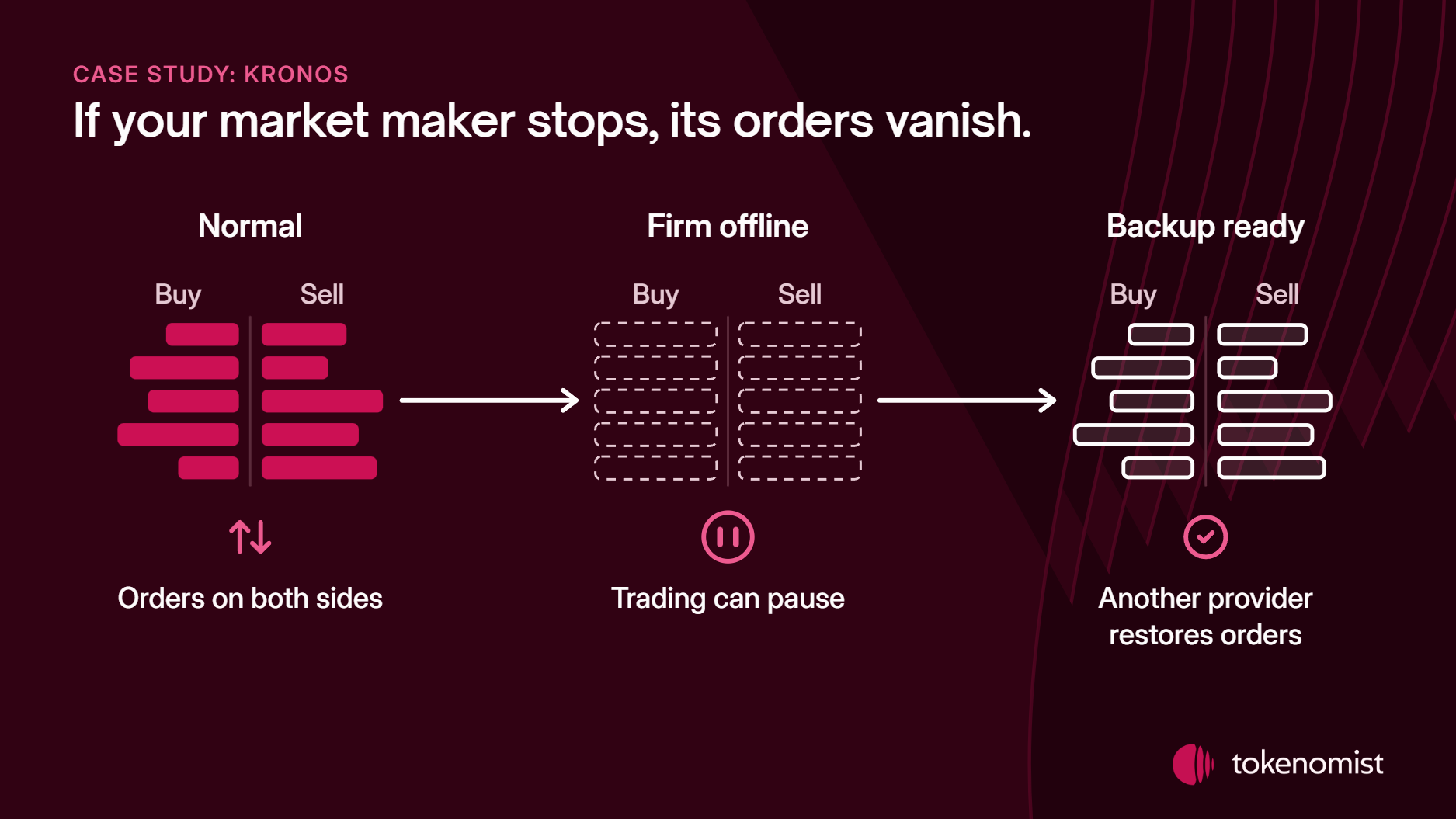
The Kronos case shows what happens when a liquidity provider stops, and why someone must be ready to take over. On November 18, 2023, Kronos Research halted trading after a breach of its API keys, the credentials software uses to access accounts. WOO X described Kronos as its largest liquidity provider and paused operations after its quotes were withdrawn.
WOO X described the interruption in its November 18, 2023 status update.
Status update
— WOO X (@_WOO_X) November 18, 2023
- First and foremost, all client assets are safe
- TLDR our largest liquidity provider Kronos Research recently experienced a hack that caused them to pause all trading on WOO X
- Since Kronos Research is the primary liquidity provider for spot markets and around… https://t.co/sDR8QHvmZC
WOO X's incident review, published November 21, 2023, describes a staged restart coordinated with other market makers. Perpetual futures trading reopened before withdrawals and spot trading. WOO X says limited liquidity during the restart caused partial or full liquidations for 227 users, all of whom it compensated.
Liquidation is the forced closing of a leveraged position that no longer meets the venue's margin rules. Reopening trading does not mean normal liquidity is back; WOO X reported problems during the restart as well as in the outage itself.
WOO X said it would add other liquidity providers faster and improve how its systems handle extreme liquidity conditions. The full sequence is in its review.
For a token team, this raises a different question from the MOVE case. You need to know what happens if the firm becomes unavailable, however well it has traded. Ask who alerts your team, who contacts the exchange and whether another provider can take over.
A second provider's name on a plan is not enough. Ask whether it has working exchange access, available inventory and a clear responsibility to respond. Agree how quoting will be restored, and how your team will confirm usable depth is back before closing the incident.
Together, the cases give you three checks: trading records rather than price charts, both sides of the book, and a plan for when the firm stops.
How to choose and monitor a market maker
Start with the Market Maker Performance Index, which uses data supplied by Forgd. Keep the guide to reading the index open beside it for column definitions. Use the public record to form questions, then ask the firm for evidence from an engagement like yours.
1. Check whether there is performance data to inspect. On the main index, Integration Level shows whether a firm shares enough data to be measured, and Grade runs from AA down to CCC, like a credit rating. In the September 28, 2026 snapshot, 22 of the 43 listed firms had full integration. The other 21 had partial or no integration. All 21 were graded CCC with no measured trading results, so the grade reflects missing data, not poor trading. A dash means a missing reading. Even full integration does not guarantee every metric.
For a firm you are considering, ask which engagements the data covers, and request any missing record directly. Compare firms over the same selected period.
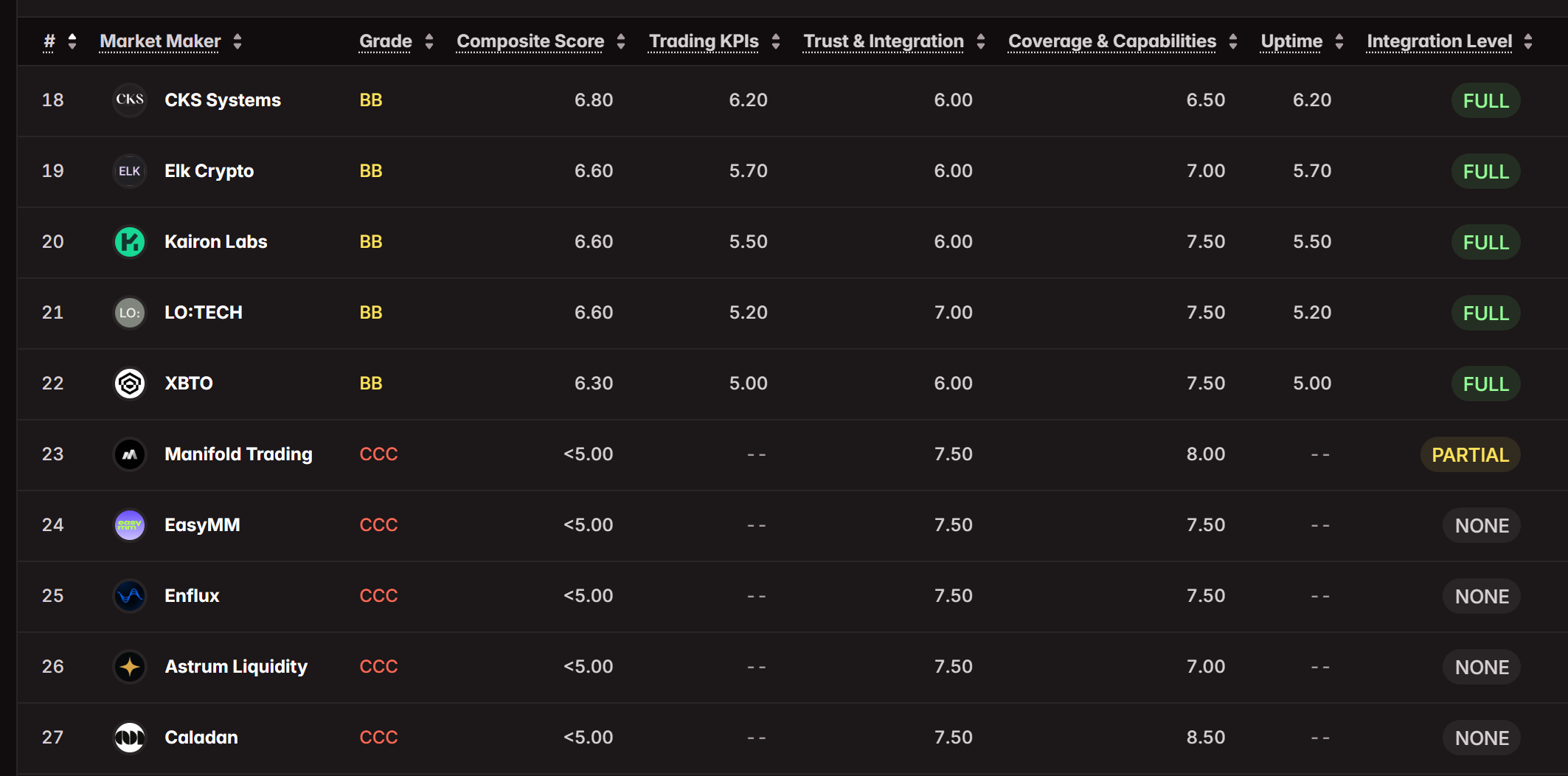
2. Check how consistently the firm met its depth target. The Depth Leaderboard shows this as Uptime %, the share of the period the target was met. The main table's Uptime column is a different measure, a score out of 10. Ask which target, venues and hours the figure covers.
In the proposal, have the firm state your target, how it will be measured and how missed periods will be reported. An average helps you compare candidates; your contract needs a definition you can check.
3. Compare posted liquidity with loaned inventory. Depth Loan Utilization, on the same Depth Leaderboard, shows how much of a firm's loaned inventory sits in resting orders. Ask which tokens, venues and period the reading covers. A firm-level figure cannot trace your loan.
For your token, ask for account-level reporting that links the inventory you supplied to the quotes delivered. A low reading deserves an explanation, but on its own it does not prove tokens were sold or misused.
4. Check whether there are enough buy orders for holders who want to sell. Compare Bid Depth with Ask Depth on the Depth Leaderboard. Bid depth is buy orders that absorb selling; ask depth is sell orders that meet buying. Compare amounts within the same price band.
Then ask how the proposed depth fits the trades your holders are likely to make. A combined total can hide a thin buy side, and unequal sides are a reason to ask about the mandate.
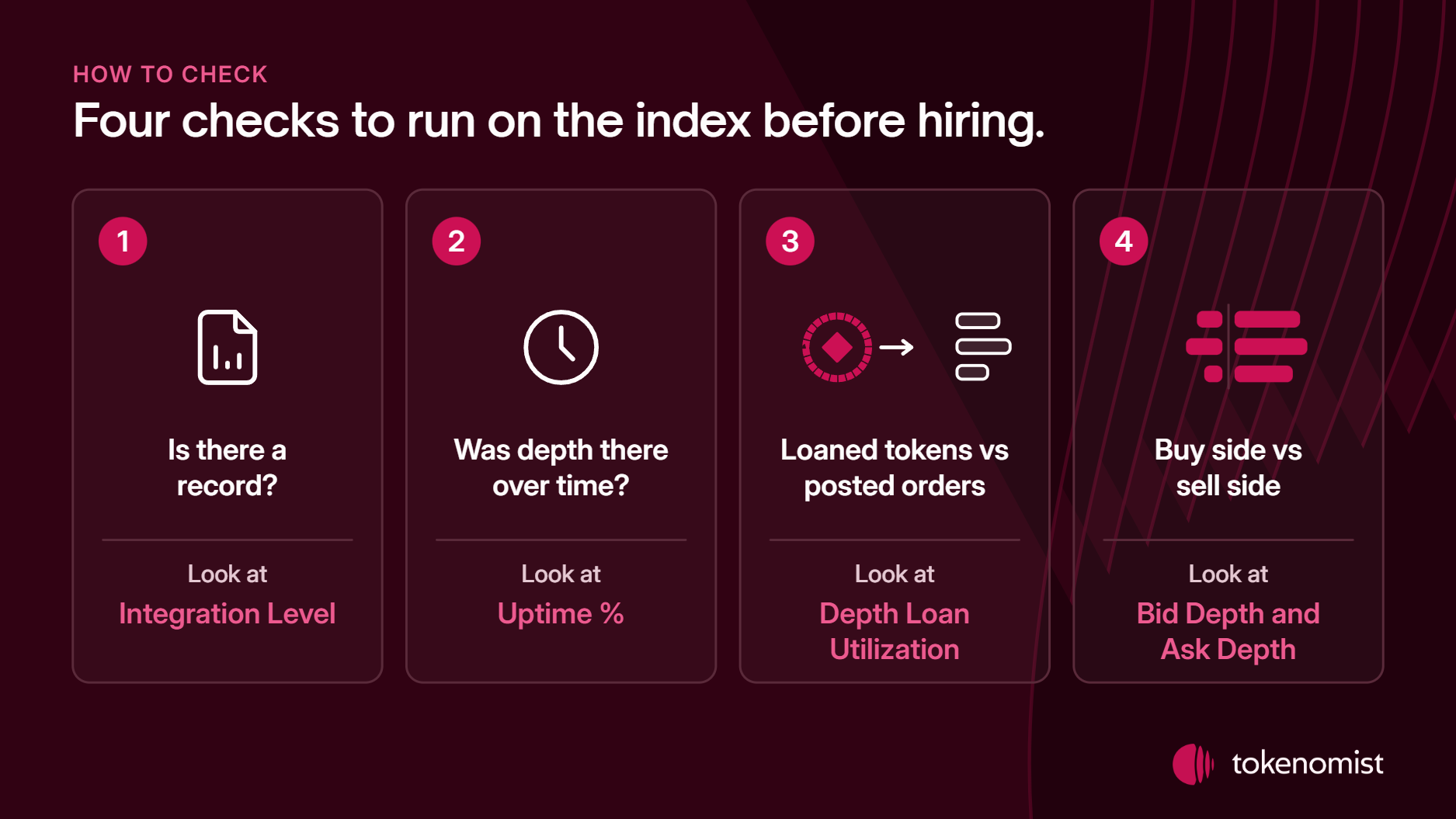
The index helps you decide what to ask before hiring. After signing, your own reports do the monitoring. Ask for a regular report that shows, for your token:
- the contract targets for spread, depth and uptime on each exchange
- what the firm delivered against each target
- buy-side and sell-side depth, reported separately
- every period below target, with its length and the firm's explanation
- the tokens and cash the firm holds for you, and how those balances moved
- executed trades, with buys and sells shown separately
Agree on the work before you sign
- Can you show measured performance for a token and exchange setup similar to ours?
- What spread, depth and uptime targets will be in the contract?
- Who controls the loaned assets, how are they returned, and how will we monitor their use?
- What is the cash fee, or the option's size, exercise price and expiry?
- Who responds when quoting stops, and what is the recovery plan?
Get the answers in writing. Then agree on what happens when a report shows a problem:
- Your team checks the report against exchange data and its own records.
- You send the firm the gap in writing and ask for an explanation by an agreed date.
- If that does not settle it, you use the contract's remedies, such as a correction period or termination with loaned assets returned.
Methodology
- Index count: the saved 30-day view captured September 28, 2026 at 07:30 UTC. Full integration is distinct from partial integration and does not guarantee every metric is available.
- GPS chart: Binance spot hourly candles from March 4 to March 12, 2025. Marked prices use the opening trades at 13:00 UTC on March 4 and March 5, 2025.
- Case accounts are attributed to Binance and WOO X. Private trading records were not independently audited. The index screenshot was taken on September 28, 2026; the other images are conceptual illustrations.
Sources
- Binance: GPS and SHELL market-maker action, March 9, 2025
- Binance: MOVE market-maker action, March 25, 2025
- Binance: Historical market data
- WOO X: Liquidity incident review, November 21, 2023
- Forgd: Market Maker Leaderboard
- Tokenomist: Market Maker Performance Index
- Tokenomist: Index metric definitions, August 17, 2026
Frequently Asked Questions
Do I need a market maker to launch a token?
For an order-book listing, ask the exchange what liquidity it requires and who will provide it. The need depends on your venue and available liquidity. Hiring a firm is useful when it fills a gap you can define and measure.
Is it normal for tokens to move from my treasury to a market maker?
It can be part of a token loan. Check the agreement before calling it one. Explain the purpose of the transfer to holders and track the firm's use of the assets through account-level reporting.
Does a CCC grade mean the firm is bad?
Not necessarily. In the September 28, 2026 snapshot, every firm graded CCC lacked full integration and had no measured trading results, so the grade reflected a missing record rather than poor measured trading. Check the firm's integration level, then ask for records from a similar engagement.
Recommend Article