Weekly Unlock Digest: Oct 12-18, 2026 | deBridge Releases 10% of Cir. Supply

🔑 Key Takeaways
- BTC fell 3.2% and ETH 7.0% on the week (Oct 4 to Oct 11 daily closes), ending a three-week winning streak, with US CPI (Oct 14) and the Oct 28 FOMC now the main macro tests.
- $DBR's Oct 17 cliff adds ~10% of circulating supply, the largest relative release among next week's top unlocks, partly offset by a buyback program funded by 100% of protocol earnings.
- Supply-side tightening dominated governance: a NEAR governance proposal would cut maximum issuance to 1.6%, and Ethena compressed 17 months of investor unlocks into a single release.
Weekly Recap
Bitcoin and ether ended a three-week winning streak after a midweek leverage flush, with ether falling harder. US spot Bitcoin ETFs posted their largest single-day outflow since June on Oct 7, about $487M.
The macro backdrop drove most of the move. Renewed US–Iran tensions lifted oil and kept a Fed rate hike in view, though the 10-year Treasury yield finished the week 4 bp lower at 5.24%. Prices steadied late in the week after President Trump ruled out an Iran strike before the midterms, though BTC still finished lower. Attention now shifts to the September US CPI print on Oct 14 and the Fed decision on Oct 28.
Among notable movers, NEAR has more than doubled over four weeks (+156%, Sep 13 to Oct 11 daily closes), outpacing BTC and ETH as its community weighs an issuance cut. The week also marked one year since the Oct 10, 2025 flash crash. Bitcoin's order book has since rebuilt beyond pre-crash depth and ether's near-price depth has more than doubled since crash day, according to CoinDesk, while altcoin liquidity continues to erode, a relevant backdrop for how smaller-cap tokens absorb scheduled unlocks.
Top Buybacks of the Week
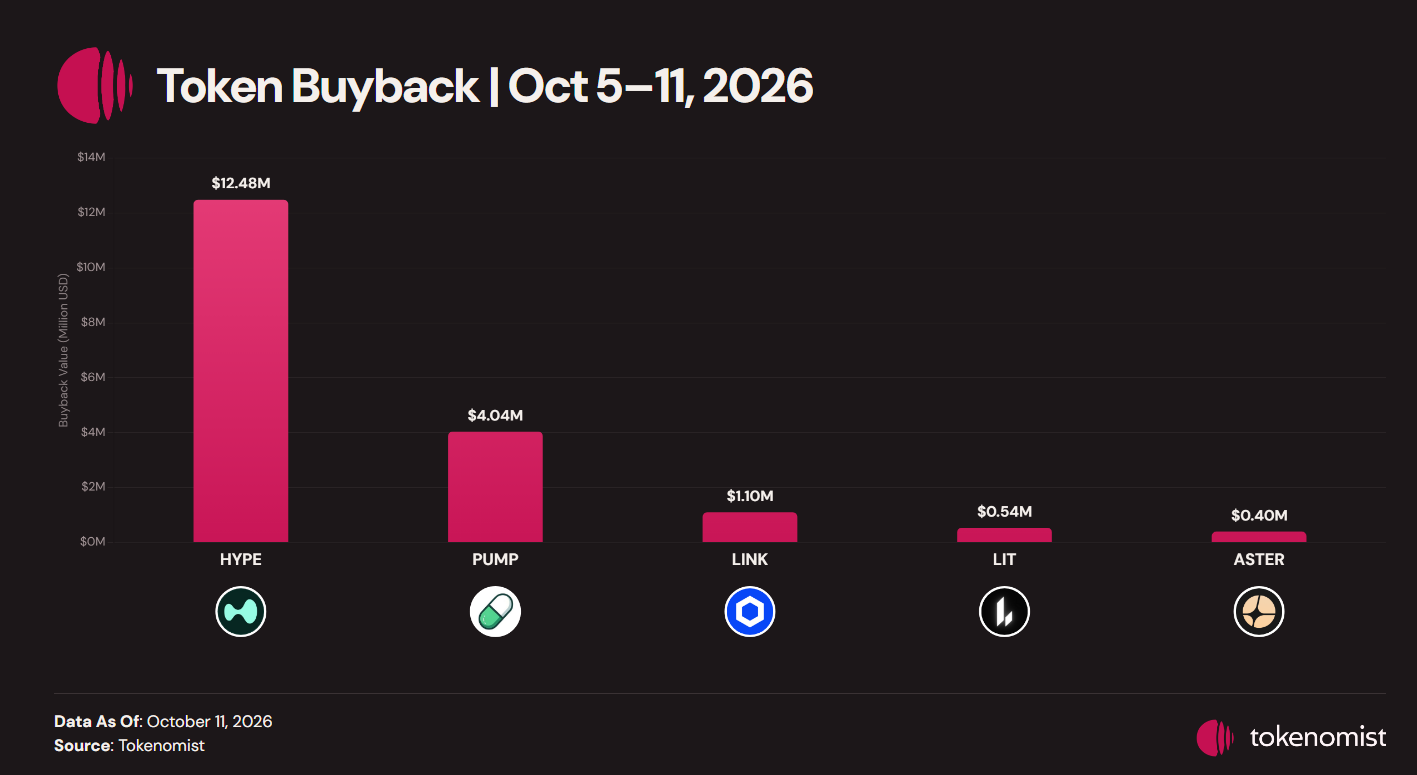
The chart reflects buybacks recorded through Oct 9, when the top five totaled $18.56M. On complete Oct 5-11 data, the top five reached $22.04M, roughly flat against $21.79M the prior week. Hyperliquid's buybacks rose from $14.20M to $14.45M, while Pump.fun's eased from $5.36M to $5.28M, and the same five tokens led both weeks.
Upcoming Events
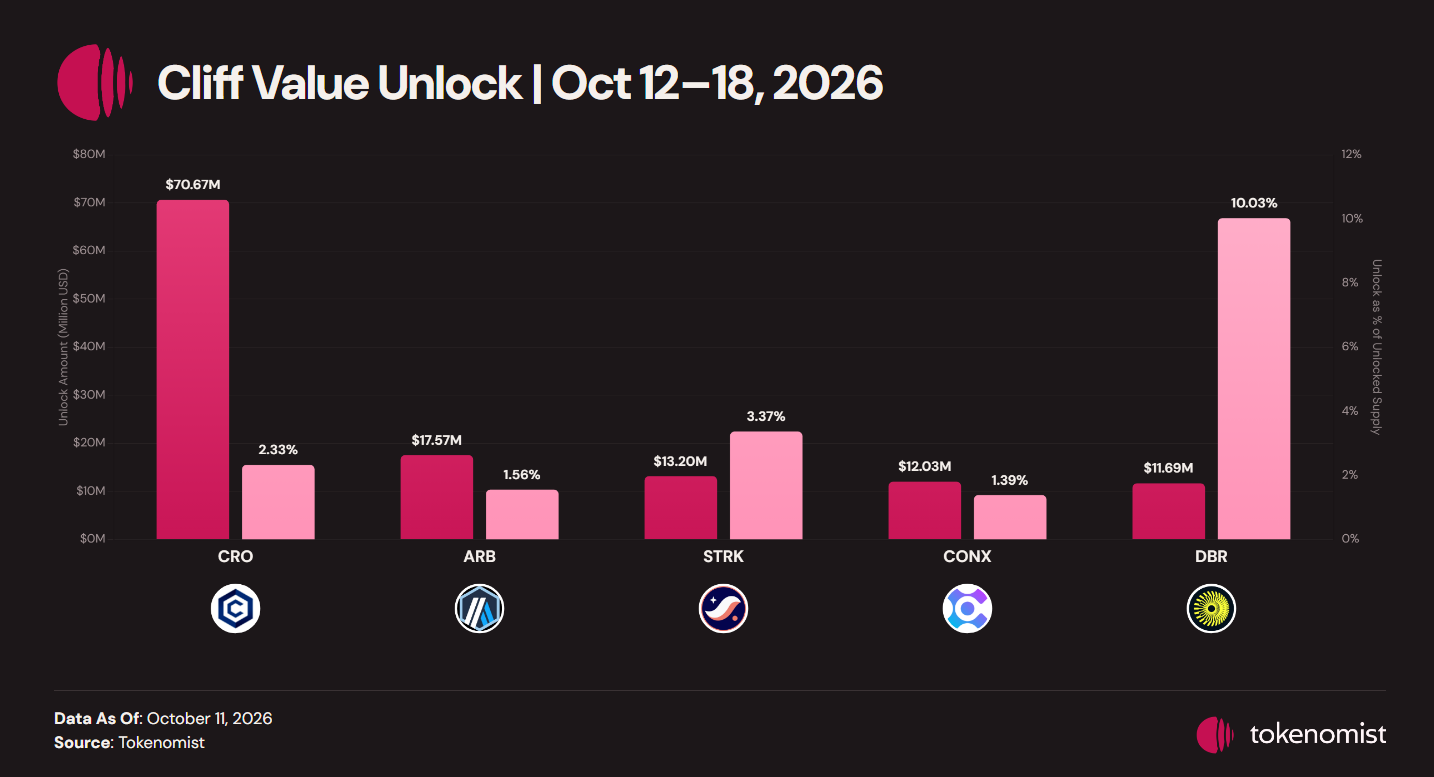
Next week’s scheduled cliff unlocks total about $155 Million in value. Dollar figures are marked at October 11, 2026. Top tokens facing the largest cliff unlocks next week include $CRO, $ARB, $STRK, $CONX, and $DBR.
$CRO leads the week with a $71M cliff unlock, equal to 2.33% of unlocked supply. It lands on Oct 17, two weeks after the Cronos community approved a 228M CRO burn and a plan to buy back and burn CRO with product revenue.
Unlock Spotlight: $DBR
- Unlock date: October 17, 2026
- Unlock amount: $11.69M
- Unlock as % of unlocked supply: 10%
- Vested allocation: Community, Founder/Team, Private Investors, Public Investors, Reserve
deBridge is an intent-based cross-chain interoperability protocol, and $DBR is its governance token, issued on Solana. The Oct 17 cliff releases 605M DBR, its eighth scheduled release counting the October 2024 launch tranche, with the full schedule extending into 2028.
At 10% of circulating supply, $DBR carries the heaviest relative release among next week's top five unlocks by value. Core Contributors and Strategic Partners (Founder / Team and Private Investors on the chart) together account for roughly 40% of the tranche; these insider allocations are the portion most often associated with near-term selling pressure. The Ecosystem and Foundation buckets are held by governance and treasury entities, so their tokens do not necessarily reach the market on the unlock date.
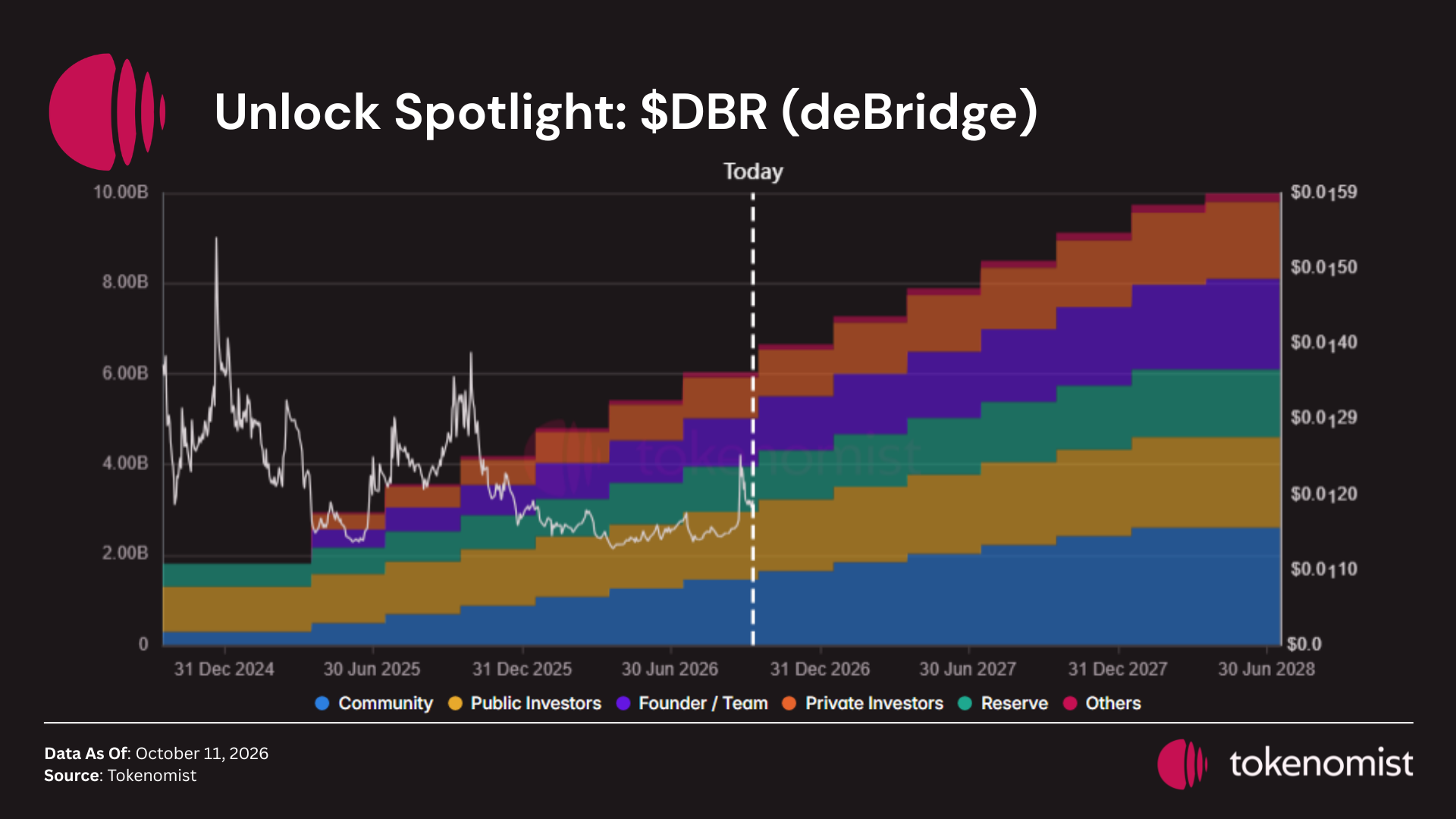
On the demand side, the deBridge Foundation's Reserve Fund has directed 100% of deBridge protocol earnings to DBR buybacks on public markets since mid-2025. That provides a recurring bid tied to protocol usage, though its ability to absorb a release of this size depends on bridge volume and fee revenue holding up.
Notable Tokenomics Updates
Ethena ($ENA): Remaining Investor Unlocks Pulled Forward
Ethena and its lead investors brought all remaining investor unlocks forward to October 5, 2026. Releases originally scheduled from November 5, 2026 through March 5, 2028 were combined with the scheduled Oct 5 release, unlocking 1,406,250,000 ENA to investors in total. This executes part of the four-part overhaul Ethena announced on Aug 27, which also included an investor buyout and an end to monthly VC unlocks.
The change concentrates roughly 17 months of investor supply into a single event. It removes a recurring monthly overhang from $ENA's schedule, but places a larger one-time block of supply in investors' hands at once.
Status: effective October 5
NEAR Protocol ($NEAR): Proposal to Cut Maximum Issuance to 1.6%
Sal Ternullo, CEO of NEAR treasury company SVRN, posted a proposal on the NEAR Governance Forum on Sep 30 to lower the network's maximum annual issuance from 2.5% to 1.6%. The cut would phase in gradually each epoch over 24 months, after a 90-day grace period, and would reduce the staking yield from about 5.4% to about 3.5%. The existing 90/10 split of new issuance between stakers and the treasury would stay unchanged.
The proposal estimates that about 66M fewer NEAR would be issued over six years. It follows NEAR's October 2025 cut from 5% to 2.5%, and frames an eventual fixed total supply as a longer-term research direction requiring a separate vote.
Status: draft proposal posted Oct 7; needs a supermajority vote and validator adoption, with no vote date published.
New proposal on the NEAR Governance Forum from @sal_ternullo CEO at @svrn_ai on cutting issuance from 2.5% to 1.6% over 24 months, plus a longer-term direction toward a fixed total supply.
— NEAR Protocol (@NEARProtocol) October 1, 2026
The floor is open to validators, House of Stake delegates, and the whole NEAR community.…
Recommend Article