Why Tokenomics Matters, Part 2

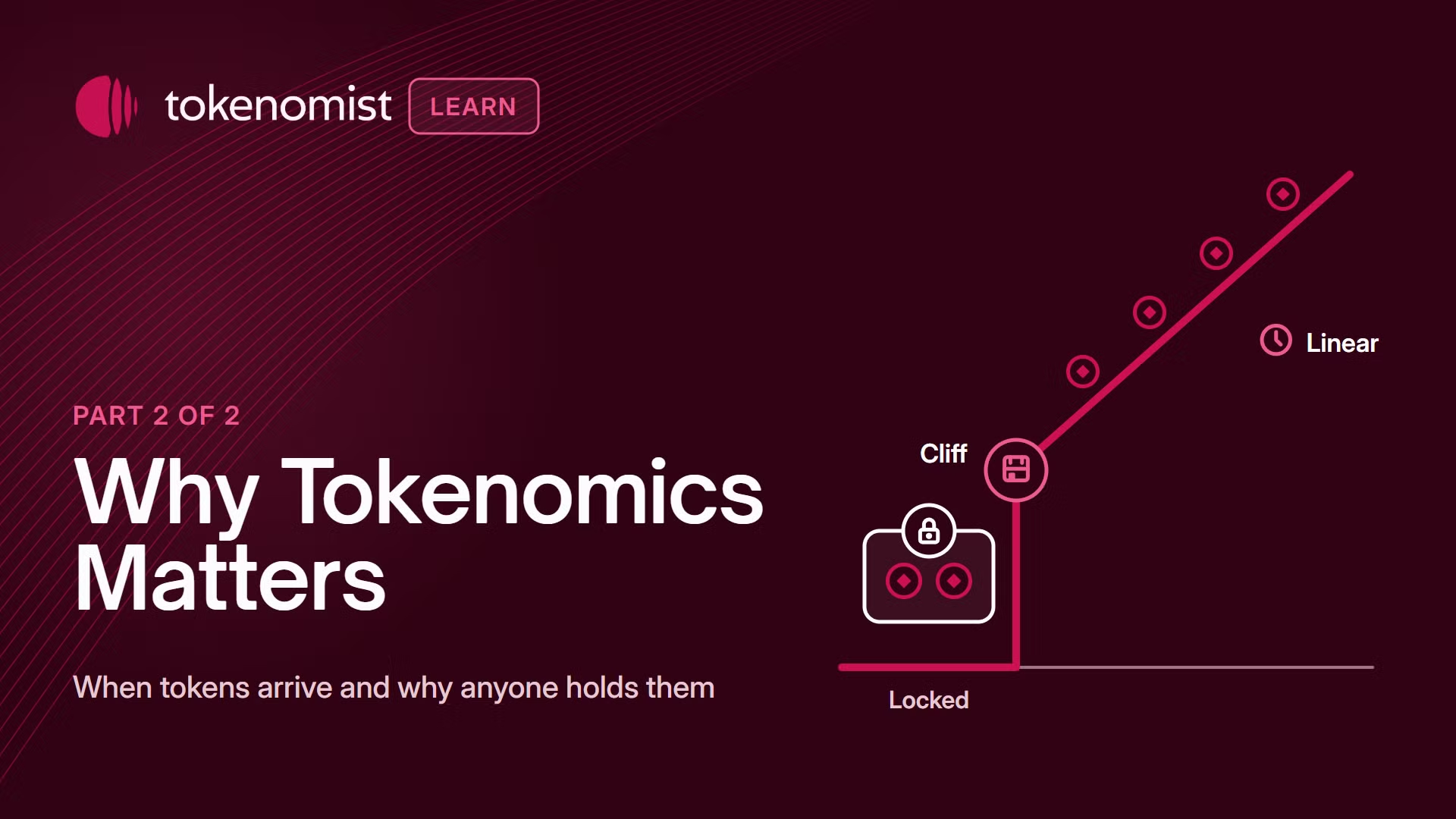
Tokens reach the market on a schedule you can read in advance, and some supply is created new rather than unlocked. This part teaches how to read that schedule, what issuance adds, why anyone holds a token and what buybacks and burns change, and it ends with six questions to ask any supply page.
Key Takeaways
- A cliff is a date; linear vesting is a rate. A cliff releases a large block of tokens on one day and linear vesting releases a little every day, so you watch the date for one and the daily amount for the other.
- An unlock makes tokens available; it does not sell them. In Tokenomist's study, unlocks weighed mainly on recently listed tokens, and tokens with a long trading history showed no clear effect.
- Supply can grow with nothing left to unlock. Issuance creates new tokens as rewards, as Bitcoin does with every block, so check the issuance rate as well as the unlock calendar.
- Bought back is not burned. Tokens a buyback keeps in a wallet can return to the market; burned tokens are gone for good.
- Six questions cover any supply page. How much trades, who holds the rest, when the next unlock is, how much is created each year, what the token does and whether revenue comes back to holders.
What Part 2 is and how its numbering works
Part 1 covered how many tokens exist and who holds them, in sections 1 to 6. This part continues from section 7 with when tokens arrive and why anyone holds them, ends with a checklist in section 12, and section 13 compares building this data yourself with buying it.
7. Cliff and linear vesting
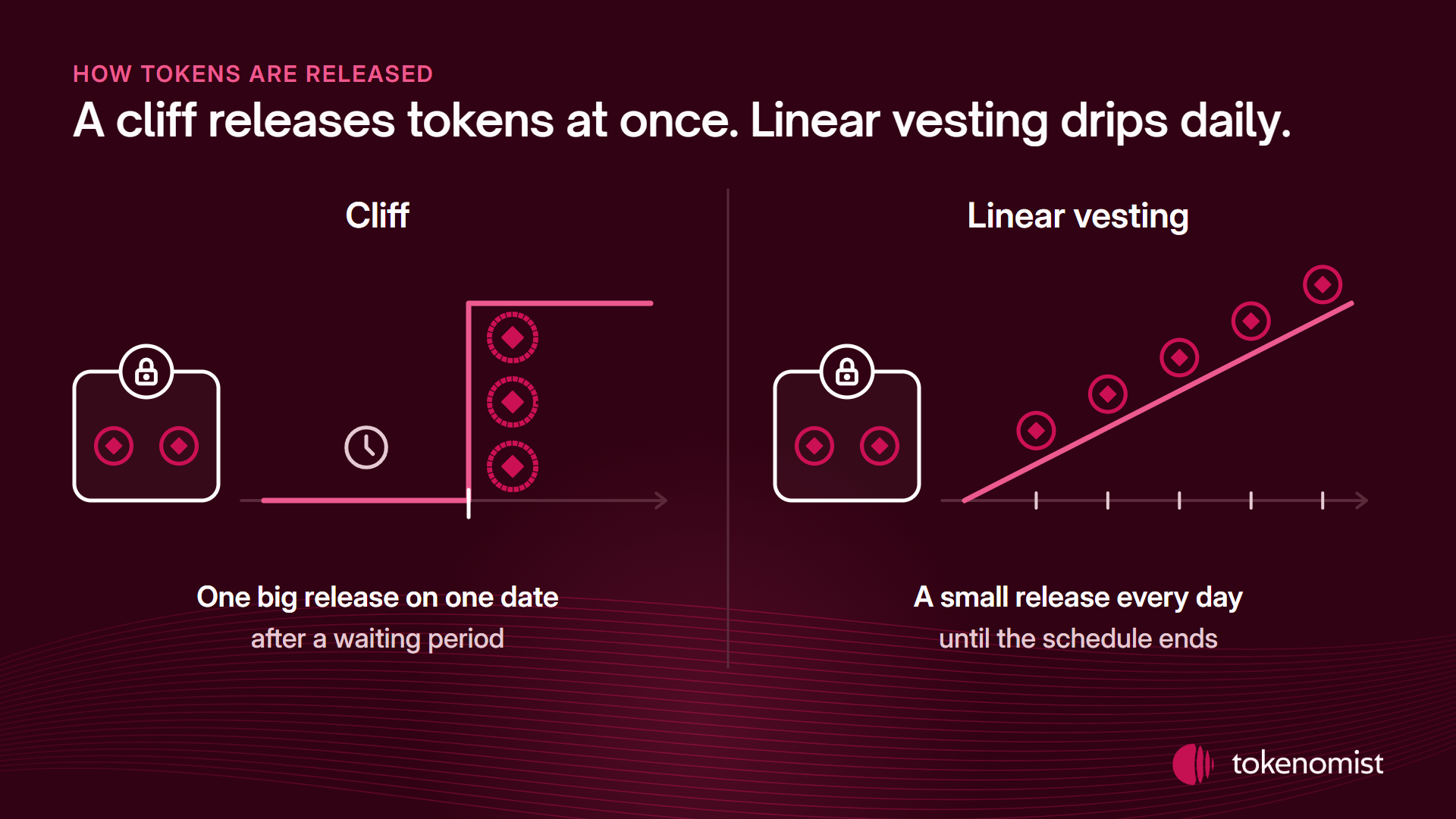
What it is. A cliff releases a large block of tokens on one date. Linear vesting releases a little every day.
Why it matters. With a cliff you watch a date; with linear vesting you watch a daily rate. A cliff can add a large amount of supply in a single day, so the date matters. Linear vesting spreads the same amount over many days, so what matters is how much arrives each day and when the schedule ends.
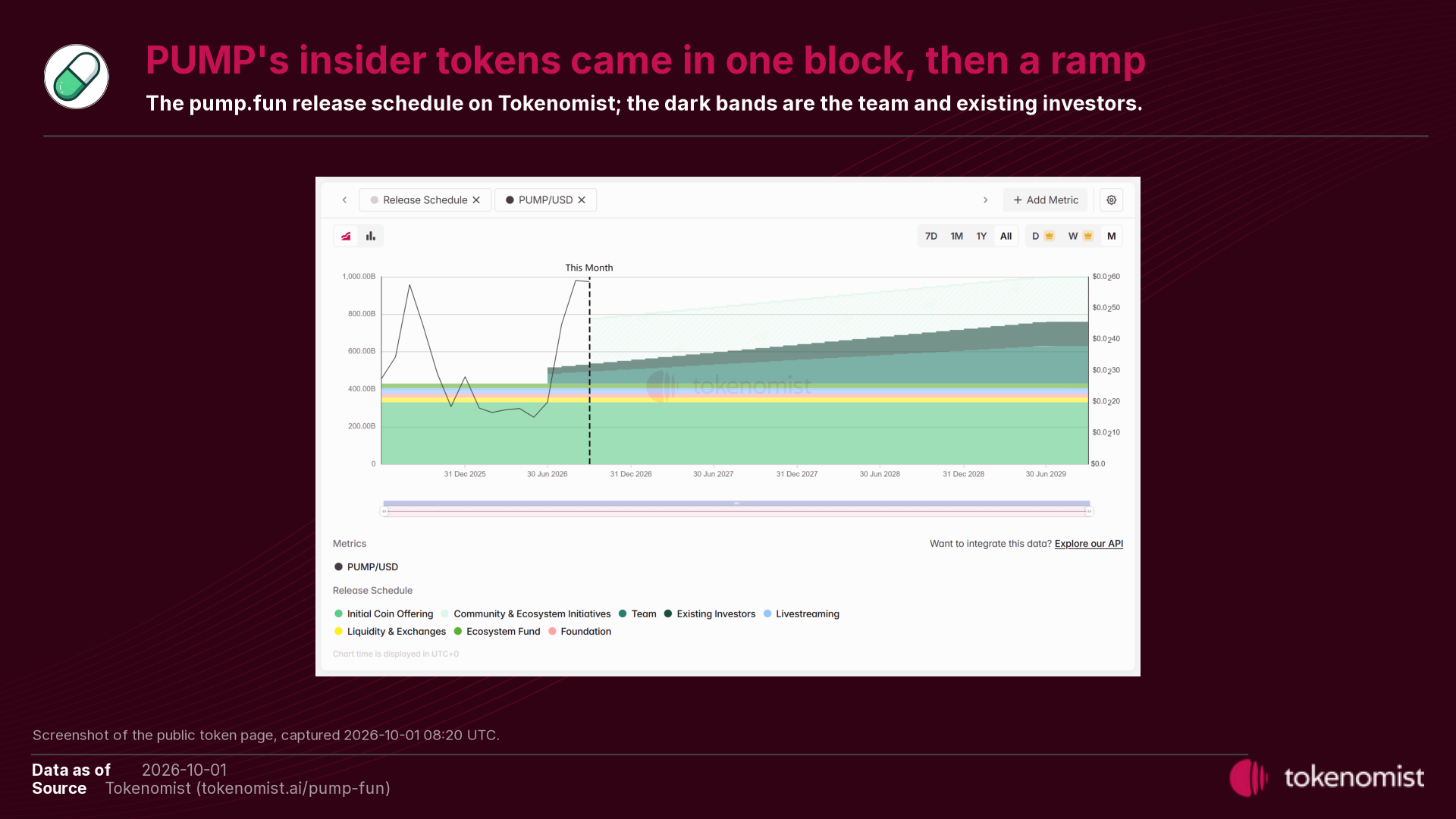
Example. PUMP's team allocation, 20% of its fixed 1 trillion supply,
- released nothing until July 12, 2026,
- released 50.1 billion tokens that day,
- and has released about 137 million a day since, on a schedule that runs to 2029.
8. Do token unlocks move price?
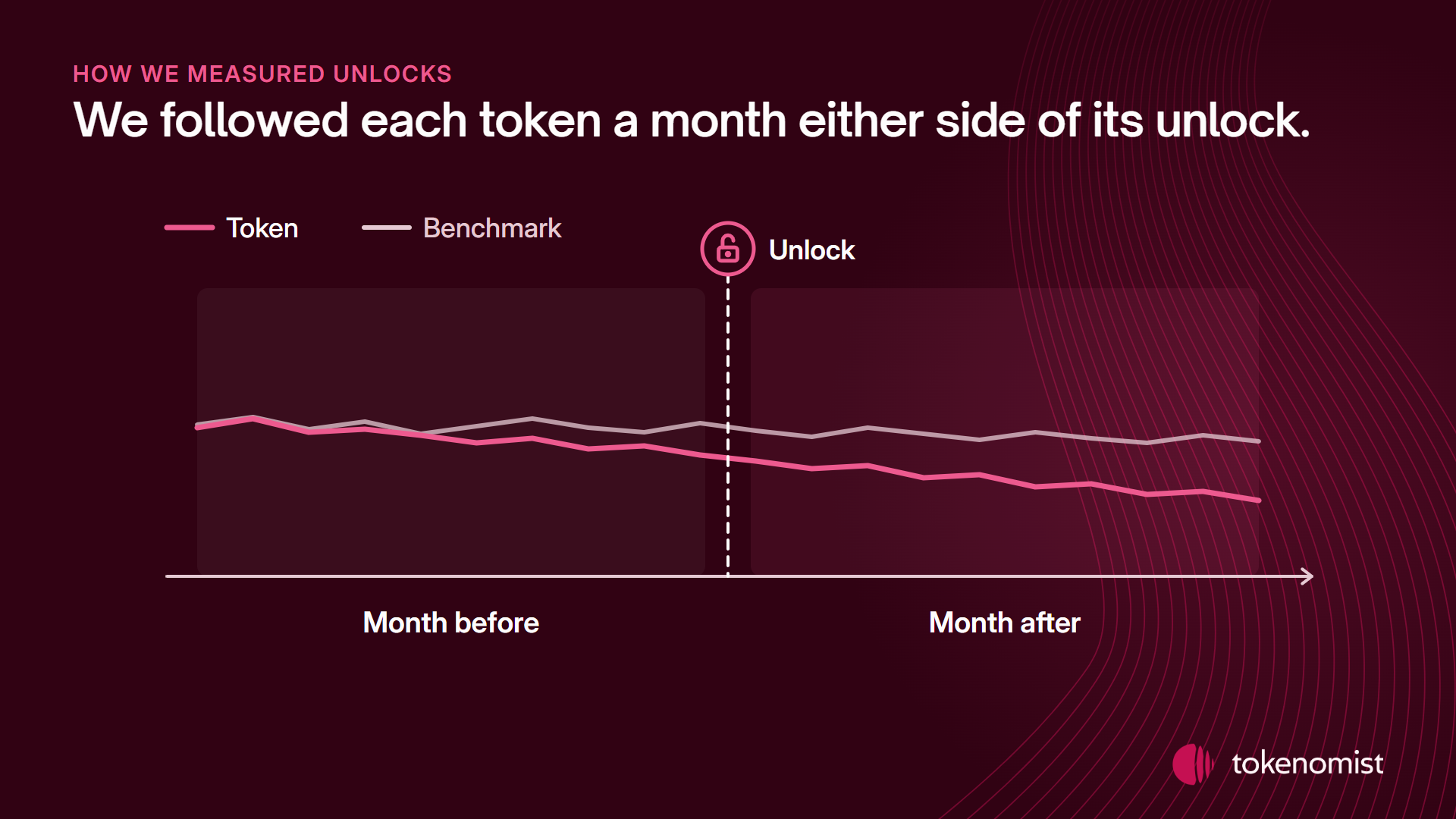
What it is. An unlock makes tokens available to their owners, which is not the same as selling them.
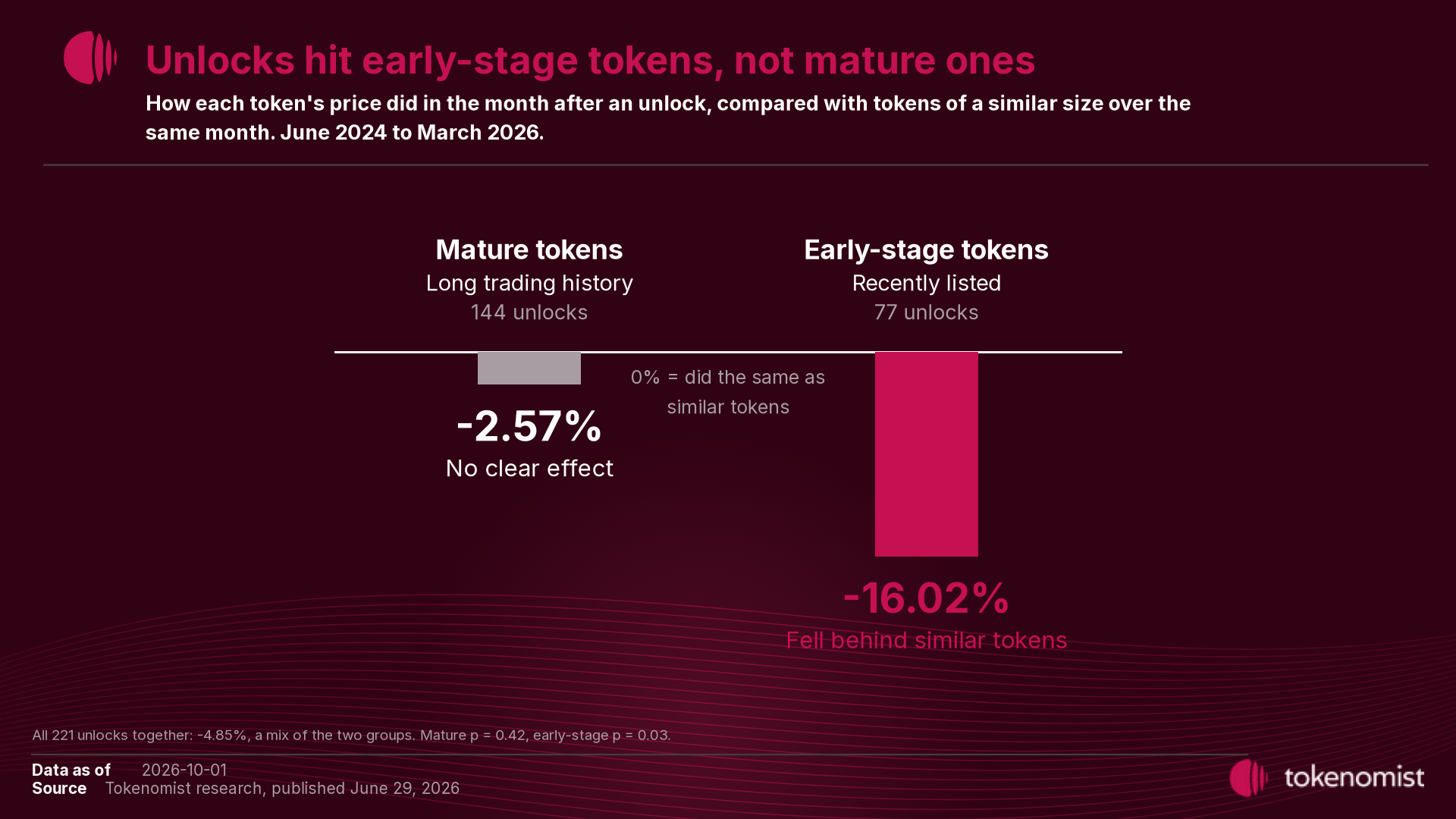
Why it matters. If unlocks move price, the release calendar is worth watching. The study below found the effect mostly in recently listed tokens. For tokens with a long trading history, it was too small to tell apart from normal price moves.
Example. In Tokenomist's unlock study, which compared 221 of 236 unlocks with tokens of a similar size,
- recently listed (early-stage) tokens fell a median 16.02% against those peers in the month after,
- tokens with a long trading history (mature) showed no clear effect.
9. Issuance (minting)
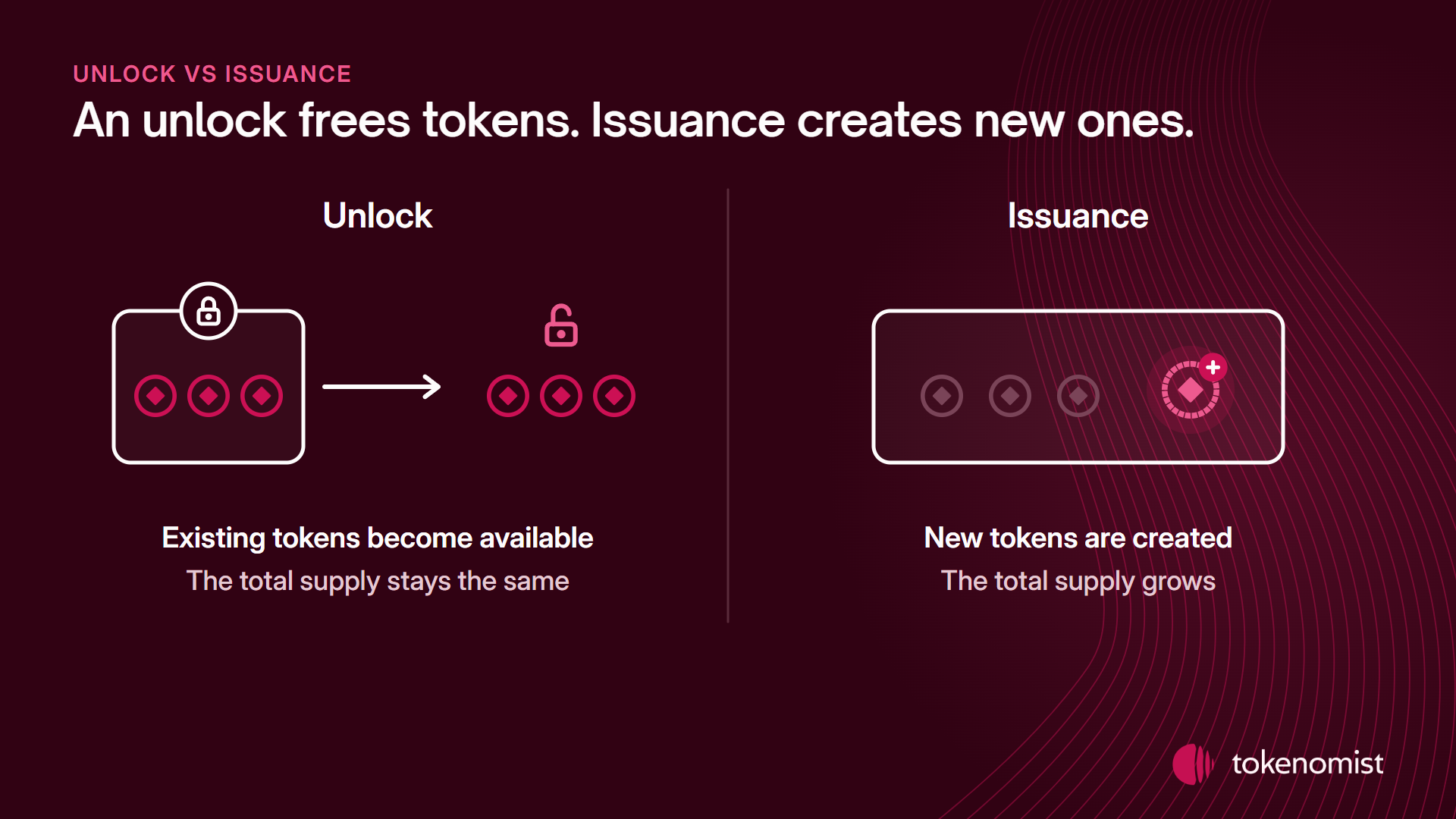
What it is. Issuance creates new tokens, usually as rewards for securing the network. An unlock only frees tokens that already exist.
Why it matters. A token with nothing left to unlock can still grow its supply every year. New tokens go to whoever earns the rewards, so a holder who does not stake owns a smaller share each year. Check the issuance rate as well as the unlock calendar.
Example. Between October 1, 2025 and September 30, 2026,
- $48.2 billion of supply was released,
- $22.5 billion of it was new issuance,
- and Bitcoin's mining rewards were $13.1 billion of that.
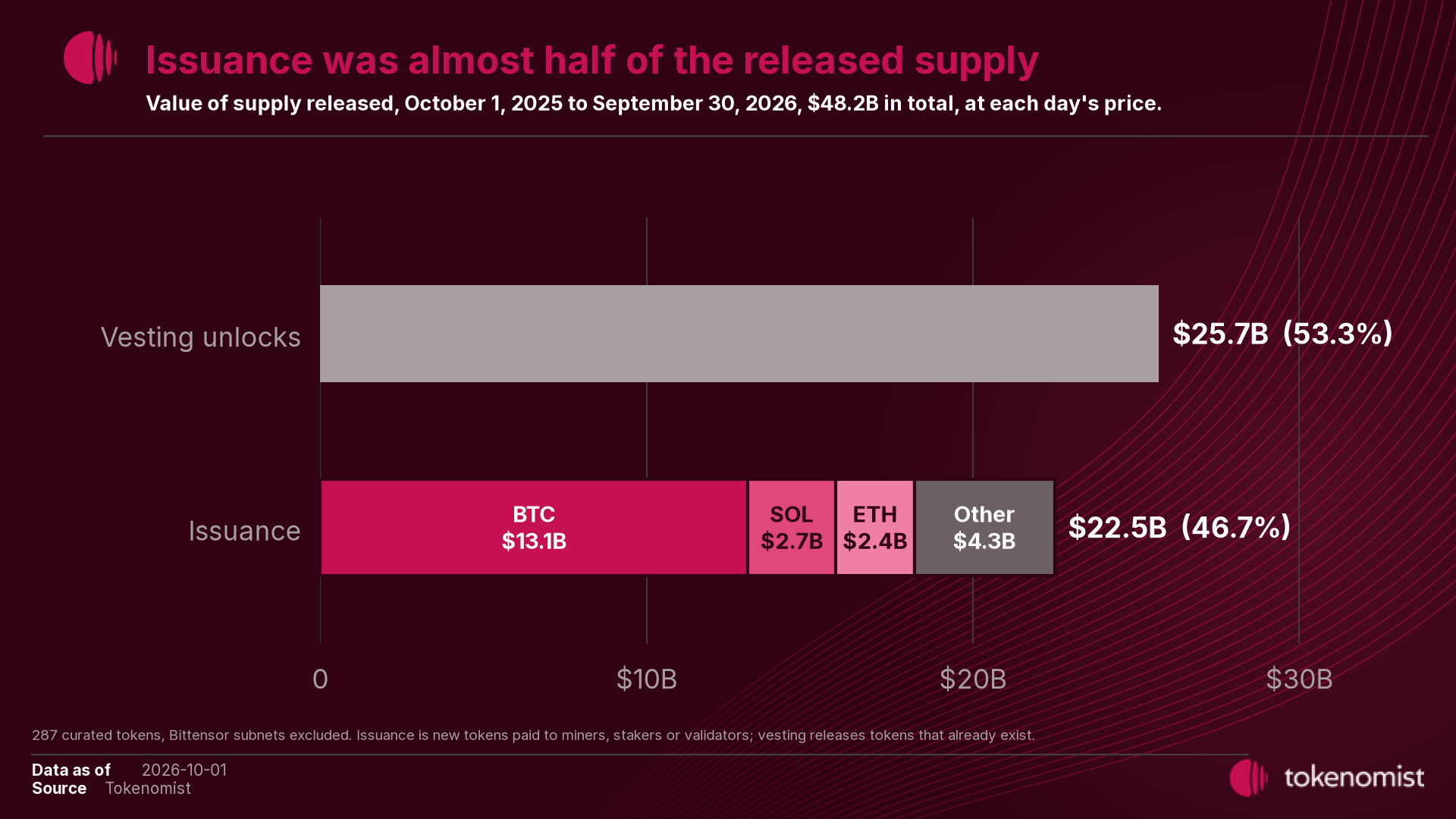
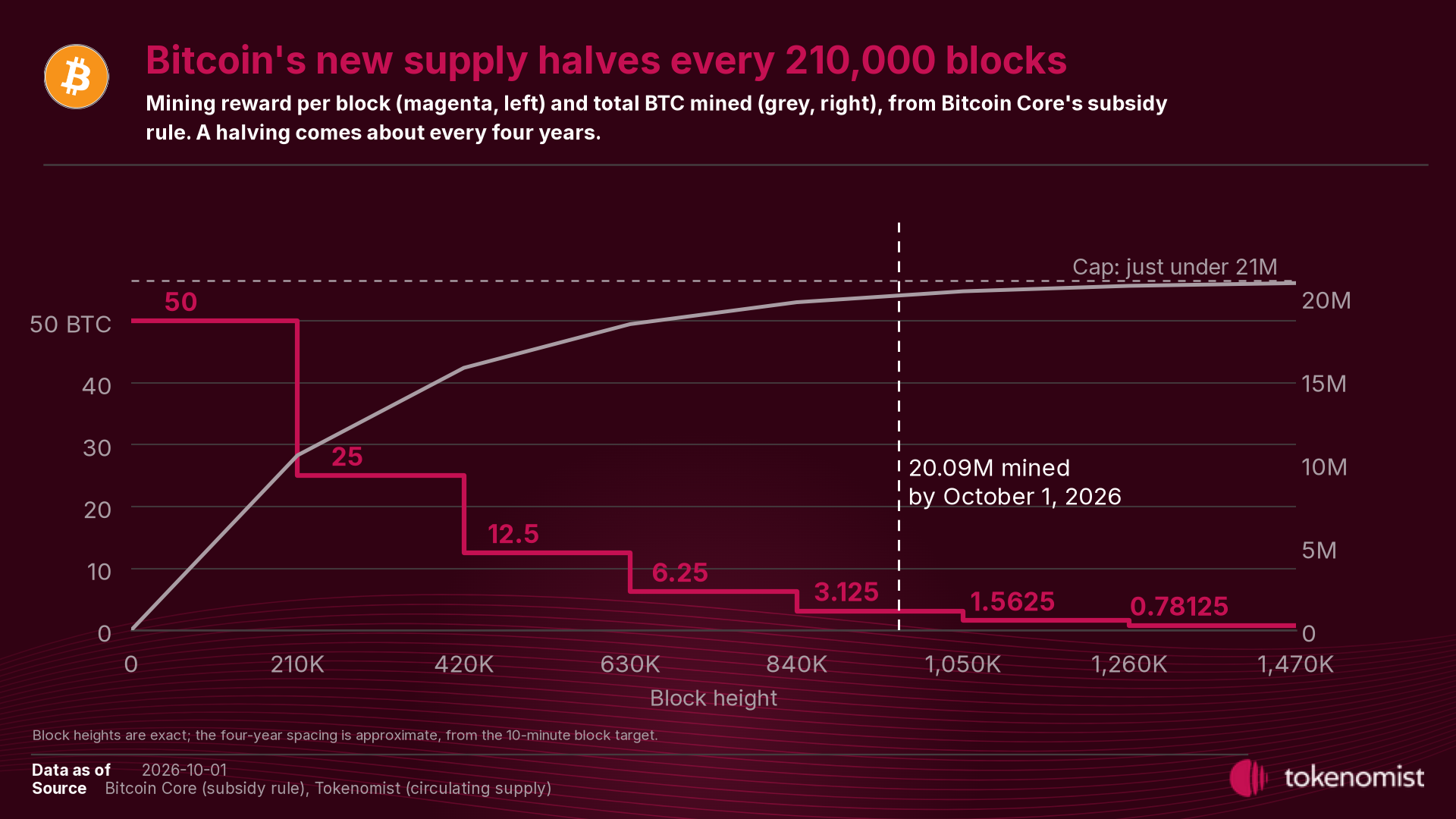
Bitcoin, for comparison. Bitcoin has nothing left to unlock and still adds supply with every block. Its code has paid 3.125 BTC per block since block 840,000 and halves that again at block 1,050,000. At the code's target of one block every 10 minutes, that is about 164,000 BTC a year, or 0.8% of the 20.09 million in circulation. Valued at each day's price, a year of those rewards comes to about the $13.1 billion above.
10. Utility and governance
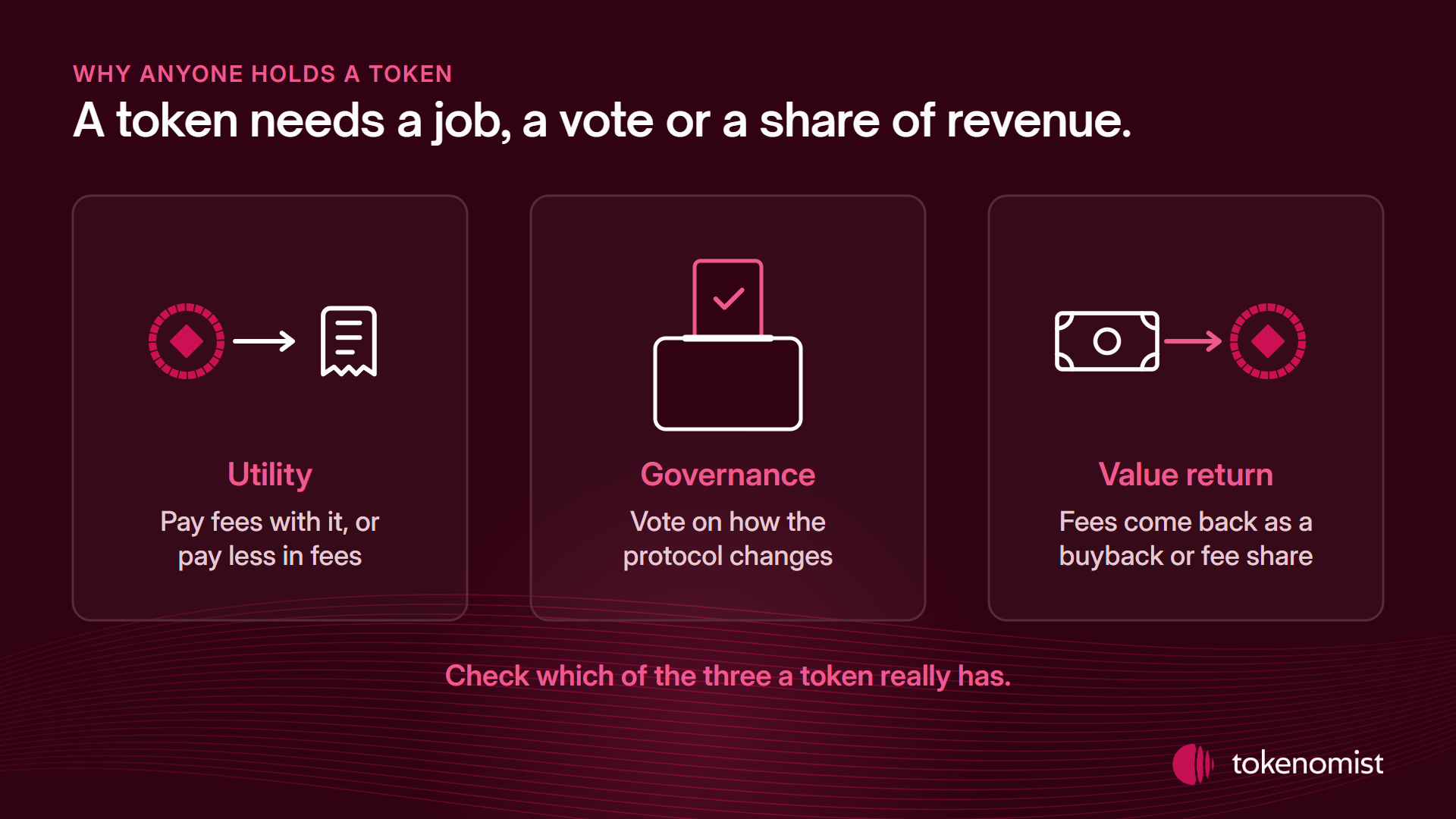
What it is. Utility is what you can do with a token. Governance is a vote on how the protocol changes.
Why it matters. A token people need for something has a reason to be held besides its price. Fees paid in the token, discounts for staking it and votes over a treasury all create demand from people who use the protocol. A token with no use depends only on people expecting its price to rise.
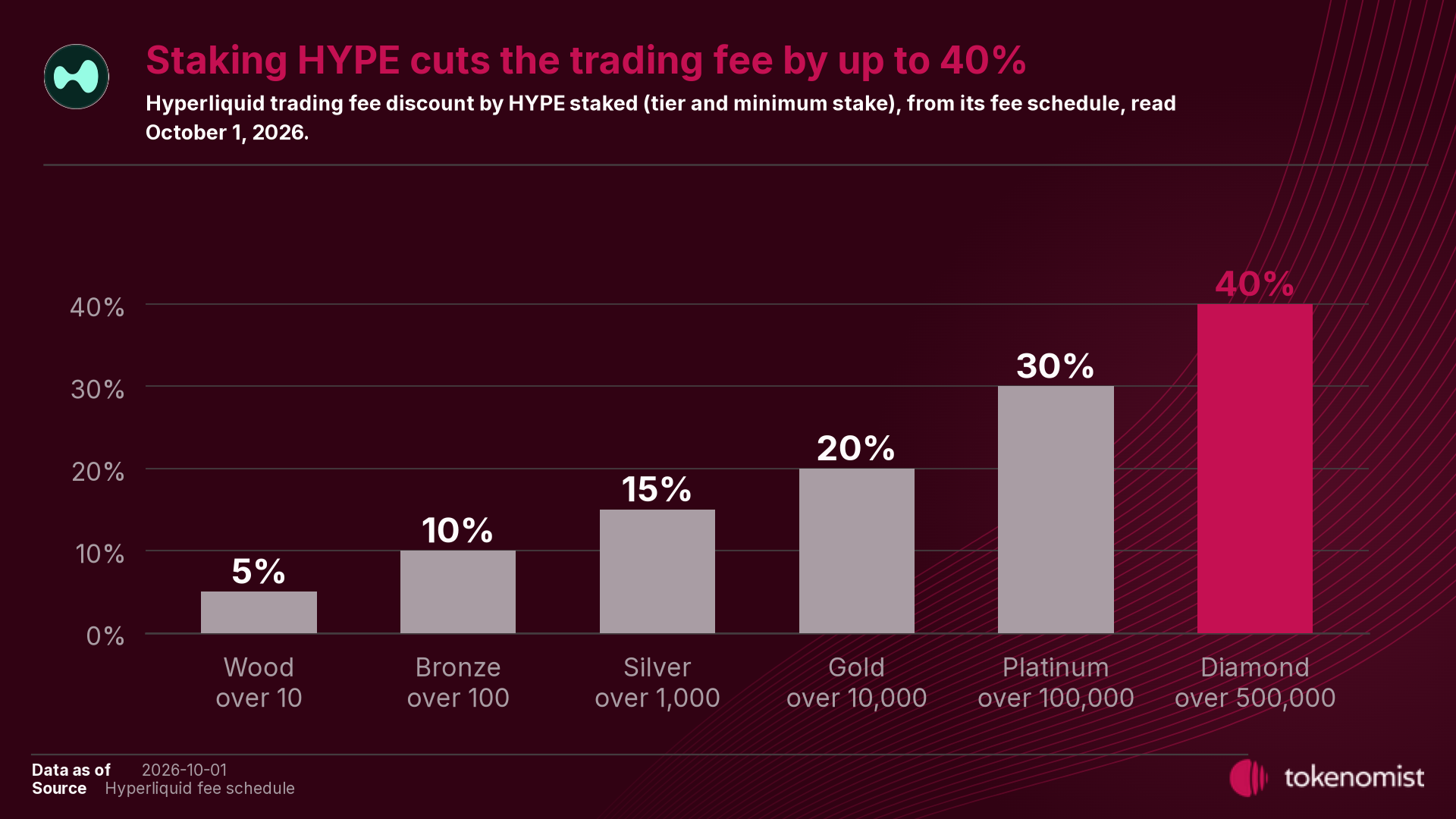
Example. On Hyperliquid, staking HYPE cuts the trading fee
- by 5% above 10 HYPE staked,
- by up to 40% above 500,000 HYPE, per its fee schedule.

11. Burns and buybacks
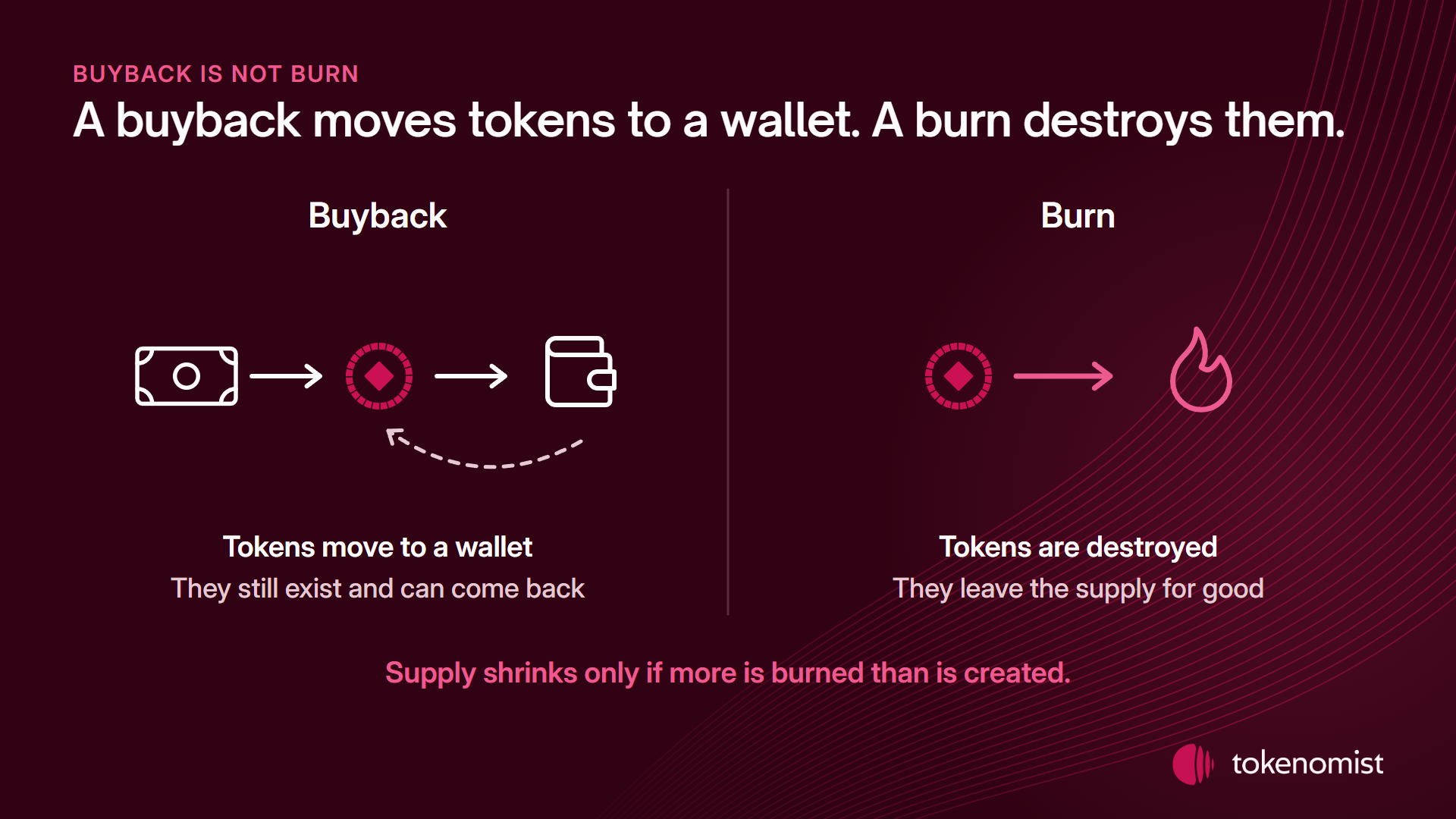
What it is. A buyback uses revenue to buy the token. A burn destroys tokens for good.
Why it matters. Bought-back tokens kept in a wallet can return to the market; burned tokens cannot. A buyback lowers circulating supply only while the tokens stay in that wallet, so check where they go after the purchase. A burn removes them for good and lowers total supply.
Example. Two projects, two routes:
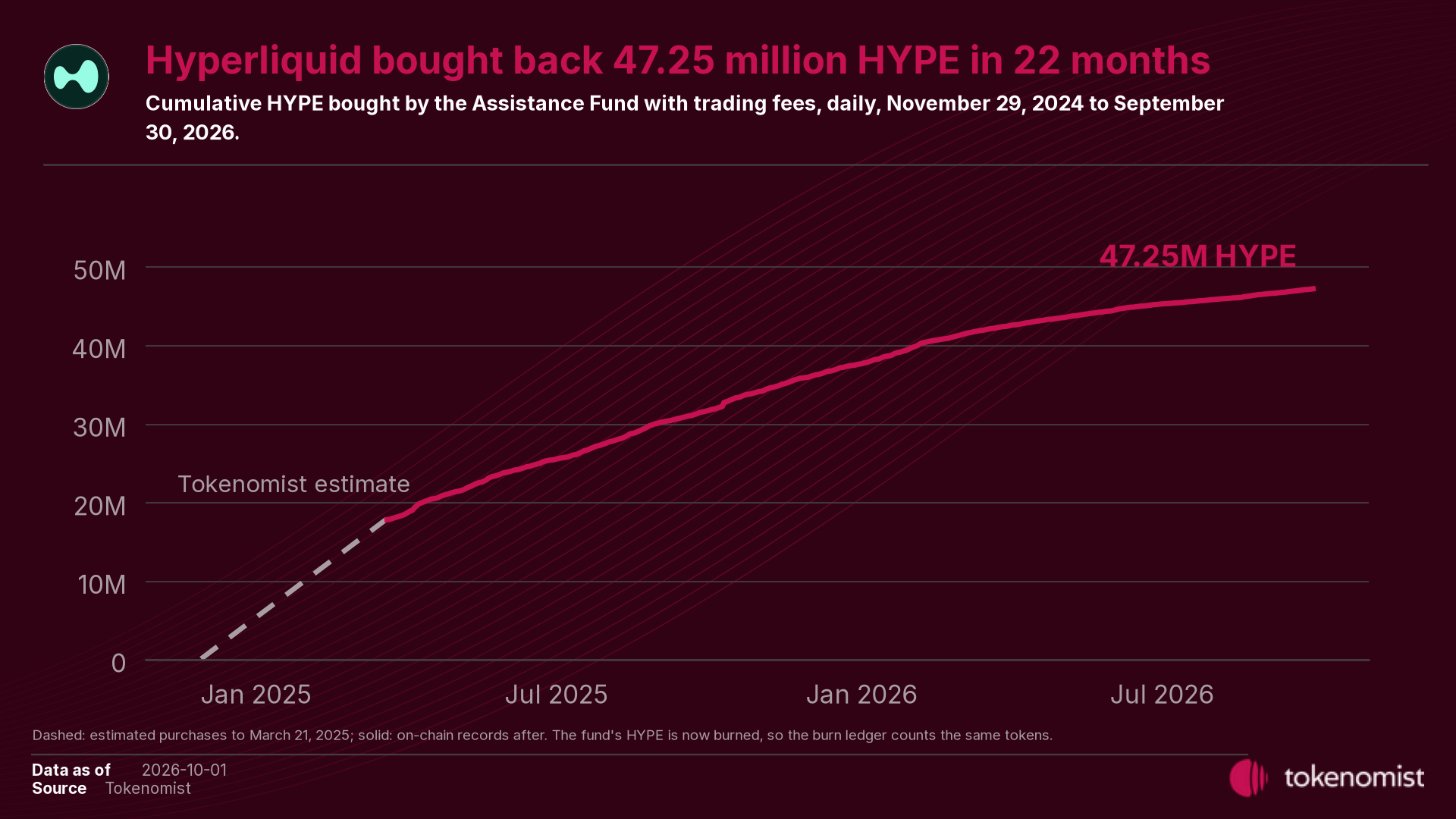
- Hyperliquid's Assistance Fund bought 47.25 million HYPE between November 29, 2024 and September 30, 2026, and its docs now say that HYPE is burned,
- Uniswap switched on fees that burn UNI after its governance approved proposal 93 in December 2025.
A proposal for the next chapter of 🦄
— Uniswap (@Uniswap) November 10, 2025
UNIfication is a joint proposal from Uniswap Labs and the Uniswap Foundation that turns on protocol fees and aligns incentives across the Uniswap ecosystem
Positioning the Uniswap protocol to win as the default decentralized exchange https://t.co/ra0Y7TKpYk
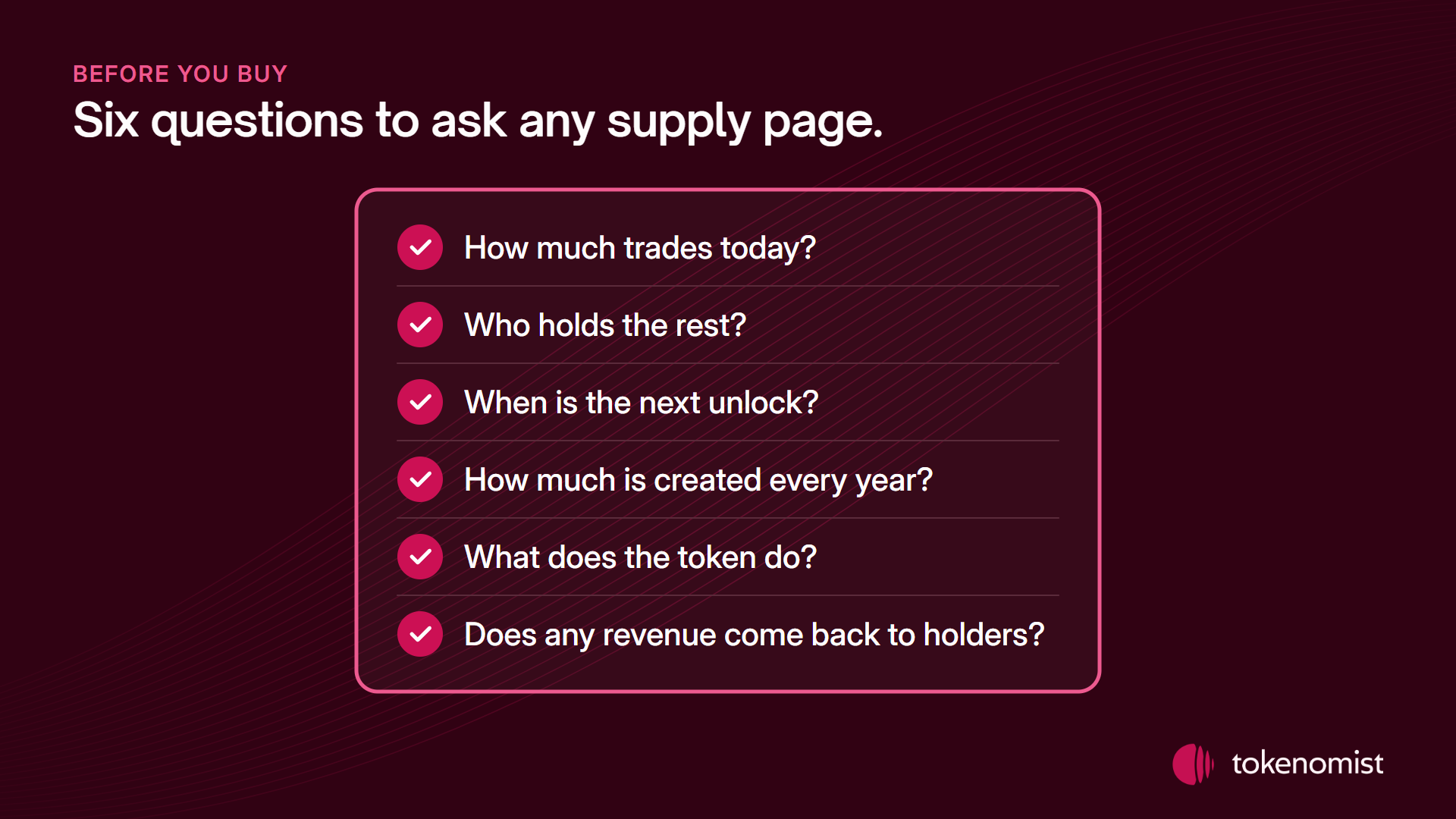
12. The checklist: six questions for any supply page
Before buying a token, open its supply page and ask:
- How much trades today?
- Who holds the rest?
- When is the next unlock, and is any supply TBD locked?
- How much is created every year?
- What does the token do?
- Does any revenue come back to holders?
Bitcoin, for comparison. The six answers for Bitcoin:
- About 95.7% of its max supply trades.
- Nobody holds the rest; it has not been mined yet.
- No team or investor unlocks and no TBD locked supply; new BTC comes only from mining.
- About 164,000 BTC a year, all from mining.
- It pays for transactions on its own network.
- No; transaction fees go to miners, not to holders.
13. Build or buy
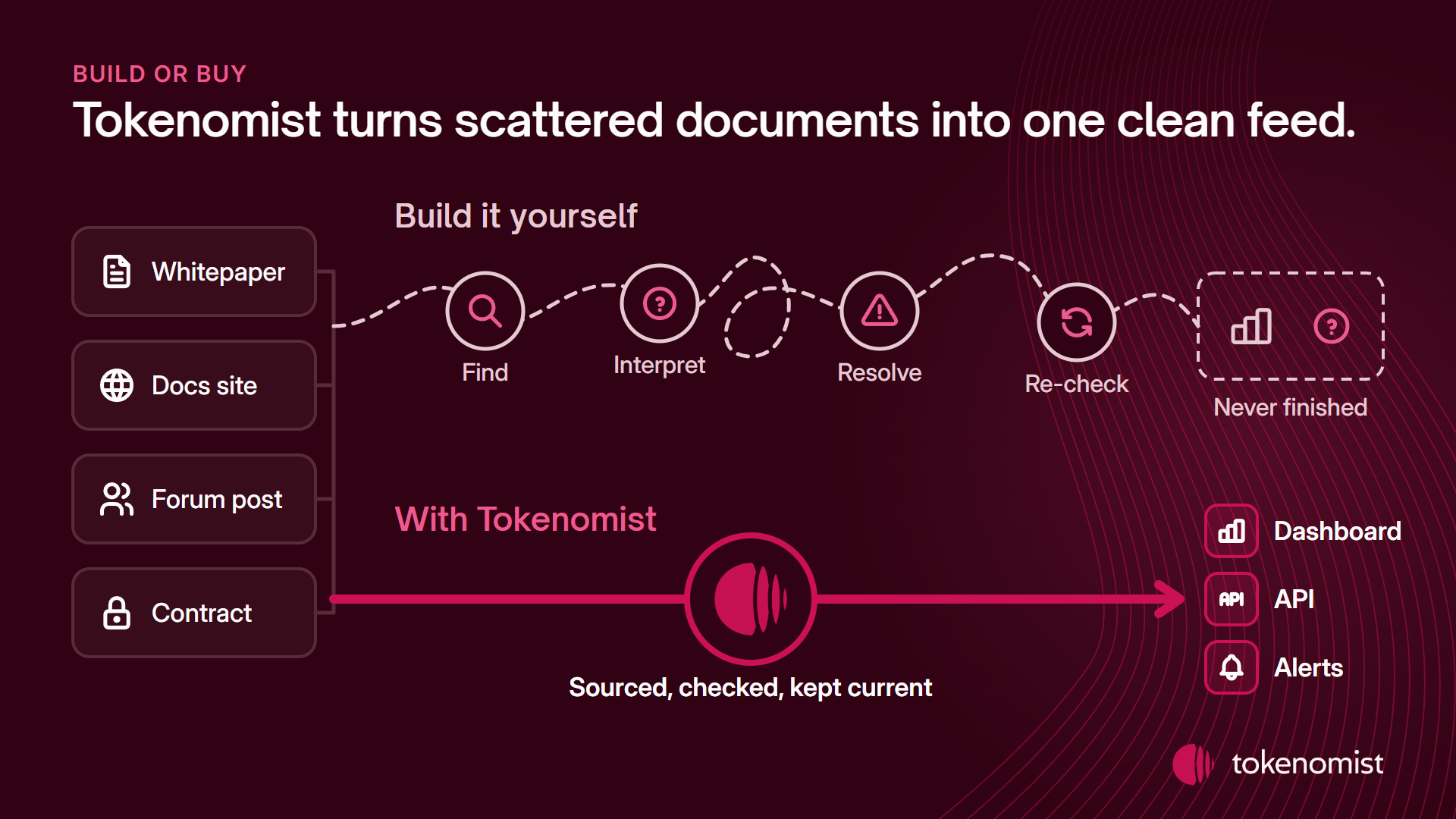
Answering these six for every token you hold is the hard part. Each answer starts in a whitepaper, a docs page, a forum post or a contract, and has to be checked again whenever a project changes its terms. For the supply questions, Tokenomist does that work for every token it tracks, shows where each schedule comes from and how exact its timing is, and delivers the result on its token pages, through its API and as alerts.
Doing it in house means someone reads every new document, settles conflicts between sources and re-checks each schedule whenever a project changes its terms, for every token you follow. Buying it means the schedules arrive with their sources and timing marked, so the time goes into the decision instead of the collection.

Methodology
- Schedules, emission values and the HYPE buyback ledger: Tokenomist, pulled October 1, 2026, 05:54 to 06:05 UTC; 287 curated tokens, Bittensor subnets excluded.
- Released supply uses each day's price; issuance is separated from vesting by allocation name.
Sources
- Tokenomist: When token unlocks actually move price
- Tokenomist: PUMP's July 12, 2026 insider cliff
- Hyperliquid: fees, staking discounts and the Assistance Fund
- Uniswap Foundation: proposal 93 vote
- Bitcoin Core: block subsidy code
- Bitcoin Core: chain parameters
Frequently Asked Questions
What is a vesting cliff?
A vesting cliff is a waiting period during which an allocation releases nothing, followed by a large release on one date. Team and investor allocations often use a one-year cliff and then release the rest a little every day. PUMP's team allocation released 50.1 billion tokens on its cliff on July 12, 2026.
Do token unlocks always make the price fall?
No. An unlock makes tokens available, and being able to sell is not the same as selling. Tokenomist's study, which compared 221 of 236 unlocks with similar tokens, found no clear effect for mature tokens and a median fall of 16.02% against peers for early-stage tokens in the month after the unlock.
What is the difference between a token burn and a buyback?
A buyback uses revenue to buy tokens in the market and may keep them in a wallet, where they can be used or sold later. A burn sends tokens to an address no one controls, which removes them from supply for good. A buyback followed by a burn does both.
Recommend Article