Lighter (LIT) Tokenomics: Robinhood Hype, a Real Burn, and the December 2026 Cliff

Lighter is a zero-fee perpetuals DEX, and since July 2026, the trading engine has been integrated into Robinhood Wallet, where Robinhood is both a distribution partner and an early investor. The recent attention is real: a first-ever token burn and ecosystem-funded points seasons, even as trading revenue has softened. The token itself tells a tighter story. Half of LIT's 1 billion supply is held by insiders, locked until a cliff on December 27, 2026, then vesting linearly over three years. The only bucket with no schedule at all is the separate 25% ecosystem/reserve, which also funds those points seasons and partnerships, including the $11M in LIT committed to Robinhood.
What you'll take away: how much of LIT's 1 billion supply is still locked, what the December 27, 2026 insider cliff actually releases, why the revenue-funded buyback removes supply now but can't keep pace after the cliff, and how the market values LIT against its revenue and its peers.


Key Takeaways
- Only the 25% airdrop (250M LIT) is unlocked; the other 75% is locked (Insiders 50% plus Ecosystem/Reserve 25%), the smallest float of any perp-DEX peer checked.
- Insiders hold 50% of max supply (Team 26% plus Investor 24%), both still locked as of July 17, 2026.
- The insider 50% sits on a published, dated clock: a one-year cliff ending December 27, 2026, then a three-year linear vest to about late December 2029, not an unknown schedule.
- The only genuinely schedule-less bucket is the 25% Ecosystem/Reserve, with zero release in all 181 of Tokenomist's forward emission weeks.
- The December 30, 2025 airdrop released 250M LIT at $2.73, about $682.5M, the only unlock that has actually happened.
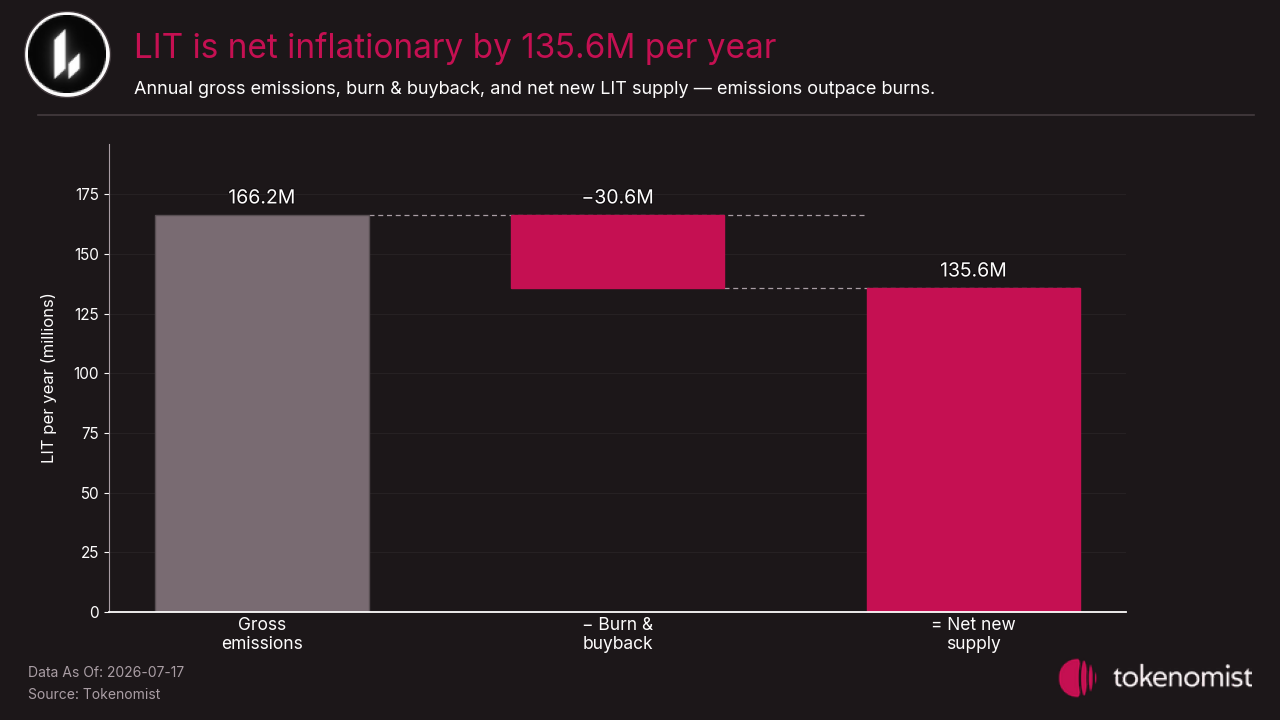
- Buyback-burn keeps LIT net-deflationary today at about 30.6M LIT a year removed, but net supply flips to about +135.6M LIT a year once the December 2026 cliff turns on vesting, because gross vesting runs about 5.4 times the burn pace.
Lighter Is A Zero-Fee, ZK-Verified Perp DEX
Lighter is a decentralized perpetual-futures exchange built as a custom zero-knowledge (ZK) rollup on Ethereum. Every order match, funding payment, and liquidation is proven with ZK circuits and verified on Ethereum's base layer (L1), a design the project calls "verifiable matching." Trading is zero-fee for retail and competitively priced for high-frequency and market-maker flow (Lighter Docs). It was founded by Vladimir Novakovski, formerly of Citadel, who pivoted his earlier AI startup Lunchclub into Lighter in 2022 (Fortune).
What's a ZK rollup? Lighter runs trading off-chain for speed, then posts cryptographic proofs back to Ethereum so anyone can verify each trade was executed correctly, without trusting the operator. "L1" is Ethereum's base settlement chain.
The sector is perp DEX and derivatives, one of the more active corners of crypto. Monthly volume across decentralized perp exchanges peaked above $1 trillion in October 2025, then cooled through 2026 (DefiLlama). Lighter's closest comparable peers are Hyperliquid, dYdX, Aevo, GMX, and Jupiter Perps, the anchor set for the sector comparison below.
Staking For LLP Access Is LIT's Only Confirmed Utility
LIT's confirmed utility is staking, which unlocks four things (Lighter docs; staking dashboard):
- Liquidity-pool access: each 1 LIT staked lets a user deposit up to 10 USDC into the Lighter Liquidity Pool (LLP) and earn its returns; staking is required for LLP access.
- Staking yield: about 6% APR, paid in LIT.
- Fee waivers: staking at least 100 LIT removes withdrawal and transfer fees.
- Eligibility for LIT Fee Credits.
About 110.7M LIT is currently staked, roughly 44% of the float, at that 6% APR (down from roughly 17.8% at the January 2026 staking launch), now funded from the ecosystem reserve rather than pre-launch revenue.
The token also anchors the protocol's capital-return mechanism: trading-fee revenue funds daily buybacks, and since June 30, 2026, repurchased LIT is permanently burned. Those supply mechanics are covered in the buyback-burn section below. Some secondary sites call LIT a "governance asset," but Lighter's own docs do not mention governance rights, so that remains an unconfirmed lead.
— Lighter (@Lighter_xyz) June 30, 2026
Just 25% of LIT's 1B Supply Has Ever Unlocked
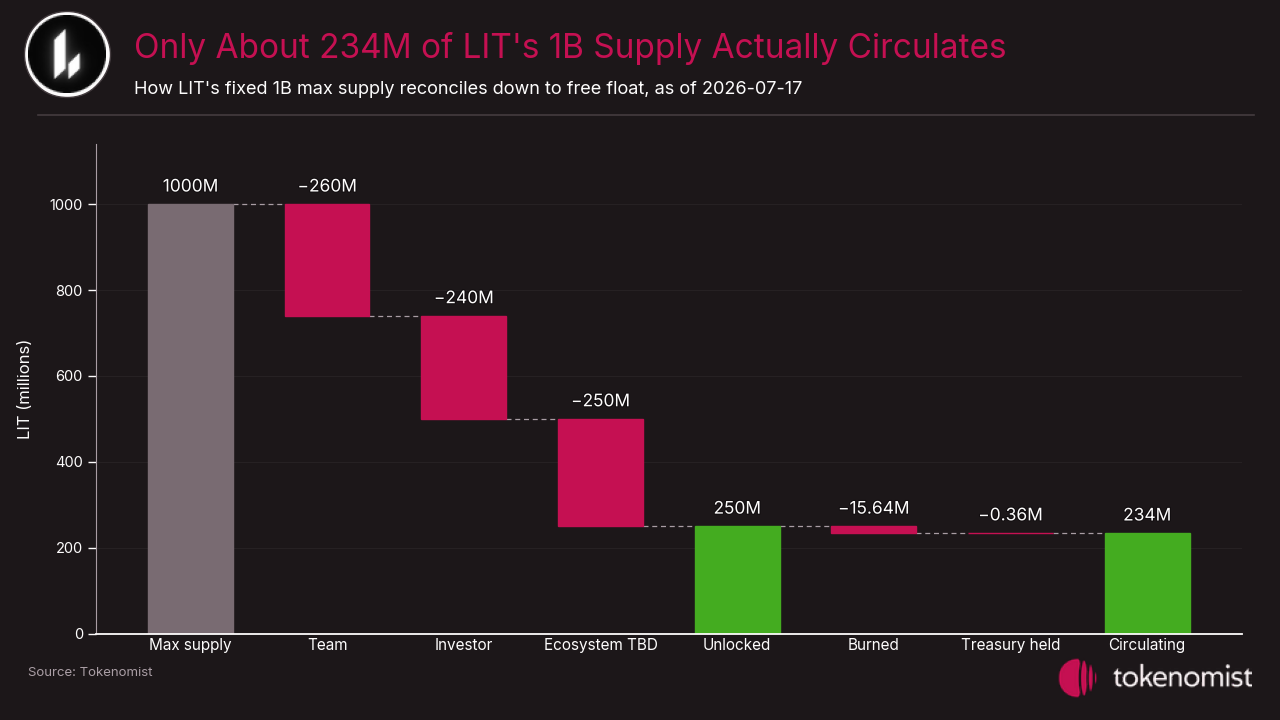
One quarter of LIT's 1 billion supply has ever unlocked. The airdrop released 250M LIT at the December 2025 launch, and other buckets remain locked. At $2.29 per LIT, the market cap is near $572M, against a fully diluted valuation of about $2.29B.
| Metric | Value | Why it matters |
|---|---|---|
| Circulating supply | 250,000,000 (about 234.0M net of burn) | Tokenomist reports the full 250M and does not net the burn; the reconciled figure is lower |
| Locked supply | 750,000,000 | Insiders 500M (scheduled to the December 27, 2026 cliff) plus Ecosystem 250M (TBD) |
| Max / total supply | 1,000,000,000 (about 984.4M post-burn) | 15,638,703 LIT was burned on July 10, 2026 and netted out of max |
| FDV vs market cap | about $2.29B vs about $572M | FDV is roughly 4 times market cap, the gap being locked supply |
| Emission type | Cliff + Linear | The governing type once insider vesting turns on |
| Net new supply / yr | about −30.6M pre-cliff; about +135.6M post-cliff | Two regimes split by the December 27, 2026 cliff |
| Upcoming unlock pressure | about 3.2M LIT/wk from December 27, 2026 | About $7.3M, under 1.3% of market cap in the first week |
Source: Tokenomist, as of July 17, 2026; price basis $2.29.
Two float figures appear for LIT and mean different things. The 25.0% float in the peer table is the airdrop divided by raw max supply (250M ÷ 1,000,000,000). About 23.8% float on the live page is the net circulating supply divided by the post-burn supply (about 234.0M ÷ about 984.4M). Same token, two bases, not a contradiction.
Note: the LIT that is staked counts toward this circulating float, not on top of it (see staking details above).
Half The 1B Supply Sits With Insiders
Here is the full 1 billion LIT allocation:
| Allocation | % of max | Amount (LIT) | Status | Unlock starts |
|---|---|---|---|---|
| Team | 26% | 260,000,000 | Locked | December 27, 2026 |
| Investor | 24% | 240,000,000 | Locked | December 27, 2026 |
| Airdrop | 25% | 250,000,000 | Unlocked | December 30, 2025 (done) |
| Ecosystem/Reserve | 25% | 250,000,000 | Locked | TBD |
| Public Sale | 0% | 0 | — | — |
Source: Tokenomist
Insiders hold 50% (Team 26% plus Investor 24%), the headline supply-pressure read. What matters is not the percentage itself, but that this 50% is still entirely locked.
Investors Bought In Near A $1.50 Implied FDV
Lighter has raised about $89M across two rounds. The Series A (2024) raised $21M, led by Craft Ventures and Haun Ventures, with Dragonfly Capital and Robot Ventures joining. The Series B raised $68M at about a $1.5B valuation, led by Founders Fund and Ribbit Capital, with Haun Ventures and Robinhood joining; it was structured as equity plus token warrants (Fortune, November 11, 2025, quoting founder Novakovski).
That $1.5B valuation implies an entry near $1.50 per LIT on a fully diluted basis (roughly $1.5B ÷ 1B supply). Because the round mixed equity and warrants rather than a clean token sale, treat this as entry-price context, not a cost-basis fact. The market currently prices LIT around $2.29, above that implied entry. The Investor 240M allocation is locked, so this is context on where investors came in, not a sell-pressure claim.
Nothing Insider-Held Moves Until The December 2026 Cliff
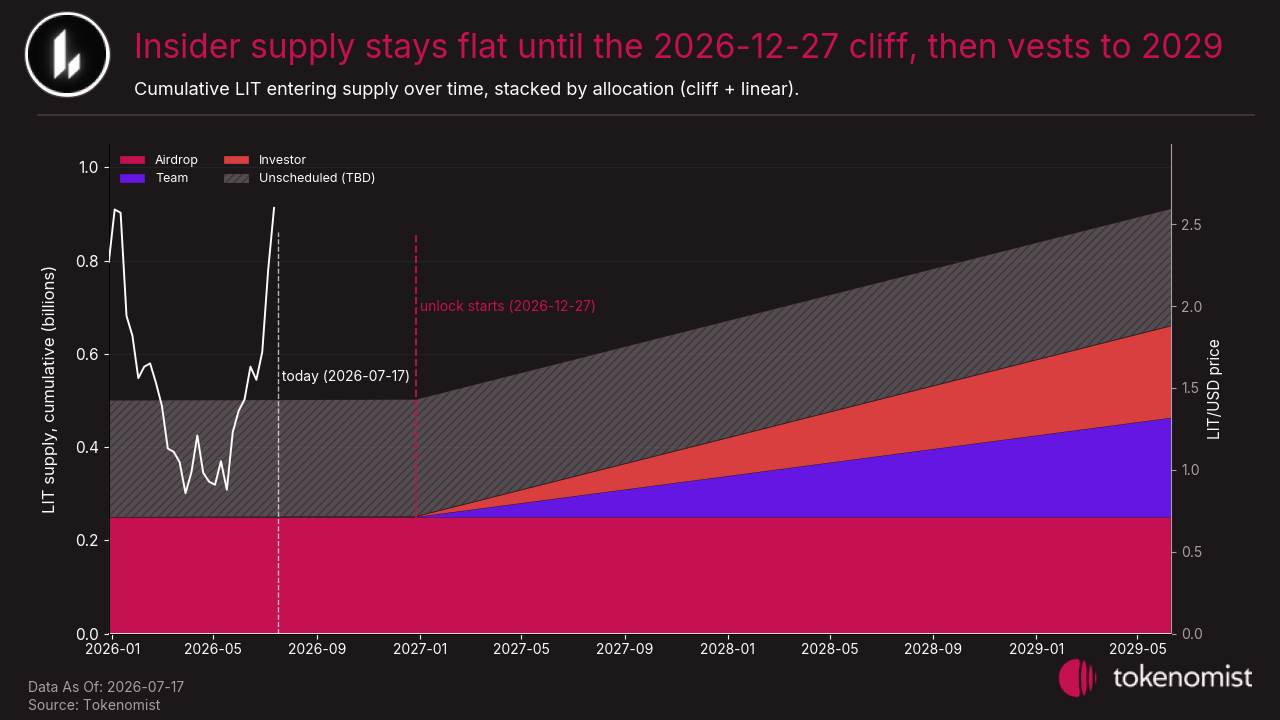
Only one unlock event has ever fired: the airdrop on December 30, 2025, which released 250M LIT at $2.73 per LIT. No event exists yet for the Team, Investor, or Ecosystem buckets. That means none has been minted, not that there is no schedule.
The schedule: a one-year cliff ends on December 27, 2026, after which Team and Investor vest linearly over three years, ending around late December 2029. Nothing insider-held moves until that cliff; then the combined release runs about 3.2M LIT per week, roughly 166M per year, about $7.3M, and under 1.3% of market cap in the first week. It is a linear vest, not a cliff dump. This is scheduled availability, not selling: insiders are locked, and no insider selling has been reported. Unlocked is not the same as circulating, and neither is the same as sold.
The only bucket with no published schedule is the 25% Ecosystem/Reserve, with zero release in all 181 forward-emission weeks. Lighter says it funds staking rewards, points seasons, and partnerships, including the $11M committed to Robinhood users (Lighter). None carry a fixed release timing, so the bucket stays unscheduled even as it is drawn down.
The remaining 25% of the ecosystem allocation will be used for future points seasons and, to a lesser degree, partnerships and growth initiatives. The team and investors all have a 1-year unlock and 3-year linear vesting after. The breakdown is 26% team, 24% investor.
— Lighter (@Lighter_xyz) December 30, 2025
Revenue Has Cooled Sharply Since Its November 2025 Peak
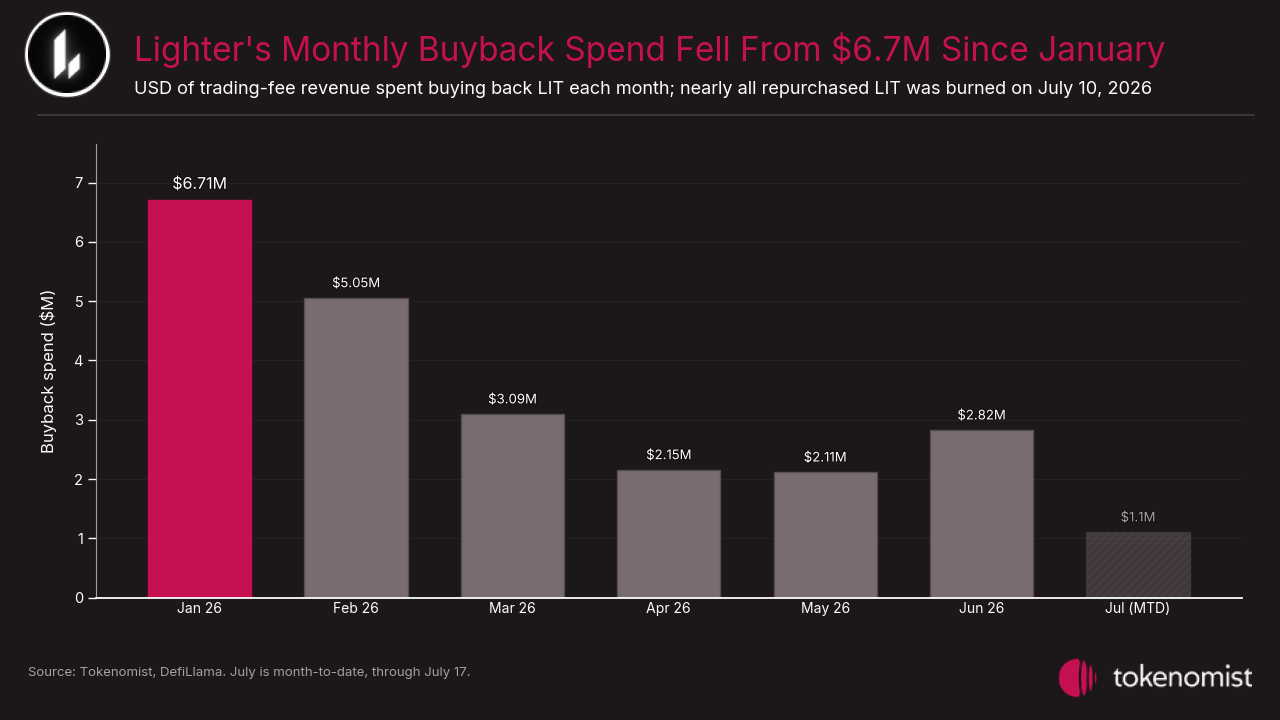
Lighter's buyback-burn only works if fees keep coming in, and they have been shrinking. Protocol revenue peaked near $14M when trading launched in November 2025 and has cooled to roughly $2-3M a month recently, with July tracking about $1.2M month-to-date. Since Lighter pays no token incentives, the buyback (live since January 2026) has tracked that revenue almost dollar-for-dollar (DefiLlama, July 2026).
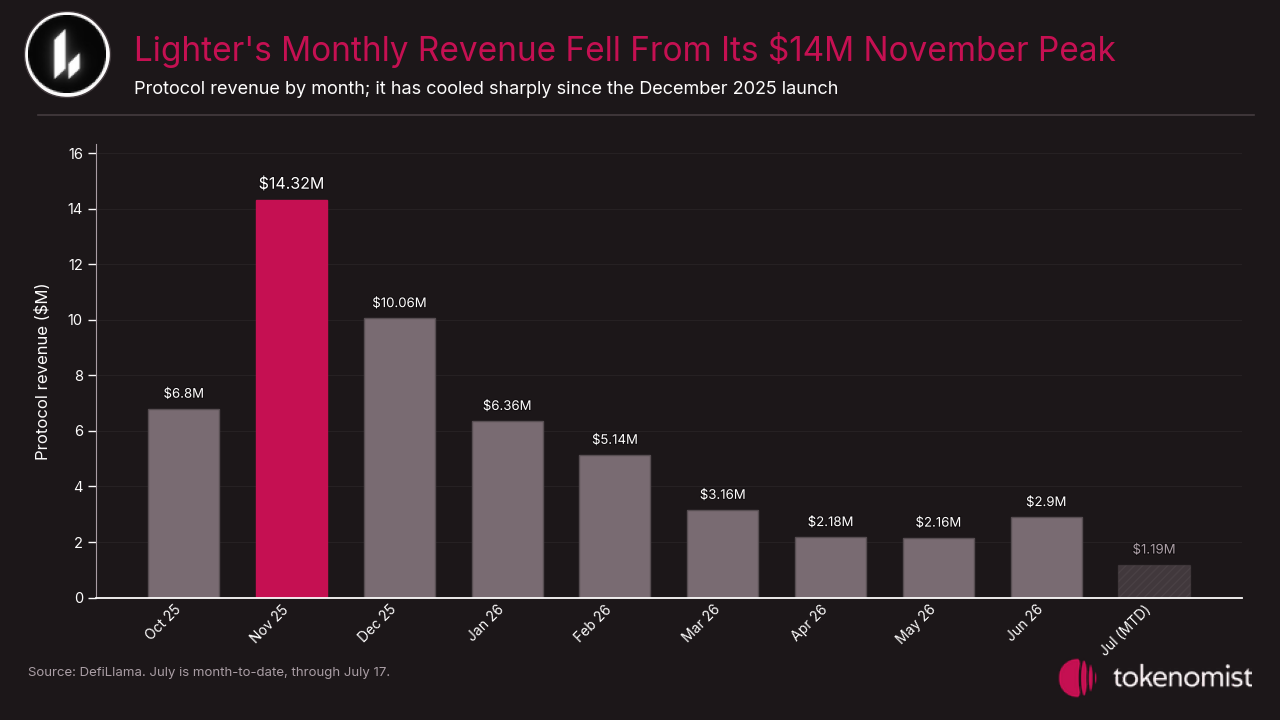
The deflation engine is real, but its fuel is shrinking: a smaller revenue base buys back less supply, right as the December 2026 vest is set to add more. Reversing that slide is what the Robinhood distribution is meant to do.
The Buyback-Burn Removes Supply Today, But Fades After The Cliff
Lighter runs a revenue-funded buyback that now ends in a burn. The two figures below sit on different bases, so read them as a pair rather than a discrepancy.
| Mechanism | Amount | Note |
|---|---|---|
| Burned to date | 15,638,703 LIT (about $37.5M) | First-ever burn, two events on July 10, 2026; the $37.5M is a mark-to-market value at the $2.40 burn-day price, not capital spent |
| Bought back | 16,000,294.58 LIT (about $23.0M) | Real USDC actually spent, about daily from January 5, 2026 to July 17, 2026 |
| Held, not yet burned | 361,591.58 LIT | Buyback minus burn (16,000,294.58 − 15,638,703) |
| Buyback-burn run-rate | about 30.6M LIT/yr | A trailing six-month run-rate, directional and scaling with volume |
| Locked supply now | 750,000,000 LIT | Insiders 500M plus Ecosystem 250M |
Source: Tokenomist (burn and buyback details through July 17, 2026); buyback-to-burn policy shift announced by Lighter on June 30, 2026 (@Lighter_xyz).
The token counts reconcile cleanly: 16,000,294.58 LIT bought back minus 15,638,703 LIT burned leaves 361,591.58 LIT held but not yet burned. Since the June 30, 2026, policy change, all future repurchased LIT is permanently burned.
We've executed the burn of 15,638,702 LIT, permanently removing these tokens from circulation.https://t.co/nPt4gZlNYr https://t.co/tSY5WTs7tZ
— Lighter (@Lighter_xyz) July 10, 2026
The direction of net supply flips across the December cliff. Before December 27, 2026, the only supply force is the buyback-burn, so LIT is net-deflationary at about 30.6M LIT a year removed. After the cliff, gross vesting of about 166.2M LIT a year dominates: subtract the roughly 30.6M annual buyback-burn, and net new supply is about +135.6M LIT a year, strongly positive. Gross vesting runs about 5.4 times the buyback-burn pace, so the burn narrows dilution; it does not reverse it.
Lighter Has The Smallest Unlocked Float Of Any Perp-DEX Peer
Against its perp-DEX peers, Lighter's insider share is unremarkable, but its float is not. Peer snapshots are not the same instant, so read this as a structural comparison.
| Token | Insiders % | Unlocked float | Read |
|---|---|---|---|
| Lighter (LIT) | 50% | 25.0% | Entirely locked on a roughly six-month-old token |
| Hyperliquid (HYPE) | 23.8% | 45.5% | No-VC design |
| dYdX (DYDX) | 50.0% | 77.1% | 2021-TGE legacy, effectively fully vested |
| GMX | 1.89% | 97.6% | Fair launch, no VC |
| Aevo (AEVO) | 41.5% | 100% | Fully unlocked |
| Jupiter (JUP) | about 50% | 49.4% | Tokenomist-tag artifact, not a clean like-for-like |
Source: Tokenomist
On insider share Lighter is mid-to-high, but its 25% float is the smallest in the set and the largest fraction sitting behind a lock.
On insider percentage alone, Lighter's 50% is level with dYdX, above Aevo's 41.5%, and far above Hyperliquid (23.8%, no VC by design) and GMX (1.89%, a fair launch). But dYdX's 50% is a 2021-TGE legacy now effectively fully unlocked after four-plus years of vesting, which describes history, not overhang. What sets Lighter apart is that its 50% is entirely still locked on a roughly six-month-old token, and its 25% float is the smallest available float in the peer set (against Hyperliquid at 45.5%, dYdX at 77.1%, GMX at 97.6%, and Aevo at 100%). The Jupiter figure carries a caveat: Tokenomist's tags fold a strategic reserve and operational buckets under the founder/team label, inflating its insider share, so it is not a clean like-for-like.
Zooming in on the market leader, the head-to-head runs well beyond structure:
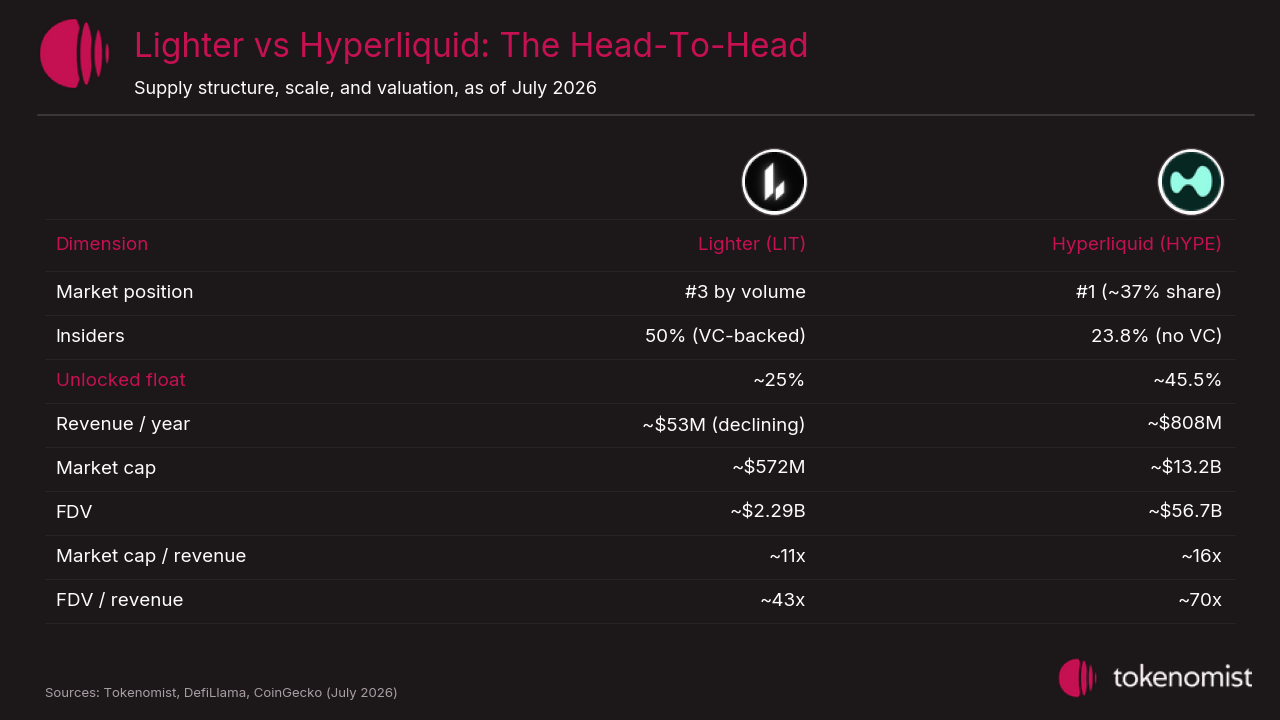
Supply and float: Tokenomist (LIT, HYPE). Revenue: DefiLlama (LIT, HYPE). Market cap and FDV: CoinGecko (LIT, HYPE) (July 2026).
Hyperliquid leads on scale, revenue, and a cleaner cap table (no VC, higher float). Lighter's revenue multiples are lower, but that reflects a smaller and still-falling revenue base and a supply that is half locked, not an obvious verdict either way. The open question is whether Robinhood distribution reverses the revenue slide before the December 2026 cliff.
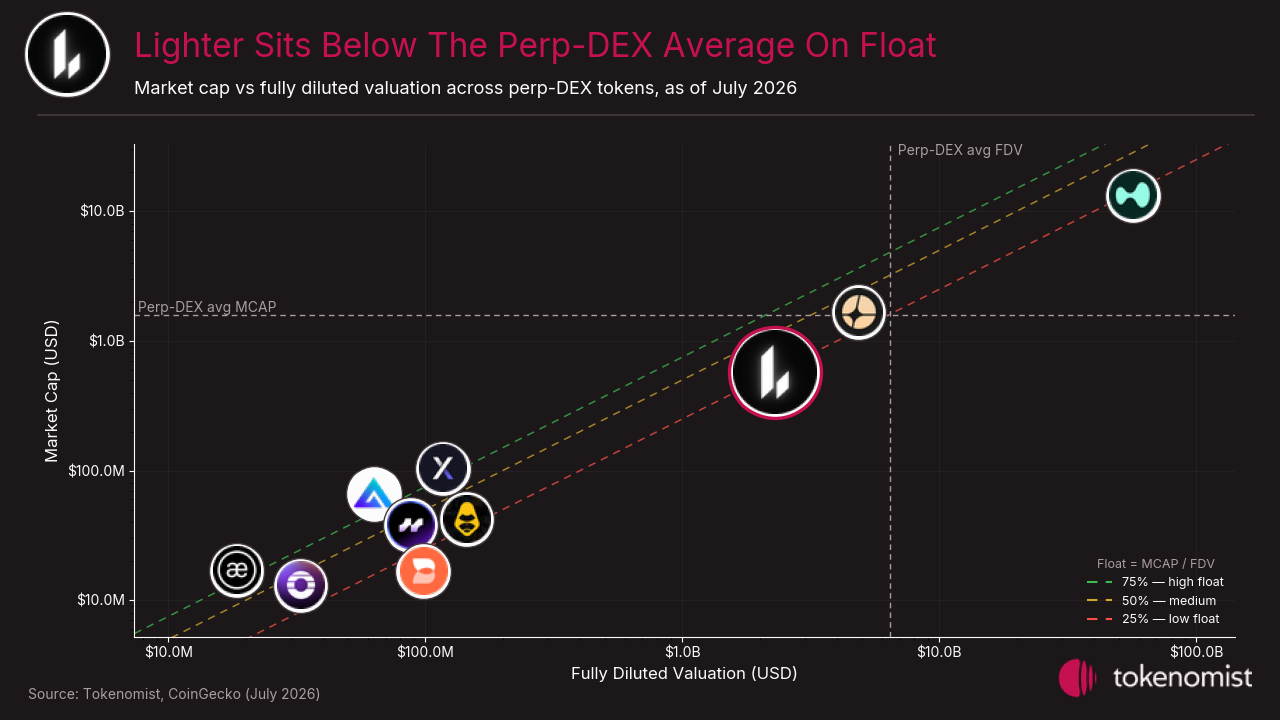
Source: Tokenomist, CoinGecko (July 2026).
Robinhood And The Burn Explain The Attention, Not The Supply Picture
The catalysts explain the attention, not the cap table. Lighter's recent attention comes from growth catalysts that sit apart from the locked-insider structure: they explain why LIT is in the conversation, but they do not change the fact that the insider half is locked and the December 2026 cliff is the structural event on the calendar.
Three fresh catalysts: Robinhood distribution, a revenue-funded burn, and a CFTC advisory seat. First, distribution: on July 1, 2026, alongside the Robinhood Chain mainnet launch, perps trading went live on Lighter inside the Robinhood Wallet, with USDG as collateral, though it is unavailable to residents of the US, UK, Canada, Switzerland, the UAE, and Singapore (Robinhood; crypto.news, July 2026). Lighter committed $11M in LIT to Robinhood incentives. Second, the tokenomics overhaul: after the June 30, 2026 policy change, repurchased LIT is now burned rather than held, and the first burn removed 15.64M LIT on July 10, 2026. Third, regulation: founder Vladimir Novakovski sits on the CFTC's Innovation Advisory Committee, with his membership publicly confirmed on July 4, 2026 (CFTC), a policy advisory seat, not a Lighter approval.
The post-airdrop $250M withdrawal was users pulling their deposits, not insiders selling tokens. Within 24 hours of the December 30, 2025 airdrop, about $250M left Lighter, roughly 20% of its then-$1.4B TVL, and LIT fell about 23% (from $3.37 to $2.57) (CoinDesk, December 31, 2025). That money was collateral leaving the exchange (TVL), not LIT being dumped on the market. Analysts at Bubblemaps and CertiK read it as typical airdrop-farmer and hedger rebalancing rather than distress, the same pattern seen at Hyperliquid and Aster.
The Cliff Trims Overhang Risk, But Doesn't Erase Dilution
The core supply finding: the insider 50% is a known clock, not an unknown cliff. Nothing moves until December 27, 2026; then it releases as small weekly tranches of about 3.2M LIT to roughly late 2029, not a wall. The only genuine unknown left is the 25% Ecosystem/Reserve. It has no published schedule but is already being drawn down: the $11M committed to Robinhood users comes from this bucket, so the open question is the timing of further spending, not whether the reserve sits dormant. On valuation, investors entered near a $1.50 implied FDV while the market prices LIT around $2.29, a reset already underway before the vest.
Net supply pivots on one date: LIT is deflationary today, but once the cliff opens, gross issuance runs about 5.4 times the buyback-burn pace and net supply turns clearly positive, so the burn narrows dilution without reversing it. The Robinhood distribution-and-burn narrative explains the attention; it does not move the December 2026 cliff.
The signals to monitor: the December 27, 2026 cliff and the release pace after it, whether the buyback-burn scales with trading volume, and whether the Ecosystem/Reserve bucket ever gets a published schedule.
Frequently Asked Questions
When do Lighter's insider tokens unlock?
The insider half (Team 26% plus Investor 24%) is fully locked until a one-year cliff on December 27, 2026, then vests linearly over three years to about late December 2029. That works out to roughly 3.2M LIT a week, about $7.3M and under 1.3% of market cap in the first week. It is a scheduled drip, not a one-time cliff dump.
Is Lighter actually backed by Robinhood?
In two ways. Robinhood is a distribution partner (since July 1, 2026, Lighter is the perpetuals engine traded inside the Robinhood Wallet) and was an investor in the Series B round. Lighter also committed $11M in LIT from its ecosystem reserve to Robinhood users. It is not owned by Robinhood.
Is a 50% insider allocation a red flag?
Lighter's 50% is mid-to-high among perp-DEX peers, but the whole insider half is still locked on a roughly six-month-old token (the smallest unlocked float of any peer checked), and it releases on a published, dated schedule rather than at will. Unlocked is not the same as sold, and no insider selling has been reported.
Does the burn make LIT deflationary?
For now, yes. The revenue-funded buyback-burn removes about 30.6M LIT a year, so LIT is net-deflationary today. But once the December 27, 2026 cliff opens, gross vesting of about 166M LIT a year runs roughly 5.4 times the burn pace, so net supply turns positive. The burn narrows dilution; it does not reverse it.
What do you get for staking LIT?
Staking is LIT's only confirmed utility. It unlocks Lighter Liquidity Pool (LLP) access (each 1 LIT staked allows up to 10 USDC of deposit), about 6% APR paid in LIT, fee waivers (stake at least 100 LIT), and eligibility for LIT Fee Credits. About 110.7M LIT, roughly 44% of the float, is currently staked, funded from the ecosystem reserve.
Does LIT have governance rights?
Not confirmed. Some secondary sites describe LIT as a "governance asset," but Lighter's own documentation does not mention governance rights, so treat that as unconfirmed. LIT's documented utility is staking.
Sources
- Tokenomist — supply, allocation, unlocks, emission, burn, buyback, fundraising, market cap (LIT and peers)
- Lighter docs, staking dashboard — utility and staking
- Lighter on X — $11M Robinhood commitment; buyback-to-burn shift
- Robinhood newsroom — perps launch and restricted markets, July 1, 2026
- Fortune — Series B terms, November 11, 2025
- CoinDesk — post-airdrop withdrawal, December 31, 2025
- CFTC — Novakovski advisory seat
- DefiLlama — revenue; perps volume
- CoinGecko — peer market cap and FDV, July 2026
Supply-side analysis. Not financial advice.
Recommend Article